


355. Effect Of Light On Rickets
Description
This section is from the book "The Newer Knowledge Of Nutrition", by Elmer Verner McCollum. Also available from Amazon: The Newer Knowledge of Nutrition: The Use of Food for the Preservation of Vitality and Health.
355. Effect Of Light On Rickets
Several observers have recently reported the successful treatment of rickets in children by radiation with ultra-violet rays derived from the mercury vapor lamp, with X-rays and also with sunlight. It is necessary, therefore, that any discussion of the etiology of rickets, to be convincing, must satisfactorily account for the tendency for rickets to heal under such treatment. The work of several observers should be noted in this connection.
In 1904 Buchholz (31) reported the recovery of sixteen children suffering from rickets, on treatment with the rays of the "Gluhlicht." The nature of the light was not described. As early as 1890 Palm (32) became convinced as the result of a noteworthy topographical study of the incidence of rickets, that the disease was rare or absent from regions receiving much sunlight, and progressively more common in others where the amount of sunlight was less abundant. He pointed out the desirability of accurate observations on the chemical activity of the sunlight of large cities, and recommended the use of sun baths and the removal of children suffering from rickets as early as possible to localities where sunshine abounds. In 1912 Raczynski (33) again correlated the relationship which exists between the incidence of rickets and lack of sunlight. He pointed out that the curve representing the number of cases admitted to the hospital began to rise sharply in January, reached a maximum in May and fell rapidly in June.
Raczynski reported an experiment with two puppies born of the same mother in May. One was kept in the sunlight from morning to evening, while the other was kept in total darkness. Both puppies were nursed exclusively by the mother. At the end of six weeks the two were killed for examination. It was found that the one which had lived in the light was normal whereas the one kept in darkness had but poorly assimilated mineral salts necessary for the formation of a skeleton.
The use of the X-ray in tracing the development of the healing process in rickets in children has made possible more definite and accurate observations on the effect of therapeutic agents in the treatment of the disease. Fraenkel and Lorey (34) in 1910 published an atlas devoted to rickets, in which they reproduced X-ray pictures of the bones of rachitic children in all stages of healing and relapse. Phemister (35), in America, has used this method for the study of the effects of phosphorus on growth and ossification. With this aid Huldschinsky (36) studied many cases of rickets in children as they were effected by the ultra-violet ray. He found that under the influence of this type of radiation there was a deposition of calcium salts in the ends of the long bones which was observable in radiographs. Control children who were not treated with the rays showed no improvement.
In 1919 Winkler (37) reported very spectacular results in the treatment of rickets with the X-ray. Putzig (37) in the same year corroborated the findings of Huldschinsky as did also Karger (38) and Riedel (39). In 1921 further confirmation of the observations of Huldschinsky have appeared in the work of Sachs (40), Erlacher (41), Mengert (42) and Hess (43). Hess' views regarding the curative effects of radiant energy on children suffering from rickets, and based on his own observations, led him to assert in 1920 (44) that the violet ray was not effective in the treatment of rickets. He further stated in connection with a discussion of the value of sunlight as a preventive measure against rickets: "But the fact that rickets is exceptional in the Arctic regions where there is lack of sunlight for the greater part of the year is a strong argument against its predominant influence." Even Glisson in 1650 (8) expressed the view that moist, foggy climates were an etiological factor in the production of rickets. Since the appearance of the work of the German investigators noted above Hess (44) has reported new experiments which are fully in accord with the latter in supporting the view that ultra-violet light and sunlight are very effective in the treatment of the disease. In 1921 Hess and Unger (44) reported their demonstration by means of the X-ray, that sunlight alone possesses the same curative action as does the ultraviolet ray in human rickets. They exposed rachitic infants for periods of one-half hour to several hours daily whenever sunlight was available. Different parts of the body were in turn subjected to the action of the rays. Under this treatment calcification of the cartilage-shaft junctions of the bones occurred.
Thus far all investigations relating to the curative effects of sunlight or of ultraviolet rays in rickets had been made on human subjects and all the evidence regarding their effects had been furnished by radiographs. Park, Powers, Shipley, Sim-monds and McCollum (45) have recently carried out experiments with rats which were fed a diet which had previously been shown to induce rickets within a few weeks. Two groups of animals were employed. These were fed the same diet, and one group was kept in a northeast room in which there was no direct illumination except through glass and the light was always subdued. The other group was kept in direct sunlight in summer for varying periods. Individuals were given the sun treatment for 62-67 days, and the average period of exposure was four hours daily.
The control animals which were kept in a room with little light, all developed severe rickets as shown by autopsy and histological examination of the bones. They also showed the typical deformities described earlier in this chapter. The illuminated animals on the other hand, while they did not grow in a satisfactory manner, did increase in weight to a certain extent, and none showed any signs of rickets. This was confirmed by careful autopsies and by histological examination of sections of the bones.
The diet employed in this experiment consisted of wheat 33 per cent, maize 33 per cent, gelatin 15 per cent, wheat gluten 15 per cent, sodium chlorid 1.0 per cent and calcium carbonate 3.0 per cent. The diet was of good quality in respect to the content and quality of its protein. It contained about twice the optimal content of calcium; less than the optimal content of phosphorus and was very poor in fat-soluble A. Any diet so constituted will, as we have previously shown, cause the development of a condition of the bones which is anatomically indistinguishable from that seen in rickets of human beings.
The marked improvement in the rats exposed to sunlight over those which were not, affords convincing evidence that the good effect of the illumination was not limited to the bones, but had a profound influence on all the cells of the body. Sunlight is in this respect comparable with cod liver oil, which, when added to the diet employed in these experiments, not only makes the bones essentially normal in structure, but also makes the appearance of the animals receiving it greatly superior to control animals on the same diet without the oil.
These results have a wide biological significance. Cod liver oil contains and sunlight embodies something which is essential for optimal cellular functioning. Either cod liver oil or light, when made available to an animal previously deprived of either, enables the organism to put into operation defense mechanisms or adaptations which it could otherwise not avail itself of. Neither cod liver oil nor light corrects the defects of the diet as respects the faulty relation of calcium and phosphorus, for the oil does not contain either of these elements. It is this faulty content of the diet with respect to calcium and to phosphorus which plays the most significant role in predisposing the animal to the development of the rachitic syndrome. Either cod liver oil or light serves, however, to make the cells function more satisfactorily under these unfavorable conditions than they otherwise could do. They raise the potential of cellular activity so as to secure a most efficient utilization of the calcium and phosphorus available for bone formation. Without one or the other of these agencies acting, the animals would develop rickets on this diet, but under their influence bone growth is essentially normal. Under their influence the animals do not suffer from general physical debility as they otherwise would. Sunlight enabled the animals to adapt themselves not only to a shortage of a vitamin (fat-soluble A) but also to the unfavorable relationship between the calcium and phosphorus in the diet.
It is apparent from these results that, within certain limits, diets which are deficient in some degree with respect to certain factors, when the body receives only subdued light or is kept in darkness, may suffice in much greater degree to maintain nutrition and promote well-being in the same species under circumstances where a good supply of sunlight is available. It seems to be definitely proven that a certain amount of sunlight is beneficial to physiological well-being. The possibility is also suggested that a diet which supplies the optimal amounts of certain dietary factors for an animal living in darkness or semi-darkness, may furnish excessive amounts for an individual which is bathed in light. This question is deserving of further inquiry.
Since cod liver oil is able to act as a substitute for active light in its effect on certain of the processes of growth and metabolism, it becomes necessary to think of it (and probably certain other foods as well) as being able to compensate for deprivation of light. The mechanism which is operative between light and certain foods is reciprocal, in that they are interchangeable. It is conceivable that the extent to which the body is irradiated by sunlight may determine in an important degree the amounts of certain dietary essentials which will suffice for the maintenance of satisfactory physiological well-being.
It may well be significant that people who live in the far north and receive little sunlight, take regularly in their food large amounts of fish oils and other fats. The same is true of Arctic animals of carnivorous dietary habits. This element in their food must, it appears, compensate for the lack of illumination, for rickets is very rare in that part of the world. On the other hand, rickets is also rare in the warmer parts of the world, and this may now in great measure be correlated with the amount of sunlight which is received. We may expect severe rickets to become common in the Arctic regions should the type of diet which is common in lower latitudes of America supplant the primitive diet. There appears, as already mentioned earlier in this chapter, to be evidence that rickets is already appearing among children in northern Alaska. The infants in the "black house" of the Hebrides are protected against skeletal defects through the consumption by their mothers of cod heads stuffed with minced cod livers.
It appears, therefore, that Nature has provided a substitute for light in an organic substance or substances contained in certain foods, and that the function of these may be in some way associated with the provision of some form of radiant energy, produced, it may be, through oxidation of compounds of unique character. This view, resting as it does, on a sound experimental basis, opens a new and attractive field for investigation. It introduces into nutrition problems factors which the physicist must be called upon to help solve, and must stimulate profound inquiry into the therapeutic possibilities of purely physical agencies which have hitherto been employed in a haphazard manner and based on empirical reasoning.
It should be emphasized, in view of what has just been said, about the possibility of affording a measure of protection for an animal restricted to a diet which is deficient in certain respects, by providing it with a liberal supply of a particular vitamin (calcium-depositing substance), that this does not afford a justification for relaxing our insistence upon the wisdom of taking regularly a diet which is just as nearly of optimal composition as possible. When the diet is defective in any respect, the enhancement of the food with respect to any other factor or factors will make the animal able to appear better nourished than it otherwise would, but the defect is certain to leave its mark somewhere in the life history of the individual or its progeny.
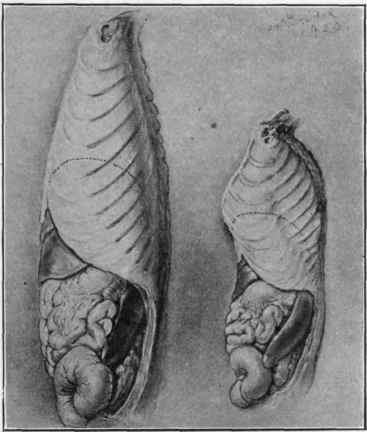
Fig. 16. - Illustrates the appearance of the exterior of the thorax of a normal and of a rachitic rat. The animals were the same age. The normal one on the left exhibits the perfection of form in this species. The rickety rat was small, round shouldered, and had the typical "pigeon breast" seen in severe cases of rickets in children. The bending inward of the ribs resulted in a flattening and deformity of the thorax, and the formation of a groove along the line of insertion of the diaphragm.

Fig. 17. - Illustrates the appearance of the inside of the thorax of a normal rat and also one suffering from rickets. Note the smooth and symmetrical form of the normal animal on the left. On the right the rickety rat is seen to have great deformity of the thorax. The shoulders are rounded and the breast bone misshapen. There are large knobs on the ribs due to spontaneous fracture and attempt at healing. The junctions of the ribs with the cartilages are enlarged, and the ribs are bent inward at their ventral extremity. The beaded condition of these is the analogue of the "rachitic rosary" seen in children.
Continue to:


My Books

