


Chapter 12. The Face
Description
This section is from the book "Reichian Therapy. The Technique, for Home Use", by Jack Willis. Also available as a hardcopy from Amazon.com.
Chapter 12. The Face
Move the face slowly
Smile inhale, frown exhale
Blow through the lips
Shit on a stick
Put exhale
Spread the nostrils
The mirror look
There are seven face exercises and they are very important. Research shows that the face is the most emotionally expressive set of muscles in the whole body. You may do the face exercises before you have finished the breathing work in Part One of this book.
Your face, more than any other part of the body, displays your personality. The importance of the face runs both ways. That is, your personality is reflected in your face and your face effects your personality (as well as your place in many social situations). A face can, in non-verbal language, say you are open or unavailable; say your are angry, happy or sad; say you are friendly or hostile; etc.
Currently, we have a model in the actor, Jim Carry, whose career is based in large part on the motility of his face. Movie and television actors, in close-up shots, portray the essence of their character by their face.
Move The Face Slowly
This face exercise is part of your daily routine. But it has more effect when done with the breathing. Simply because you have made this exercise part of your morning routine does not mean that it should not also be part of your work sessions.
Like all exercises, this exercise is done with the breathing. The essential issue with this exercise is that the face is moved slowly from one position to another in fluid motion, not jerky. The breathing should not change and the sound is still the same soft 'ah' sound.
There are, in most people, 22 muscles in the face (we are all unique and thus there can be fewer muscles in some people). Take note that we are interested in the face muscles, not the muscles that move the jaw. This does not mean that the jaw does not move, it only means that you should concentrate on the muscles of the face and not be taken in by jaw movement in place of facial muscle tension and relaxation.
Just to give you some idea, the mouth can smile, pout, or frown. The lips can open to 'bare the teeth' or they can purse. The tip of the chin can be tense or relaxed. The eyebrow can be raised on one side, the other side, both, just in the center above the nose, just at the outer corner. The corner of the mouth can be drawn back on one side, the other side, or both. And so it goes. As with all exercises, keep trying to improve your performance, that is, keep trying to use more of the 22 muscles in your face.
This is as good a time as any to repeat some of the discussion of the 'ah' sound. This is a very soft sound. It is not articulated. That is, rather than the sound being made to be followed by the exhale, the sound is simply inserted into the stream of air of the exhale as I hope you can hear on the audio. True, the 'ah' sound is made at the beginning of the exhale, but still the soft sound is not the start of the exhale, it simply occurs at the same time. Reich, aptly, described the sound as like the sound of a sigh.

Figure 76
Smile Inhale, Frown Exhale
On the inhale draw the corners of your mouth up as though in a smile. Note that this refers to the corner of the mouth, not the jaw or a full smile. The exercise is to draw the corners of the mouth up. If you smile with your whole face you are not doing the exercise properly.
On the exhale draw the corners of your mouth down as though to frown.

Figure 77
Notice in the above figure that our model is smiling with his whole face rather than just with the corners of his mouth. That is technically not correct, but the frown is a good start. Note also that his eyes are almost unchanged from the smile to the frown. That is correct. This exercise uses only the corners of the mouth coordinated with the breathing.
Blow Through Lips
On the exhale, put your lips together and blow through your lips. The lips are not tight. They should vibrate like a baby's, making a kind of motorboat sound. This exercise can be done while you are learning the breathing.
In order to do this exercise properly you have to be able to fully relax your lips. If you find that the sound is hard to start or that it stops during the exhale, then you still have unneeded tension in your lips. In Reich's terms, your mouth is still "armored."
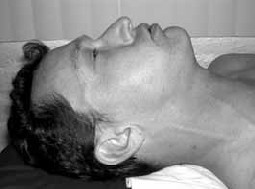
Figure 78
Shit On A Stick
On the inhale, wrinkle your nose as if you are smelling something very bad. On the exhale let your nose muscles relax. It is best to do this exercise with a mirror as it is (1) easy to wrinkle between the eyes (the so-called frown lines) and think you are wrinkling the nose and (2) many people cannot locate this muscle and thus cannot tell whether it is or is not being wrinkled. Using a mirror can answer these questions.
This exercise sounds very simple and, as far as the issue is use of the muscle, it is simple once you can locate and tense the muscle. However, this exercise is one of those that has a simple description and a simple execution but its effects are profound.
This exercise should not be done while you are still learning the breathing. Please believe me, this is a powerful exercise and you should hold off on doing it till you have made good progress on the breathing.
Figure 79 on page 202 shows wrinkling, but it is not being done correctly. Look first at the figure and see if you can guess the error. Don't read the next sentence until you examine Figure 79 and see if you can spot the problem.
Footnote 27. This exercise was named by Francis Regardie. To honor him, the name is retained.
The error is that he gets the wrinkling by squeezing his eyes shut. That is another example of fused muscles. He has the "bad smell" muscle at the top of the nose linked to the muscle that closes the eyes.
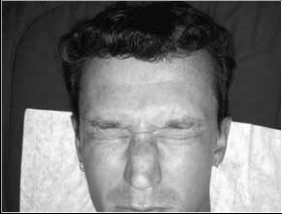
Figure 79
Pout Exale
Mouth is open during the inhale; mouth is closed into a pout during the exhale. The lip placement during a pout is very similar to the lip placement during the blow through the lips exercise. The difference is that in the blow through the lips the lips are relaxed so that they can vibrate. In a pout the lips are tensed so that even though the air is exiting through the mouth, the lips do not vibrate. An example is shown in Figure 80.
If you can do it, you can let yourself feel like a young child when you pout.
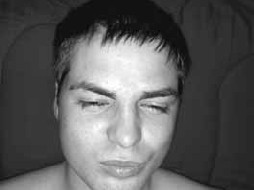
Figure 80
Spread The Nostrils
You may well not know it, but there actually are muscles which can expand (dilate) the nostrils. On the inhale dilate your nostrils, on the exhale let them relax. Again I recommend the use of a mirror to be able to see whether you are or are not actually making the motion.

Figure 81
It is difficult to see the difference in the two photos in Figure 81, but the nostril openings on the left actually measure 25% wider than on the right.
Note the absence of fusing. Where in Figure 79 our model had to squeeze his eyes shut in order to produce wrinkling in the nose, here there is no noticeable change in the model's face from the left panel to the right panel.
The Mirror Look
This is actually one of the most interesting of all the exercises in terms of what it can produce; but its utility is very dependent on your ability to relax to and allow the experience. Don't be concerned if for some time you don't seem to be getting anything from this exercise. It is very dependent on your ability to let go of control. I discussed control back in Part One, Chapter five starting on page 114. This might be a good time to reread those few pages.
This exercise needs a hand mirror that you use to look at your own face. It is similar to the daily exercise of using a mirror, but it is much more advanced and thus, potentially, more powerful.
Holding the mirror well above your face so that you can see your whole face, attempt to create emotion in your face.
There are two parts to this. In the first part you want to look at how well you are actually manifesting the emotion you are attempting to create. In the second part you want to respond to your own mirror emotion. Now that takes a bit more discussion.
To just coldly, as it were, make your face look as it would if the given emotion were present, is to actually distance yourself from the experience. Let's take fear as an example. To just open your eyes wide as though in a fearful state would be noting more than the simple fact of opening your eyes wide. It would be the face of fear, but not the emotion of fear. As you make the face of any given emotion you want to try to create that emotion not just in your face but as well throughout your whole body.
That relates to part one and I will return to it shortly, but let's first look at part two.
Here you are responding to your own created (or emulated) emotion. Continuing with fear: looking at that fearful face what is your response to it. Just as some examples, you might respond to your own fear with disapproval or determination (to surmount) or with cowardice or with boredom or with any number of other emotions and feelings.
This calls up the point I made about the nature of emotion. Here you are attempting to create an emotion (of fear) but what is your attitude, your opinion, of fear. That attitude will, in turn, produce other emotions. Emotion as a response to emotion? Yes. To a cognitive mind, emotion is just like any other experience (physical or mental) and it is evaluated by your mind and results in yet other ideas and emotions.
Before continuing let me state yet again that NEVER PUSH THIS OR ANY EXERCISE BEYOND YOUR LIMITS. Anything that comes up is part of you, it will still be there in the future. If you push too hard, just like exercising too hard, you will occasion damage not improvement. How old are you: twenty, thirty, forty, more? It has taken you all those years to become what you are now, you are not going to correct it in a few months or even in a few years. The motto is: ALWAYS TOO SLOWLY.
Returning now to part one and combining it with part two, you are going to try to create an emotional state in yourself as expressed in your face and, based on that state, you are then going to observe your own reaction to your own created emotion. Don't expect to be good at this immediately. In fact it is better if you are not that good at it at first. If you get too deeply into this exercise the first time or even the first 20 times, the result is likely to be trauma. That trauma can prevent you from then getting nearly as deep ever again.
I want to emphasize that while I have used fear as the example, there are over 550 named emotions in the English language. Making a face of mirth or ridicule or disdain or anger or longing or sadness or any of the other over 550 emotions is completely valid in this exercise. In fact the more you vary the emotions you try to create and react to (from the mirror), the better this exercise will work.
Continue to:


My Books

