


Boyhood Of Ferguson
Description
This section is from the "The Boyhood of Great Men" book, by John G. Edgar. Amazon: The boyhood of great men.
Boyhood Of Ferguson
The noblesse of Florence furnished the illustrious astronomer whose boyhood has been briefly sketched; the peasantry of Scotland, a class which enjoys the ennobling distinction of having given the poet Burns to the world, produced this good and celebrated man, who, in happier times, on a free soil, and with the favour of his sovereign, exercised the great talents with which Providence had endowed him to minister essentially to the progress of astronomy, and to present an encouraging instance of successful study and perseverance. Ferguson has left a frank and simple record of the struggles, difficulties, and disappointments he had to encounter, which is, at the same time, highly interesting, instructive, and worthy of attention, and conclusive as to his having originally had no worldly advantage, save that of being the son of honest and religious parents.
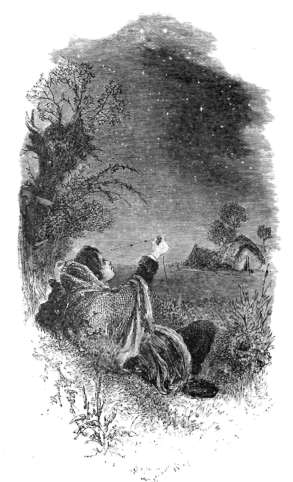
Ferguson's First Studies in Astronomy.
James Ferguson was born in the year 1710, near the village of Keith, in Banffshire, where his father was a day-labourer, and the cultivator of a small plot of ground rented from a neighbouring proprietor This honest man's family was somewhat too numerous to admit of his paying regularly for their education out of his limited means, and he was under the necessity of teaching his children to read and write himself, as they reached the age which he considered as fitting them to profit by his instruction. It appears, however, that our astronomer anticipated the period which his father considered early enough for commencing his lessons. While an elder brother was being taught the Presbyterian Church Catechism, Ferguson was in the habit of giving his earnest and undivided attention to what was going on; and when they left the cottage he would, from memory and study, go carefully over the lesson which he had just heard. Being ashamed, as he states, to apply to his hard-wrought father for the necessary information, he used to seek it from an old woman who lived hard by, and who aided him so effectually, that he was enabled to read with considerable correctness before his father had deemed it time to bestow any instruction upon him. Greatly and agreeably surprised, therefore, was the latter when he, one day, suddenly came upon his son, quietly seated in a corner, and earnestly poring over pages which he had hitherto been held utterly incapable of compre-hending. On being enlightened as to the circumstances which led to this knowledge, the gratified father gave him further information, and initiated him into the mysteries of penmanship; so that Ferguson was soon so accomplished as to be sent for the completion of his education to the gram-mar-school at Keith, where he remained for a few months, and, no doubt, profited much by the tuition he received.
About this time a lasting taste for mechanics was accidentally awakened in him by a very simple occurrence. When he was between seven and eight years old, the roof of the cottage having partly decayed and fallen in, his father, in order to raise it again, applied a prop and lever to an upright spar, and, to the astonishment of his son, lifted up the ponderous roof as if it had been a trifling weight. Young Ferguson's wonder was not unmixed with terror at the gigantic strength which, at first sight, appeared to have been exercised to produce this result; but, while considering the matter carefully, it struck him that his father had applied his force to the extremity of the beam, which he immediately concluded to be an important circumstance in regard to the operation. He resolved, however, to ascertain the correctness of this idea by experiment; and having formed several levers, soon found that he was correct in his conjecture as to the importance of applying the moving force at the farthest possible distance from the fulcrum. He also discovered that the effect of any weight made to bear upon the lever is exactly in proportion to the distance of the point on which it rests from the fulcrum. Considering, then, that by pulling round a wheel, the weight might be raised to any height by tying a rope to the weight and winding it round the axle, and that the power gained must be just as great as the wheel was larger than the axle thick, he found it to be exactly as he had imagined, by hanging one weight to a rope put round the rim, and another to the rope coiled round the axle. Thus he had made most important advances in the knowledge of me chanics, without cither book or teacher to assist him; and, indeed, without any other tools than a small knife and a turning-lathe. Having made these discoveries, he proceeded to record them carefully on paper, imagining his account "to be the first treatise of the kind ever written," till a gentleman whom the manuscript was shown undeceived him, by producing for his inspection a book on mechanics. Neverthless, he had the satisfaction of knowing that his young genius had enabled him to arrive at important philosophical facts, and that his account, so far as it went, perfectly agreed with the principles of mechanics as now unfolded to him. He states that, from this time, his mind preserved a constant tendency to improvement in that science.
Being unfit for more vigorous labour, Ferguson was sent to a neighbour to take care of sheep; but tending sheep, an employment said to be suggestive of fine ideas, and in ancient times considered not at all derogatory to the dignity of the sons of wealthy proprietors of the Scottish soil in their boyish days, was not, by any means, his sole occupation. It was at this period that his attention was first turned to the movements of the heavenly bodies; and in the day-time he was always busy making models of mills, spinning-wheels, or anything of the kind he happened to notice.
Having terminated his first engagement as sheepboy, lie renewed it with another farmer, whom he found so kind a master as to indulge him in what were naturally enough regarded as boyish eccentricities. Indeed, it may well be imagined that his predecessors in the humble office cared little for such matters. But Ferguson, instead of acting on the schoolboy motto, opere peracto ludemus, which is generally considered sufficiently binding, was in the habit of wrapping himself closely up in a blanket, and betaking himself to the fields near the farm-house to make observations on the stars.
"I used," he writes, "to stretch a thread with small beads on it, at arm's length between my eye and the stars; sliding the beads upon it, till they hid such and such stars from my eye, in order to take their apparent distances from one another, and then laying the thread down on the paper, I marked the stars thereon by the beads My master, at first, laughed at me; but when I explained my meaning to him, he encouraged me to go on, and that I might make fair copies in the day-time of what I had done in the night, he often worked for me himself. I shall always have a respect for the memory of that man."
Continue to:


My Books

