


Boyhood Of Sir Astley Cooper
Description
This section is from the "The Boyhood of Great Men" book, by John G. Edgar. Amazon: The boyhood of great men.
Boyhood Of Sir Astley Cooper
This most scientific and enterprising surgeon was born at Brooke Hall, an ancient manor-house in the rich county of Norfolk, which has, in these latter times, contributed so fair a share of distinguished men to the service of the world. Some vestiges of the old hall may yet be traced where it stood, about seven miles from Norwich; though the whole place has undergone a marked change since the time when Sir Astley's reverend father used to issue forth, on Sunday morning, in a stately coach, drawn by four black horses, to officiate at Yelverton; or, when he himself plunged into the huge moat, shaded by the branches of the famous old oak-tree.
His grandfather held a respectable position, and amassed a handsome fortune as a provincial surgeon, and was, moreover, a man of more than ordinary literary attainments. His father enjoyed in the locality a high character for intellect, and reputation as a divine; and his mother, a woman of domestic virtues and mental endowments, was known as the authoress of many works, several of which were written with the praiseworthy object of improving the young, and guiding them in the way they should go.
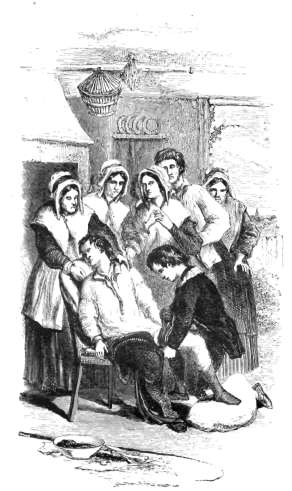
Astley Cooper's Debut in Surgery.
The birth of Sir Astley took place on the 23d of August, 3768, and his baptism in the following month; a few days after which he was sent from home to be nursed by a vigorous country-woman—a practice which he afterwards condemned with all the weight of his authority, and with an earnestness that Rousseau might have envied. At all events, the fact, in his case, is somewhat interesting, as connected with an occurrence which subsequently exercised a considerable and important influence on his choice of a profession. Meantime, it appears that he escaped any fatal disadvantage from the custom being followed, and was restored safe and sound to his mother's arms. His life was soon after exposed to great danger, from his accidentally running against a knife, which a brother with whom he was playing was, at the moment, holding in his hand, unclasped. The blade penetrated the lower part of his cheek, passed upward, and was only stopped in its deadly course by the socket of the eye. Blood flowed profusely, but medical aid being instantly procured, the wound was attended to, and at length healed; though the scar remained visible to his last days. As soon as he was old enough to receive instruction, he was initiated into the elements of education by his mother, who, as may be conceived, from her tastes and accomplishments, was well qualified for the task. Notwithstanding her literary occupations, she managed to devote a considerable portion of her well-spent time to imparting knowledge—and especially religious knowledge— to her family, and grounded young Astley in the rudiments of English grammar and history, for the latter of which he ever retained a strong attachment. At the same time he acquired from his father as much learning in the Greek and Latin classics as enabled him to read the New Testament in one language, and Horace in the other. Another preceptor was the village schoolmaster, who daily attended at the hall to instruct the young Coopers in writing, ciphering, and arithmetic. But Astley does not appear to have made any particularly rapid progress under his tuition. Indeed he was much too fond of fun and frolic, and too much of a boy in every sense of the word. His pranks were the wonder and alarm of the village; though his frank, open, and generous temper rendered it all but impossible for any one to be angry with him; and they were, as usual, the delight of his youthful associates. The hazardous adventures he engaged in are not such as can be deemed worthy of applause. The very objectionable exploit of plundering orchards, which then prevailed to such an extent that, as we have seen, even a future Lord Chancellor could indulge in it, was frequently practised under his advice and direction. He rode, without the aid of a bridle, horses which his comrades were afraid to mount when properly bitted; drove out the herd of cows from some neighbouring pasture, mounted on the back of a fierce bull, whose horns others would have-feared to approach; and ran along the eaves of high barns, with the utmost indifference as to consequences. One day, while performing the latter feat, he fell from so great a height, that death must have been the penalty of his giddy rashness, but for his tumbling into the stable-yard, which at that time, fortunately, happened to be filled with hay. On another, having climbed to the roof of the church, he suddenly lost his hold, and was precipitated to the ground; but escaped almost miraculously with a few bruises. On a third, while leaping a horse, which he had caught on the common, over a cow lying on the ground, he was overthrown by the horned animal rising at the instant; and though the bold rider escaped unhurt, the collar-bone of the steed was broken in the fall. On a fourth he would tease some hapless donkeys, till severely kicked by them in retaliation.
But before leaving with his father for Great Yarmouth, he left a more honourable memorial of his energetic spirit than the remembrance of such doings as have been mentioned. He was not yet thirteen when he gave a memorable proof of his calm courage and innate skill in dealing with that human frame, which afterwards formed the chief subject of his laborious study. A son of his foster-mother, a lad rather older than himself, while driving a cart loaded with coals for the vicar, fell in front of the wheel, which passed over his thigh before he could regain his footing, and, besides other injuries, caused a laceration of the principal artery. The unfortunate boy was borne home utterly exhausted, and sinking from loss of blood, which flowed so copiously that surgical aid not being at hand, the assembled villagers, finding their efforts to stop it utterly futile, were in terror of his bleeding to death; when Astley, having beard of the accident, hurried to the place. Undeterred by the feeling of sickness which the sight of so ghastly a wound naturally produces, and undis-mayed by the affright of the trembling spectators, he, with consummate presence of mind and a firm hand, instinctively did exactly what should have been done, encircled the limb with his handkerchief above the wound, and bound it so tightly, that the bleeding was effectually stayed till the arrival of the surgeon, with whose aid the boy was saved
In after-life Sir Astley used to refer to this circumstance as a remarkable event in his career; and he regarded it as first giving his mind the bent towards the profession which he adorned. Moreover, he was likely to be incited in that direction by the example of his grandfather, who had followed it with honour and profit at Norwich; and of his uncle, who had acquired distinction as a surgeon in the metropolis. But though the inclination mutas agitare inglorias artes was thus conceived, no steps were taken to gratify it at the time, nor does he seem to have made any preparation for giving effect to it. On the contrary, when settled in his father's new parsonage at Yarmouth, he divided his time between frolicsome levities and evening parties, till roused into action by the visits of his uncle. The professional knowledge, lively talents, and extensive information of this gentleman, captivated his keen spirited and active-minded nephew, who resolved forthwith to devote his life and energies to the promotion of that science, in which he won such high renown. So, after witnessing the performance of an operation at Norwich, he determined on becoming his uncle's pupil, and was articled accordingly.
Continue to:


My Books

