


Boyhood Of Sir David Wilkie
Description
This section is from the "The Boyhood of Great Men" book, by John G. Edgar. Amazon: The boyhood of great men.
Boyhood Of Sir David Wilkie
THERE was little in the circumstances of this cele-brated man's birth likely to lead him into the sphere which was enlarged by the workings of his genius, and adorned with the fruits of his industry. When once asked by a northern baronet whether his father, mother, or any of his relations, had a turn for painting, or what led him to follow that art, he replied, with his usual quiet humour: "The truth is, Sir John, that you made me a painter. When you were drawing up the statistical account of Scotland, ray father had much correspondence with you respecting his parish, in the course of which you sent him a coloured drawing of a soldier in the uniform of your Highland Fencible Regiment. I was so delighted with the sight, that I was constantly drawing copies of it; and thus, insensibly, I was transformed into a painter."
Wilkie belonged to a family that had from time immemorial held an honourable place in the higher class of Scottish yeomanry, and whose members were considered remarkable in their various walks of life for morality, economy, and independence. Perhaps the character of the men may, in some measure, account for the fact, that their estate, consisting of sixty acres, neither increased nor diminished in the course of the four centuries during which, according to authentic documents, it was in their possession. This was Ratho-Byres, in Mid Lothian, which Sir David's grandfather, a good and worthy man, held as tenant and cultivator, it having become the property of a younger branch of the same family. It is important to bear this in mind when considering Wilkie's distinguished career, because to almost every man born north of the Tweed, the feeling of being "a representative of the past," brings with it ambitious desires and longings for fame, not seldom productive of splendid results. To Wilkie, the birth-place of his fathers was ever dear: Gogarburn, a small stream near it, inspired him with an enthusiasm similar to that felt by poets for magnificent rivers; and a grey gable of the old house, in which his grandsire had dwelt and practised all the old-fashioned virtues, attracted his finest sympathies.
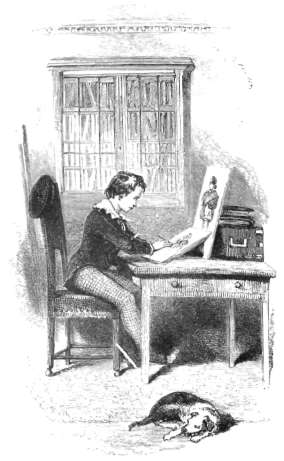
Wilkie's early Attempts.
Even after he had won renown, it was a darling dream to buy back the acres so long held by his race, build a mansion where the old wall stood, and adorn it with pictures by himself, recording the ancient glory of his country, towards which he was, from first to last, animated by a spirit of ardent patriotism. From his boyish days he listened with delight to stories of the heroes or poets of the Scottish soil, retained a preference for his own countrymen throughout life, and had so little freed himself from his prejudices at twenty-eight, that he expresses the mortification he felt at his French hostess being igno-rant of the existence of such a place as his native land.
Wilkie's father, after struggles as trying, if not so severe, as those by which his son impressed his genius on the hearts of millions, became minister of Cults on the banks of Eden-water, in Fifeshire. Here the great painter was born on the 18th of November, 17 85 His mother was the daughter of a Mr. Lister, an exemplary and sagacious man, who figures in his grandson's famous picture of Pitlessie fair; though, at the time that distinction was conferred upon him, he would have been much better pleased with a prospect of the juvenile artist figuring with credit in his father's pulpit.
But from his infancy Wilkie gave indications, clear and not to be mistaken, of his turn for that art, of which, ere long, he became so great a master. The following is the traditionary account of one of his very earliest efforts.
When he was a very little boy, Lord Balgonie one day came into the manse, as a Scottish parsonage is called. Mrs. Wilkie was burning heather in the chimney, and David taking out a half-consumed stalk from the fire, quietly sketched his lordship's nose, which is stated to have been a very formidable one, on the hearth-stone, and then exclaimed, "Mother look at Gonie's nose!" His lordship was much amused, and declared the likeness to be admirable. Somewhat later he adorned the nursery walls with amusing and fanciful representations of his father's parishioners, which, more than twenty years after were, by accident, unfortunately effaced, on the occasion of its undergoing some repairs for a new incumbent.
Having been previously taught to read by his mother, Wilkie was, at the age of seven, sent to Pitlessie school, the master of which soon perceived that his pupil was by no means fond of the appointed lessons, but rather of drawing heads of the boys on the slate put into his hands for a very different purpose. However, he speedily acquired favour and reputation with the school-children, who, of course, were not a little proud of having their lineaments transferred to paper. For each of the portraits, some of which are still preserved, he levied a marble, or something of the kind, as a reward for the exercise of his skill. He practised his youthful talents by sketching the boys as they stood in classes and liked to stand with his hands in his pocket watching them at play, or lie on the grass drawing their figures on his slate, as they moved about at their rustic games. In the school-room he was not reckoned an acute or gifted boy, and out-of-doors cared little for the sports indulged in by his hardy comrades, many of whom, the sons of farm-labourers and rural tradesmen, would, in after-life, find their honest hearts swell with pride at the eminence attained by him who had, in boyhood, given them the first idea of the shape of their features tanned with the sun, and of their round heads closely shorn in some of the village workshops, with shears borrowed from the nearest shepherd.
In 1797 Wilkie was removed to a grammar-school at Kettle, the master of which pronounced him the most singular scholar he had ever attempted to teach. He himself has been heard to declare that he could draw before he could read, and paint before he could spell; and it appears that throughout his school-days he was always, fortunately as it turned out, readier to devote himself to the latter pursuits. Though a quiet, grave-looking boy, he had ever a keen eye to anything in the shape of mischief; and all his sketches, whether of men or the inferior animals, had a tendency towards the peculiar style which made his name immortal.
Ever fond of fun and frolic, one of his favourite amusements was climbing on to the back of an unsaddled horse, and riding at full speed. This nearly cost him his life; for having, when about twelve years old, fallen, and been entangled, he was dragged for some distance, and picked up insensible. By this accident he was quite cured of the propensity, and, indeed, rendered a timid horseman for life. He inherited from his father something of a mechanical turn of mind, and interested himself in the construction of miniature mills and other machines. He frequented the workshops of shoemakers, and seemed disposed to learn their craft; watched with interest the weaver's loom; and was dexterous in handling the forge hammer of the village smithy. That such rough training was of use to him in many different ways, it is impossible to doubt.
Continue to:


My Books

