


Chapter I. Poets. Boyhood Of Sir Walter Scott
Description
This section is from the "The Boyhood of Great Men" book, by John G. Edgar. Amazon: The boyhood of great men.
Chapter I. Poets. Boyhood Of Sir Walter Scott
The time-honoured saying, that a poet is born, not made, may he quite true so far as it goes; hut that he will soar and sing, like the lark, irrespective of the influences to which he is subjected, and the advantage he takes of the circumstances in which he is placed, is hardly confirmed by the lives of those who have left the impress of their innate genius on the heart and mind of a busy world.
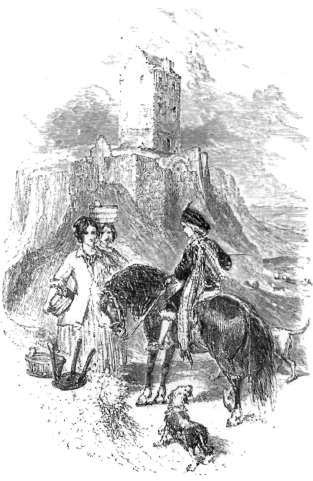
It would, perhaps, be impossible to name any poet, the story of whose life has excited more real and permanent interest than that of the author of "Marmion;" and it would be difficult, indeed, to mention any period of it more attractive than his boyhood: for it was then that, seated by some ivy-clad ruin, shattered fortress, or haunted stream, he imbibed his strong love of legendary lore, his peculiar sympathy with the events of past times, and his enthusiastic admiration of picturesque scenery, which were afterwards harmoniously blended and displayed in those marvellous works of poetry and romance that charm the imagination, touch the heart, dazzle the fancy, and inform the mind of every reader.
Fortunately, his own magic pen has left an account of his early years, which scarcely any can peruse without regretting its brevity; and it has been ex plained and illustrated by one who thoroughly understood and appreciated the spirit and genius of the "mighty minstrel." From such a storehouse, and other less famous quarters, it may not be impossible to gather sufficient materials for a brief, but not altogether uninstructive sketch.
Sir Walter Scott's father was a most respectable Writer to the Signet, and the first of the line who had passed his daily life in the populous haunts of men. From the renowned Border family of Harden., the exploits of whose members the great bard loved so well to celebrate and dwell upon, he derived his descent, through several generations, including small landed proprietors, who rode tall bony steeds, and coursed with lean greyhounds, second sons who lost all in the cause of the exiled house of Stuart, and shipwrecked mariners transformed into successful agriculturists. Some ancient traditions would, no doubt, linger around the hearth of the worthy lawyer, but it appears that he had hardly one particle of poetry or romance in his nature, A Pres-byterian after the most rigid fashion, Sunday was so strictly kept within his walls, that the privilege of reading the "Pilgrim's Progress" was deemed a favour of no trivial kind. Had Scott passed the first few years of his life in his father's house, it is unlikely that there would ever have come out of it a poet, with the soul of a cavalier, who laboured assiduously, and not without success, to restore the Royalist heroes of a bygone age to popular favour, though, in all probability, he would have gained distinction in some other field than that of literature. Dr. Johnson tells us, that true genuis is a mind of large general powers, accidentally determined in some particular direction; and, as it happened, an illness which induced a physical infirmity, was the cause of this 'cadet of Harden and clansman of Buccleuch," though the native of a crowded city, becoming "the last and greatest of the Border minstrels."
Walter Scott was born on the 15th of August, 1771, at the head of the College Wynd in Edin-burgh. His mother, a daughter of Dr. Rutherford. Professor of Medicine in the University, who added lively wit and literary ability to his professional acquirements, had a taste for books of poetry, which was by no means common among the ladies of the period. The future bard is represented as having been an uncommonly healthy infant; He provi-dentially escaped the extremely perilous guardianship of a consumptive nurse, and showed great signs of vigour till he was eighteen months old, when a severe fever brought on that lameness which luckily was not, in the end, such as to mar the symmetry of his noble form, or to embitter for a moment his still nobler mind. However, every other remedy which physicians, or quacks, or wrinkled ladies could suggest, having failed to restore his strength, he was removed for change of air to Sandie Knowe, "the thatched mansion" of his grey-haired grandsire, whom he has described as
"Wise without learning, plain and good, And sprung of Scotland's gentler blood; Whose eye, in age, quick, clear, and keen, Showed what in youth its glance had been."
Hard by, on the summit of rocky crags, down which, in days of yore, restless prickers had spurred their steeds to plunder the cattle-sheds and burn the haystacks of Northumberland, stood Smailholme Tower, the scene of his fine ballad, "The Eve of St. John;" at no great distance,
"Old Melros' rose, and fair Tweed ran;" and in the immediate neighbourhood were those dismantled baronial castles, mouldering abbeys, and ruined towers, which caught his infant eye, and touched his childish imagination with a force, the effect of which was felt to his dying day. In such scenes, having narrowly escaped being murdered and buried in the morass by a love-sick maid-servant, who deemed him the cause of separation from her wooer, Scott awoke to the consciousness of existence. He speedily became a great favourite with all about the farm, and rejoiced to he carried about in the open air, as he frequently was by the young ewe-milkers; but he particularly enjoyed himself in the company of the "cow-bailie," who would take him on his shoulders when going to watch his flocks, lay him on "some velvet tuft of loveliest green," bewitch his mind with some strange tale of olden days, and then leave him to exercise himself by rolling about among the sheep and lambs. He was, some years later, by the kindness of his uncle, transferred to the back of a Shetland pony, which no doubt he mounted and bestrode with an anxious desire to imitate the deeds and achievements of some of the old forayers, whose memory "tradition's simple tongue" still kept alive in the district. Perhaps the recollection of his own early feelings and aspirations prompted his descrip-tion of the heir of Branksome's "childish sport:" "A fancied moss-trooper, the boy The truncheon of a spear bestrode. And round the hall, right merrily, In mimic foray rode."
He was much fonder of frolicking in the open air than of his alphabet; but he was soon taught to read by his "Aunt Jenny," a remarkable woman, who, as well as her aged mother, one of the Haliburton race, whose memory he has perpetuated, communicated to him much ancient lore, and lulled him to rest with such old Border-gathering songs as her memory furnished. His grandfather also could tell of adventures with gipsies, and of hairbreadth escapes by sea and land. Moreover, he was entertained with songs and tales of the Jacobites, and led to conceive a strong and lasting partiality for "the royal race they loved so well," by listening to stories of the cruelties perpetrated in suppressing the Rebellion of 1745, in which some of his kinsmen had, for their misfortune, taken part. Different lessons, it must be confessed, he would have received had ho been brought up by his strict parents. As it was, he learned by heart the ballad of "Hardiknute" before he could read, much to the annoyance of the venerable clergyman, who found it utterly impossible to enjoy a sober chat with his parishioners, so resolute was young Walter in shouting it forth.
Continue to:


My Books

