


Chapter IV. Statesmen. Boyhood Of Canning
Description
This section is from the "The Boyhood of Great Men" book, by John G. Edgar. Amazon: The boyhood of great men.
Chapter IV. Statesmen. Boyhood Of Canning
This illustrious and patriotic statesman, whose rise shook hostile parties to their centre, and whose name deservedly occupies so brilliant a space in the political history of the country, was bom on the 11th of April, 1770, in the parish of Marylebone, where he was in due course baptized on the 9th of the following month. But though London was thus his birth-place, he was ever in the habit of considering himself an Irishman, as appears by the letter to his friend, Sir Walter Scott, on the occasion of the great Border Minstrel's visit to the Emerald Isle. His father was one of the Cannings of Garvagh, in Londonderry, Where they had settled in the beginning of the seventeenth century. This talented gentleman, having incurred the displeasure of his parent, fled from his native soil; perhaps, Teucer-like, indulging in the hope of seeing a new Garvagh arise on English ground. Fortune, however, did not favour him, except in the bestowment of a son destined to enshrine the name in enduring splendour. Entering as a student at the Middle Temple, the exile was, in due time, called to the bar; but politics and literature seem to have had greater charms for him than law, so he sacrificed the study of "Coke on Lyttleton" to the Muses, and relished the society of Willies and the other mock-patriots of the day more than that of the learned array at Westminster Hall. A marriage, that had more of romance than prudence in it, involved him in somewhat galling poverty; and having failed to better his circumstances by engaging in trade, for which nature had unfitted him, he experienced the peculiar depression resulting from repeated disappointment. The birth of his son was a fresh source of anxiety, more particularly as he had, some time before, for the sake of temporary relief from pressing debt, renounced his claim as heir-at-law to the family property, and thus deprived his boy of his right to the inheritance. Preyed upon by regret and vexation, he sunk under his accumulated mortifications, and died on the completion of one year by the infant, who was to vindicate the claims of genius to a due participation in the government of the mighty empire, whose greatness his brilliant eloquence so often celebrated.
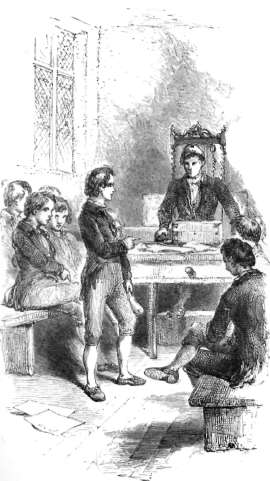
Canning's Mimic House of Commons.
An annuity, to which the clever but luckless Templar had been entitled, reverting at his death to his father, the fair widow was left without the means of support, and with no source of comfort but her child. How appropriate, in her position, would have been the lines which Campbell puts into the mouth of "the mournful mother," while affectionately watching by the couch of her slumbering infant! "Sleep, image of thy father, sleep, my boy! No ling'ring hour of sorrow shall he thine; No sigh that rent thy father's heart and mine; Bright as his manly sire, the son shall be In form and soul; but, ah! more blest than he! Thy fame, thy worth, thy filial love, at last Shall soothe this aching heart for all the past— With many a smile my solitude repay, And chase the world's ungenerous scorn away."
Thus unhappily situated, Mrs. Canning, with the advice of her friends, betook herself to the stage. She made her first appearance at Drury Lane, in November 1773, under the auspices of Garrick, and with the patronage of the Court. But, owing to in experience, and perhaps inaptitude for the calling, she was not so successful in her histrionic efforts as had been anticipated; and, notwithstanding her youth and beauty, she was obliged to repair to the less fastidious audiences of the provinces. A mar-riage, into which she was soon unfortunately drawn, placed her son under the care of, and in perpetual contact with, a man of intemperate habits and disreputable character, rendering it extremely impro-bable that he should ever arrive at high distinction, or even ordinary respectability.
The world is indebted to Moody the actor, a man of blunt and rough manners, but of a kind and honest heart, that one of its brightest children did not fall a victim to unpropitious circumstances. He was struck with the boy's talents, and became strongly interested in his welfare. Resolved to do what he could to promote it, he applied to his uncle, Mr. Stratford Canning, a London merchant, drew an alarming picture of his perilous position, declared that he was on the highroad to the gallows, dilated on the wonderful promise he displayed, and confidently predicted that, if properly brought for ward in the world, he would one day become a great man. The step was bold, as all communication with the family had long since ceased; but it succeeded; for though the uncle, with a selfishness excusable enough under the circumstances, was at first excessively unwilling to interfere, the benevolent player's perseverance overcame all obstacles, and the wealthy trader consented, on certain conditions, to take charge of his hopeful nephew.
The duty thus hesitatingly undertaken, was well and faithfully fulfilled; and a small estate in Ireland, which, at the earnest solicitation of his grandmother, had been set aside for the purpose, defrayed the expense of the future "great man's" education. He was instructed in the rudiments of learning at Hyde Abbey School, near Winchester. The master was one of those rigid disciplinarians who, in the fashion of the day, spared not the rod; but it has been supposed that Canning's studious and regular habits saved him from the inconvenience of such a system. At all events, unlike some of the other pupils, he entertained throughout life a grateful sense of the advantages derived at the establishment; and, when at the height of his power, showed his appreciation of them by presenting his old preceptor with a pre-bendal stall in Winchester Cathedral.
Even at this early season of youth he possessed great skill in versification; and when sent to Eton, at the age of twelve, was at once placed as an oppidan. He immediately acquired distinction, from the ease and elegance of his Latin and English compositions, and by the manliness of his habits. He never played at games like other boys, but at once assumed the sober dignity of manhood. Indeed, he prosecuted his studies as if prescient of the career before him; and endowed, as he must have felt himself to be, he was so far from placing his trust entirely in the inspirations of genius, that he was remarkable for the industry and assiduity with which he applied himself to mental improvement. His reputation grew rapidly, and the more choice spirits began to gather round him. At that time a society existed at Eton for purposes of discussion, and used to meet periodically in one of the halls. The pro-ceedings were conducted in imitation of the House of Commons; the Speaker was elected according to rule; the ministerial and opposition parties were regularly formed; and the subject of debate was entered upon with due gravity, decorum, and solemnity. In this arena Canning soon gained celebrity by the clearness and vigour of his speeches— pledges slight indeed, hut in his case sure, of those magnificent powers he was to exhibit in Parliament, where, in the words of a living orator, he "ruled the House as a man rules a high-bred steed, as Alexander ruled Bucephalus; of whom it was said, that the horse and the rider were equally proud."
Continue to:


My Books

