


Chapter XIII. Soldiers. Boyhood Of Buonaparte
Description
This section is from the "The Boyhood of Great Men" book, by John G. Edgar. Amazon: The boyhood of great men.
Chapter XIII. Soldiers. Boyhood Of Buonaparte
When the island of Corsica was invaded by the French, in 1767, a young lawyer of Italian extraction was residing in Ajaccio, its chief town. He laid claim to remote and illustrious lineage; his person was handsome and his mind vigorous. He had married one of the most accomplished ladies who graced the island, and eventually had a family of thirteen children, — eight of whom lived to find their name the terror and admiration of the world. When the invasion occurred, Charles Buonaparte, still in the pride of youth, abandoned his peaceful professional pursuits, and eagerly grasping the weapons of war, united with his brother islanders to resist the foreign
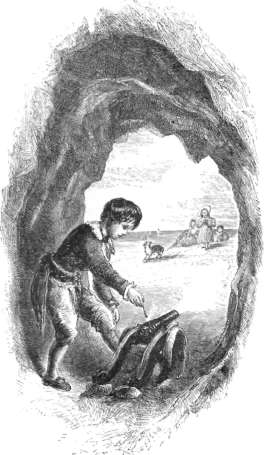
Napoleon's Warlike Predilections, and limited means. But her mental endowments were so great as to enable her to fulfil most creditably the duties devolving on her; and Napoleon used afterwards to declare that it was by her training that they were fitted to act with dignity in those lofty and dazzling heights to which they in after-life ascended. She resided with her family at a delightful villa by the sea-shore, a few miles distant from the city. The approach to the house was bounded by high trees, and bordered with blossoming shrubs. In front was a smooth, pleasant lawn, on which the children were accustomed to pursue their sports, happily unconscious that they were ere long to fill such high places. But he, the greatest of them all, and by whose genius they were to be raised, was not there; for his favourite and beloved resort was a lonely and romantic cave, still pointed out as "Napoleon's grotto," which was the scene of his early meditations. There he played fondly and contemplatively with a small brass cannon, whose sound and echo were as music to his ears as it startled for a moment his brothers and sisters, and hushed their merry voices. At other times, reclining in this dear and long-remembered retreat, with a book spread before him, he would gaze musingly on the wide waters of the Mediterranean, and dream, not vainly, of future greatness and glory. Even at this season he mani-fested his disposition to rule, and indeed to act in a despotic manner, so plainly that an uncle, as if pre-sciently, remarked, "Joseph is the eldest of the family, hut Napoleon the head." He hated the French with all his heart, and listened with bitter and tumultuous feelings to the narration of the severe woes which the Corsicans had suffered in defence of their insular rights and liberties. The story of his mother's hardships and sufferings, when she and her husband fled from village to fastness, and from the solitary place to the busy sea-port, with the brave but vanquished heroes of the soil, filled his eyes with tears and his heart with emotion. These marked the peculiar enthusiasm of his character, and the boldness with which he expressed opinions speedily brought him into notice.
At the age of six he was placed at a school in the neighbourhood, with a number of other children, among whom one fair-haired little girl quite captivated the heart of the future emperor. He used to walk to and from school leading her affectionately by the hand, much to the amusement of the older boys, who of course made very merry at his expense. Sometimes his anger would rise at what he conceived to be their insulting ridicule; and he would attack them with any species of weapon, that chance threw in his way. He enjoyed another, and perhaps less enviable, distinction at this period, — that of such extraordinary slovenliness that his stockings were almost invariably about his heels. A juvenile wit threw the two peculiarities into a couplet, which was harassingly shouted about the playground in his hearing, —
"Napoleone di mezza calzetta Fa l'amore a' Giacominetta," which, being interpreted, is, "Napoleon with his stockings half off makes love to Giacominetta," — the name of the first object of the great conqueror's affection. The Count Marboeuf, who on the subju-gation of the island had been appointed its governor, being impressed with the great beauty of Madame Buonaparte, her dignity of bearing and intellectual gifts, became a warm friend of the family, and took a special and lively interest in Napoleon, whose rise to extraordinary greatness he confidently predicted. By the influence of the Count, Napoleon was at the age of ten admitted to the military school at Brienne, near Paris. When parting from his mother, the pang was so severe that he wept like an ordinary boy.
On being established at school, he soon found that his associates, mostly sons of the proud, haughty, and exclusive noblesse of France, regarded him as a foreigner, and treated him with an indifference which his sensitive spirit could ill brook. Indeed, he was touched to the quick with the indignities he met with, and laid, in mortification, the foundation of that prejudice which he ever after entertained against men of high birth. His feelings, in this respect, at once led to his seclusion from the com-pany of his fellow-students; and burying himself in books and maps, he soon acquired so much knowledge as to be looked upon and spoken of as the ablest and most hopeful youth in the institution. He applied himself more particularly to mathematics, but history and geography were by no means neglected, while Latin and the ornamental studies received due and full attention. In German alone he could not be brought to take any interest; and the teacher of that language, consequently and excusably enough, entertained a very poor opinion of his talents. On one occasion, Napoleon being absent from the German class, the master, on inquiry, found that he was then employed in study at the class of engineers.
"Oh! then, he does learn something," said the teacher, ironically.
"Why, sir," exclaimed one of the pupils," he is esteemed the very first mathematician in the school."
"Truly," replied the annoyed and irritated professor, "I have always heard it remarked, and have uniformly believed, that any fool, and none but a fool, could learn mathematics."
In relating this anecdote in after-life, when Continental Europe was at his feet, Napoleon laughingly remarked, "It would be curious to know whether M. Bouer lived long enough to learn my real cha-racter, and enjoy the fruits of his own judgment."
Napoleon read poetry with great delight, and eagerly devoured books on history, government, and practical science. It was by such means that he learned to "combine the imperial ardour of Alex-ander with the strategy of Hannibal."
Plutarch's "Lives" constituted his favourite read-ing; and his whole soul became so imbued with the spirit of the illustrious men therein treated of, that when he made the acquaintance of Paoli, that veteran general under whom his father had fought for Cor-sican liberty was so struck with the decision and energy of character displayed, that on one occasion he rapturously and admiringly exclaimed, "Oh, Napoleon! you do not at all resemble the moderns — you belong only to the heroes of Plutarch."
Each student at Brienne had a small plot of ground allotted to him, which he was allowed to cultivate or not, just as he pleased. Napoleon con-verted his into a garden, in the centre of which he constructed a convenient bower, where he could study without the hazard of interruption. He gave his days and nights to mental toil, and his thoughts were wholly bent on military glory. In a letter to his mother, dated from this place, he said, "With my sword by my side, and Homer in my pocket, I hope to carve my way through the world." Many of his companions disliked him, but his character for honour and integrity commanded their respect. Yet he was high in favour with the younger boys, whom he was ever zealous to defend, with courage and determination, against those of riper years and greater strength.
One of the ladies of Brienne was in the laudable habit of inviting the boys to supper at her chateau; and on an occasion of the kind, the conversation turned upon the character of the illustrious Tu-renne,
"He was certainly a very great man," said the lady of the house; "but I should have liked him better had he not burned the Palatinate."
"What signifies that," was Napoleon's too characteristic observation, "if the burning was necessary to the object he had in view?"
The winter of 1781 was one of unusual severity; and the boys being precluded from their customary walks and exercises by the fall of snow, Napoleon proposed that they should beguile the time by erecting fortifications of snow. On this plan being readily agreed to, he at once assumed the conduct of it. Indeed, he had so diligently studied the science, that, under his superintendence, the works were executed in accordance with the strictest rules; and so determined and overpowering was his strength of will, even at this early period, that no one thought for a moment of questioning his authority. One luckless boy did, indeed, disobey orders, but Na-poleon unhesitatingly felled him to the ground, inflicting a wound which left a mark for life.
This year he was passed on to the military school at Paris, where he immediately brought himself into notice by addressing an energetic remonstrance to the governor against the luxurious and effeminate system that therein prevailed. He argued, certainly with some show of reason, that the student of military affairs should learn to groom his own horse, clean his own armour, and accustom himself to the per-formance of such duties as would be required of him for service in the field; and it is a striking fact that the military school, afterwards established by him at Fontainbleau, was founded on the system recom-mended in this youthful memorial. Among the students he was rather unpopular; but the diligence of his study, his powers of conversation, and the information he possessed, attracted much notice, and his intellectual superiority was readily recognised.
Happening at this time to be at Marseilles on a day of festivity, a large party of ladies and gentlemen were amusing themselves with dancing, but Napoleon declined taking part in it. On being rallied for his want of gallantry, he sternly replied, "It is not by playing and dancing that a man can be formed."
The Abbe Raynal became so forcibly impressed with his extraordinary abilities, as to invite him fre-quently to his house to meet learned and illustrious guests, and in after years introduced him to the brilliant drawing-rooms of M. Necker, when embel-lished by the presence of his accomplished daughter, Madame de Stael.
At the age of sixteen, on being examined to receive a commission in the army, Napoleon passed the ordeal with so much triumph, that the historical professor wrote opposite his signature, "A Corsican by character and by birth. This young man will distinguish himself in the world, if favoured by fortune."
In consequence of this examination, he was, much to his joy, appointed second lieutenant of a regiment of artillery. That evening, proudly arrayed in his new uniform, with epaulettes and enormous boots, he called on a lady with whom he was intimate, and who afterwards became one of the most brilliant stars of the imperial court. A younger sister of hers being present, struck with the ludicrous ap-pearance presented by his slender proportions being encased in military habits, laughed aloud, and declared that he resembled nothing so much as puss in hoots. The raillery was acutely felt at the moment; but a few days after, to show that he had completely recovered from its effects, he returned to the house, and presented the giggling damsel with an elegantly-bound copy of the book from which she had drawn her rather severe al-lusion.
Proud, and worthily so, of his commission, Napo-leon betook himself to join his regiment at Valence There he attracted the attention of one of its most distinguished ladies, Madame de Colombier, who introduced him to much refined society.
From Valence he was sent to Lyons, where he devoted himself to the acquisition of knowledge with remarkable energy and industry. The Academy having offered a prize for the best dissertation on the question, "What are the institutions most likely to contribute to human happiness?" Napoleon wrote on the subject, and was successful in his efforts against numerous competitors. He also prepared a "History of Corsica," which he visited in 1791; but the storms that appeared on the political horizon prevented its publication. He was at Paris on important duty in 1792, when the Tuileries were at-tacked and the Swiss guards massacred, and took occasion to express his disgust with the scene. It is unnecessary to sketch the next seven years of his life, which, indeed, would be the military history of the world during that period.
He was declared First Consul in December 1799, and Chief Consul for life in 1802. Two years later he was proclaimed Emperor; but was deposed, and his dynasty declared at an end, in 1814, when he was sent to Elba.
Escaping, he arrived at Paris; and on the 18th of June, 1815, he fought the decisive battle of Waterloo, when, being totally defeated, he was banished to St. Helena. There he died on the 5th of May, 1821, without pain and in silence, during a convulsion of the elements. The last words he uttered were, "Army" and "France;" which per-haps, even then, suggested reminiscences of glory and the consolation of universal renown.
Continue to:


My Books

