


Chapter XVI. Sculptors. Boyhood Of Canova
Description
This section is from the "The Boyhood of Great Men" book, by John G. Edgar. Amazon: The boyhood of great men.
Chapter XVI. Sculptors. Boyhood Of Canova
The little village of Possagne, within the territories of the once wealthy, powerful, and high-flying Republic of Venice, enjoys the distinguished honour of having been the birthplace of this immortal sculptor, who rivalled the illustrious artists of Greece, and inspired fresh life into the expiring arts of Rome. It is situated in a remote but pleasant district of Italy, amid the recesses of the Venetian hills; and in the middle of last century consisted of a number of straggling, mud-built cottages. In one of these humble cabins at that period dwelt Pisano, the grandfather of Canova, stone-cutter of the locality, as his fathers had been for generations. The latter circumstance, with his reputation for pleasantry and good-humour, enabled him to exercise considerable ascendancy over the villagers, while his skill and diligence recommended him to the favour, employment, and even friendly regard, of his superiors in wealth and station. He possessed some knowledge of architecture, and displayed a certain degree of taste and skill in executing ornamental works in stucco and marble, several specimens of which are still to be seen in the neighbouring churches.
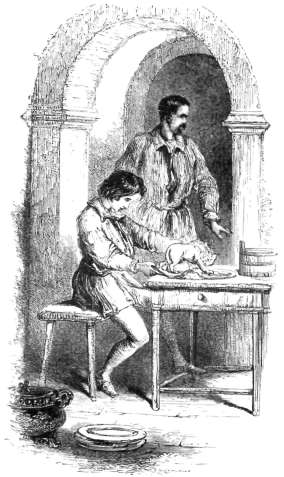
Young Canova's Skill in Modelling.
Antonio Canova was born on the 1st of November, 1757. His father Pietro, also a stone-cutter, died when the future sculptor was three years old; and his mother marrying again a few months after, left her son to be brought up by the sagacious Pisano. The boy being, like many destined to eminence, of feeble health and delicate constitution, became the object of the most affectionate care to his grand-mother, who watched over him with the most tender solicitude, told him the charming tales, and sang to him the rich ballads, of his native hills. These inspired him with a love of poetry, of which he afterwards felt and acknowledged the value; and no doubt the images and forms they raised in his imagination contributed materially to the excellence which characterises that class of his works, embodying Italian life and beauty, the best and most lasting memorials of the genius that was applauded, while he was yet twenty-five, for having produced "one of the most perfect works which Rome had beheld for ages." The venerable matron lived to see the object of her vigilance prove himself worthy of it, and he showed his grateful sense of her more than maternal kindness by sculpturing a bust of her in the costume of her native province, and keeping it in his apartments to mark his appreciation of the services she had rendered him.
When her incessant attention became less necessary, her little charge fell more under the auspices of Pisano, who, regarding him with no small pride as his destined successor in the office of hereditary village mason, was resolved that he should not, for want of instruction, be deficient in the accomplishments requisite to fill the post with credit and distinction. Almost as soon, therefore, as Antonio could hold a pencil, he was initiated into the principles of drawing. Somewhat later he commenced modelling in clay, and then learned to fashion the larger fragments of marble cuttings into ornaments of various descriptions. Of these almost infantine efforts in sculpture, two small marble shrines, one of which is inlaid with coloured stones, are still preserved.
While Antonio thus passed his years of childhood in studious occupation, working in his grandfather's shop, or listening to the fascinating lore of his grand mother, the village boys, whose sports and pastimes had not the slightest attraction for him, nettled at his indifference, styled him the "sullen Tonin," the familiar denominative for Antonio, commonly used in the Venetian State. But when he had won European fame, and had been elevated to high rank, and loaded with countless honours, the studio still continued the theatre of his ambition and the scene of his triumphs. He cared little for other matters.
After the completion of his ninth year, Canova appears to have wrought with his grandfather, no longer altogether for amusement, but as an assistant in those labours necessary for the maintenance of the little household. Still the feeble frame of the boy so nearly disqualified him for such a trade, that Pisano, probably seeing that his wish could not be fulfilled, indulged him in modelling flowers, drawing animals, and other matters congenial to his fine taste and bright fancy.
At the age of twelve he had the good fortune to attract the notice, and secure the patronage, of the noble Venetian family of the Falieri, who had a villa in the neighbourhood, to which they were in the habit of resorting periodically to enjoy the beautiful scenery and refreshing breezes that its Alpine situation afforded. Signor Faliero entertained a sincere respect for the old stone-cutter, and no season passed without several visits from the latter to the Villa d'Asolo.
Thus young Canova was first introduced to the notice of the potent senator, with whose second son he immediately formed a boyish friendship, which was proof against the influence of time and the distinctions of rank.
An interesting anecdote is told of the means by which he impressed his great powers on the conviction of the Falieri. On the occasion of a splendid banquet, when the feast was set forth and the guests assembled, the domestics suddenly discovered, to their dismay, that a crowning ornament was wanting to render the dessert complete. In this grave emer-gency old Pisano's aid was invoked, and he racked his brain to invent something suitable, but to no purpose. The genius of his grandson, however, suggested a remedy, and calling for butter, he modelled a lion with such surpassing skill and effect that it excited the wonder and admiration of the guests They were filled with curiosity to see the marvellous boy who, on the spur of the moment, had made so clever, successful, and fortunate an effort, and, accordingly, his presence was demanded. "With blushing cheeks and hesitating step, the incipient artist came to receive the congratulations of the bright and gorgeous company, and the thanks of the kind and opulent family, whose head was not slow to recognise and reward this timely effort. He per-ceived that the boy was possessed of rare dexterity; and, resolving to give him encouragement and opportunity to develope it with advantage, he had him placed under Toretto the elder, who was one of the most skilful Venetian sculptors, and had just come to reside in the neighbourhood. Ever arduous in his pursuits, Canova employed himself perseveringly under his new instructor. Many of his drawings and models still exist in the Falieri family, as well as in other collections; and among them two drawings in chalk, one representing a Venus, the other a Bacchus, executed only a few days after their author had been placed with Toretto, but remarkable for their boldness of style and correctness of outline. During leisure hours he produced some works, which raised the hopes of his friends, and led them to anticipate for him great success The most memorable of these were the models in clay of two angels, executed without assistance from any other figures, and therefore original efforts of his creative talent. Having been produced during a brief absence of Toretto, and hastily finished, they were placed in a conspicuous position in the workshop to await his experienced judgment. When the sculptor's eye caught the productions of his pupil's genius, he is said to have been entranced, and to have exclaimed, "This is, indeed, a most astonishing work." It was with no small difficulty that he could be persuaded of their being in reality the result of a boy's labours.
Continue to:


My Books

