


What Not To Do
Description
This section is from the book "The Art Of Decoration", by H. R. Haweis. Also available from Amazon: The Art Of Decoration.
What Not To Do
One of the fixed laws of the admirers of the false Queen Anne style of room is the enmity to mirrors, only proper and wise if everyone in the house is a fright. One enthusiastic votary of this effete reaction actually recommends the 'unfortunate possessors' of lofty mirrors to cut the plate into oblong fragments; and adds, 'if strong unwillingness should exist to have large plates of glass cut into pieces.' an alternative remains, 'an ebon-ised oak or walnut frame altogether enclosing and dividing by cross-pieces the surface of the glass into compartments, and leaving perhaps one- uninterrupted oblong piece, about 18 inches high at the bottom, with a trellis work of shelves and brackets ' - for books and china !
Here is the most bornee incapacity to appreciate really good elements, or to know what to do with them when they have got to be used. It would really seem, were these people reliable, that all wall-mirrors are an abomination, unless they not only refuse to repeat pretty objects, but actually go out of their way to create hideous ones, convex mirrors of the 'Empire' time alone being admitted in such 'aesthetic' houses.
Probably this desire to mortify the flesh was the logical accompaniment of the ascetic tendency of the early nineteenth century, the period now pitched backward 100 years, and praised under the fancy name of Queen Anne. At any rate it is certain that you cannot tie on your bonnet straight in this kind of house, for you may wander from room to room without finding so much as a span-wide mirror; but you may be wholesomely reminded of the ills which flesh is heir to by that convex horror supported by a most inadequate eagle, and wherein you see your brow or jaw swell sickeningly, your would appear in a convex mirror eye burst forth or your mouth protrude, according to the position in which you place your devoted head. Only the meanest spite could wish the youngest and prettiest guests to see themselves like this.
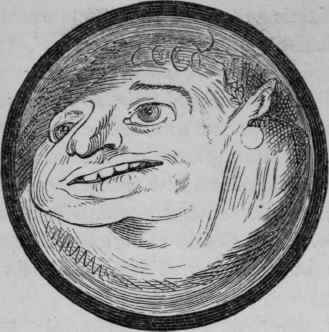
Fig. 42. - What Helen of Troy
However low our opinion of our friends' looks, 6r our own, tact forbids that we should placard it on our walls. Queen Elizabeth banished her mirror in her dismal old age because she did not know how to grow old gracefully. However, whether this practice spring from sick vanity or misanthropy, I repudiate it. I humbly study the art of beautifying home, not uglifying it, hence perhaps am behind the times (wherefore I give thanks); for in my opinion a good mirror is undoubtedly an ornament, as I have shown in a 'Louis XIV. Room.' It is one which of course can be abused - the vast mirrors which invariably accompany the coarse gilt consoles in the house of every vulgar Crcesus have disgusted us all, and the accidents to persons who have run heedlessly into looking-glasses, supposing them to be openings to new rooms, are sufficiently authentic to enjoin care in the arrangement of sheets reaching the ground. Nevertheless, a mirror, properly mounted and protected, greatly adds to the size of a room; it certainly reflects light in almost any position, it opens quaint and unexpected vistas to the eye, it doubles the number of fair faces present, and the curious mystery which pervades the world 'through the looking-glass,' inaccessible, yet so near, is not without its charm to grown-ups as well as to children.
Continue to:


My Books

