


Gala Rooms: Ball-Room, Saloon, Music Room, Gallery. Part 3
Description
This section is from the book "The Decoration Of Houses", by Edith Wharton, Ogden Codman Jr. Also available from Amazon: The Decoration of Houses.
Gala Rooms: Ball-Room, Saloon, Music Room, Gallery. Part 3
Gala apartments, as distinguished from living-rooms, should be lit from the ceiling, never from the walls. No ball-room or saloon is complete without its chandeliers: they are one of the characteristic features of a gala room (see Plates V, XIX, XXXIV, XLIII, XLV, L). For a ball-room, where all should be light and brilliant rock-crystal or cut-glass chandeliers are most suitable: reflected in a long line of mirrors, they are an invaluable factor in any scheme of gala decoration.
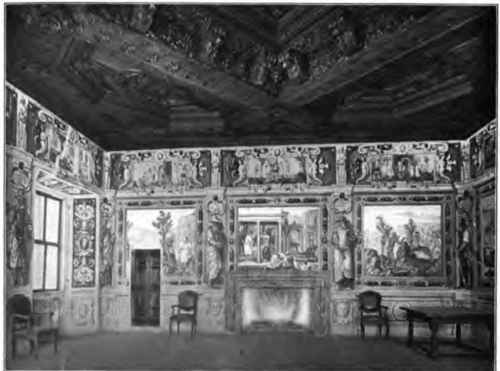
PLATE XLIV. SALOON IN THE VILLA VERTEMATI. XVI CENTURY. ( example of frescoed walls and carved wooden ceiling).
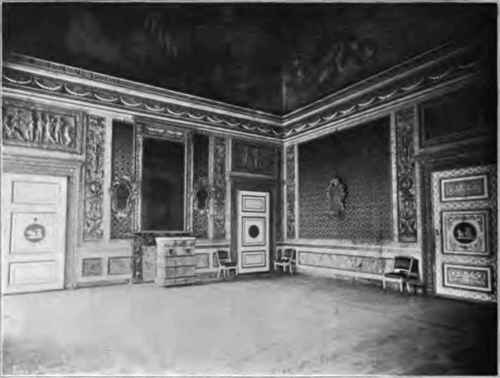
PLATE XLV. SALA DELLO ZODIACO, ROYAL PALACE, MANTUA. XVIII CENTURY.
( example of stucco decoration).
The old French decorators relied upon the reflection of mirrors for producing an effect of distance in the treatment of gala rooms. Above the mantel, there was always a mirror with another of the same shape and size directly opposite; and the glittering perspective thus produced gave to the scene an air of fantastic unreality. The gala suite being so planned that all the rooms adjoined each other, the effect of distance was further enhanced by placing the openings in line, so that on entering the suite it was possible to look down its whole length. The importance of preserving this long vista, or enfilade, as the French call it, is dwelt on by all old writers on house-decoration. If a ball-room be properly lit and decorated, it is never necessary to dress it up with any sort of temporary ornamentation: the true mark of the well-decorated ball-room is to look always ready for a ball.
The only chair seen in most modern ball-rooms is the folding camp-seat hired by the hundred when entertainments are given; but there is no reason why a ball-room should be even temporarily disfigured by these makeshifts, which look their worst when an effort is made to conceal their cheap construction under a little gilding and satin. In all old ball-rooms, benches and tabourets (small seats without backs) were ranged in a continuous line along the walls. These seats, handsomely designed, and covered with tapestry, velvet, or embroidered silk slips, were a part of the permanent decoration of the room. On ordinary occasions they would be sufficient for a modern ball-room; and when larger entertainments made it needful to provide additional seats, these might be copied from the seventeenth-century perroquets, examples of which may be found in the various French works on the history of furniture. These perroquets, or folding chairs without arms, made of natural walnut or gilded, with seats of tapestry, velvet or decorated leather, would form an excellent substitute for the modern cotillon seat.
The first rule to be observed in the decoration of the music-room is the avoidance of all stuff hangings, draperies, and substances likely to deaden sound. The treatment chosen for the room must of course depend on its size and its relation to the other rooms in the house. While a music-room should be more subdued in color than a ball-room, sombre tints and heavy ornament are obviously inappropriate: the effect aimed at should be one of lightness and serenity in form and color. However small and simple the music-room may be, it should always appear as though there were space overhead for the notes to escape; and some form of vaulting or doming is therefore more suitable than a flat ceiling.
While plain panelling, if well designed, is never out of keeping, the walls of a music-room are specially suited to a somewhat fanciful style of decoration. In a ball-room, splendor and brilliancy of effect are more needful than a studied delicacy; but where people are seated, and everything in the room is consequently subjected to close and prolonged scrutiny, sprightliness of composition should be combined with variety of detail, the decoration being neither so confused and intricate as to distract attention, nor so conventional as to be dismissed with a glance on entering the room.
The early Renaissance compositions in which stucco low-reliefs blossom into painted arabesques and tendrils, are peculiarly adapted to a small music-room; while those who prefer a more architectural treatment may find admirable examples in some of the Italian eighteenth-century rooms decorated with free-hand stucco ornament or in the sculptured wood-panelling of the same period in France. At Remiremont in the Vosges, formerly the residence of a noble order of canonesses, the abbess's hotel contains an octagonal music-room of exceptional beauty, the panelled walls being carved with skilfully combined musical instruments and flower-garlands.
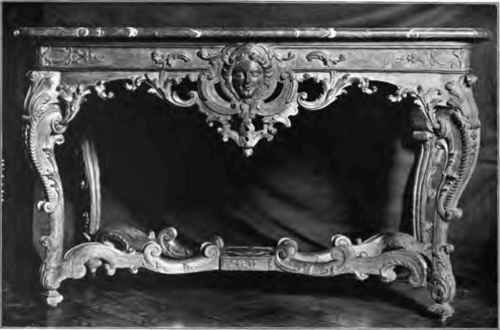
PLATE XLVI. FRENCH TABLE.
(TRANSITION BETWEEN LOUIS XIV AND LOUIS XV PERIODS).
In larger apartments a fanciful style of fresco-painting might be employed, as in the rooms painted by Tiepolo in the Villa Val-marana, near Vicenza, or in the staircase of the Palazzo Sina, at Venice, decorated by Longhi with the episodes of an eighteenth-century carnival. Whatever the design chosen, it should never resemble the formal treatment suited to ball-room and saloon: the decoration should sound a note distinctly suggestive of the purpose for which the music-room is used.
It is difficult to understand why modern music-rooms have so long been disfigured by the clumsy lines of grand and upright pianos, since the cases of both might be modified without affecting the construction of the instrument. Of the two, the grand piano would be the easier to remodel: if its elephantine supports were replaced by slender fluted legs, and its case and sounding-board were painted, or inlaid with marquetry, it would resemble the charming old clavecin which preceded the pianoforte.
Fewer changes are possible in the "upright"; but a marked improvement could be produced by straightening its legs and substituting right angles for the weak curves of the lid. The case itself might be made of plainly panelled mahogany, with a few good ormolu ornaments; or of inlaid wood, with a design of musical instruments and similar "attributes"; or it might be decorated with flower-garlands and arabesques painted either on the natural wood or on a gilt or colored background.
Designers should also study the lines of those two long-neglected pieces of furniture, the music-stool and music-stand. The latter should be designed to match the piano, and painted or inlaid like its case. The revolving mushroom that now serves as a music-stool is a modern invention: the old stools were substantial circular seats resting on four fluted legs. The manuals of the eighteenth-century cabinet-makers contain countless models of these piano-seats, which might well be reproduced by modern designers: there seems no practical reason why the accessories of the piano should be less decorative than those of the harpsichord.
Continue to:


My Books

