


Chapter XV. The Modern House
Description
This section is from the book "Interior Decoration: Its Principles And Practice", by Frank Alvah Parsons. Also available from Amazon: Interior Decoration: Its Principles and Practice.
Chapter XV. The Modern House
THE problem of the modern house involves something more than merely providing a pretty, healthful, physically comfortable place to satisfy man's demand for shelter and rest. It is the criterion of a man's taste, the visible response to his instinctive call for beauty. It furnishes the environment in which are born and nurtured the early impressions of those who are to set the taste standards in the generations that follow.
This consideration dignifies interior decoration by placing it among the serious professions. No longer a mere matter of collecting and housing like a department store or a museum, or of providing a place in which to sleep and eat, it is destined to become, as man realizes more fully the power of environment, one of the strongest and most scientific of the educational factors in our generation. The time will come when its power in the evolution of race consciousness will be appreciated at its true worth.
Though realizing fully the importance of sanitation and the difficulties arising from financial limitation, it is not our purpose to deal with these questions. It is rather our desire to emphasize here only the functional and artistic phases of this great problem. More books have been written and more has been said on the subjects of hygiene and economics than any of us can apply, but the principles that govern the choice and arrangement of materials, colours, forms and lines as they relate to common usage or as they appeal to the artistic sense, have been practically overlooked.
To stimulate the reader to think before buying, to have a sensible reason for his purchase, to know the power of colour and form, and to see how men of other nations in the past have expressed their personal and racial ideas, is our aim.
The aesthetic sense is instinctive and expresses in man his desire or appetite for beauty. What a man selects in response to this demand of his nature and how he arranges what he has selected, determines his taste. A man's taste improves as the aesthetic sense becomes refined or sensitized to the point of responding to the more subtle combinations of forms and colours. This matter of taste is not a fixed quality. One may have the gift or natural tendency to refined choice, but no man has by divine right a monopoly of good taste. Our standards are constantly changing during life as affected by study and by environment.
Every time a colour is seen, a sound heard, or an odour perceived, a new sensation is recorded in consciousness, or one previously recorded is made more permanent by repetition. This is true of all sensations received through the senses. These numberless sensation records accumulated since birth represent the part environment has played in the evolution of our consciousness. In other words, it is what one really is, for out of consciousness comes one's acts, and his thoughts and acts affect his personality and his use of all material objects. Seeing this psychological truth clearly is the foundation for recognizing the importance of the interior of the house. This, briefly, then, is the status of environment as a factor in character building and as a power in the evolution of a national civilization. It is even more lasting in its results than hygiene for the body or money for selfish purposes. It is this that determines the standpoint of taste and may become the stepping-stone to a higher plane of living both for the individual and the nation.
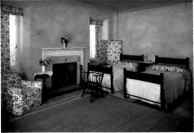
SUITABLE BEDROOM FOR TWO BOYS, ADMITTING THE ADDITION OF SUCH PERSONAL OBJECTS AS ARE ESSENTIAL TO THE COMFORT AND IMMEDIATE PLEASURE OF THE OCCUPANTS.
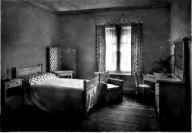
SIMPLE BEDROOM SUITABLE FOR GUEST'S CHAMBER IN COUNTRY HOUSE. WELL ARRANGED, PROPERLY DECORATED, WITH CHINTZ MOTIF ON A RESTFUL BACKGROUND. THE ROOM IS IMPERSONAL AND SUITED TO CHANGE OF GUEST.
What, then, can be more important than the house, especially its interior? Is it not here that the child first sees colours, hears sounds, touches textures? Is this not the place where first impressions are received? These impressions should be of the quality one would have the young mind make permanent as standards for future judgment. They will represent what the owner of the house regards as good taste in the gratification of his desires. As the aesthetic sense quickens, the taste for greater subtlety grows, and a changed environment is the result.
The artistic home should not be regarded as a luxury. Its possession should be regarded as a duty to the cause of civilization as well as a response to the normal desires inspired by the aesthetic sense. It is essential to the general taste standard of the future and to the full appreciation and enjoyment of beauty.
The obstacles that stand in the way of a realization of this ideal environment are numerous. There are so many questions arising in each individual problem, so many apparently insurmountable difficulties, and, worst of all, there are so many people who are willing to give up anything that does not come with perfect ease. It may be well to look into some of these complications.
In any discussion of a personal problem, outside of a limited number of wealthy people, the first difficulty raised is: "I cannot afford to buy good things. If I had the money I should certainly do so." Then: "I have bad things and why should I be so particular when I must put the new with the acknowledged bad which I already have?"
To the first of these objections it may be answered that all expensive things are not good; nor are all cheap ones bad. Of course we must allow that there is a greater field for beautiful things where unlimited means are at the command of the designer, but we must also remember that unless the designer thoroughly understands what is good and what is not, the field for his caprice and ignorance is increased in proportion to the amount of money he has to spend. Often the money limit is the saving thing in the selection of articles as to their kind or their number. The question of selection is one of colour, form, line and texture and of the principles that produce harmony. It is not a question of the kind of wood, how much it cost, and how much it is carved, nor is it a question of how brilliant the bronze is, nor how gorgeous the velvet. When one looks at any object from the standpoint of the principles of harmony, which should control its structure and its decoration, he has the answer to the objection "I have no money," for money is not the standard of judgment.
Continue to:


My Books

