


Emphasis And Unity. Continued
Description
This section is from the book "Interior Decoration: Its Principles And Practice", by Frank Alvah Parsons. Also available from Amazon: Interior Decoration: Its Principles and Practice.
Emphasis And Unity. Continued
Hang upon the wall at the left side a definitely vertical striped wall paper or textile, hang at the other end of the room a textile in which there is a definitely curved line extending from top to bottom, either in the form of the Italian or Louis XIV decorative motif, or of a vine arrangement such as may be found in the textiles of the Jacobean period or some modern wall papers. Look at the first illustration about halfway from the floor to the ceiling. The eye naturally tends at once to follow the vertical stripe to the ceiling; the tendency is next to follow it down to the floor. The eye naturally moves up and down in a straight line because it is one that extends unbroken in a certain direction. Partly because of the structural idea and partly by reason of innate human curiosity, the eye will travel to the end of this line.
If you look at the second illustration, you will find it impossible for the eye to make a straight line from the centre of the room to the top, or the bottom of the room to the top. The eye tends to follow the direction of the strongest line, the curved one which I have described.
This tendency by which the eye is led from one point to another by a continuous line, or one nearly so, is called movement, and this movement from one place to another, in this or that direction, consciously or unconsciously, detracts from the sense of rest or repose. If the function of the room is to secure repose, neither of these movements will be introduced in strong and vigorous effects without destroying the idea for which the room exists.
If dignity and formality are the chief characteristics of the room, the wandering curve will tend to make it less so than if the movement were a strictly vertical and horizontal one.
The lines of triangular picture wires, erratic lines created by draperies, oblique placing of rugs with reference to floor edges and other arrangements which have been treated under structural unity, create, each in itself, a movement contrary to the general one established by the room structure. Each movement in a direction different from that of all the others creates a maze or forest of direction movements. This results in confusing the selection, and a solution, conscious or unconscious, of the composition idea becomes impossible. Such a room is not one in which to rest.
It is not lines alone that create movement; spots of colour or arrangements of forms, close enough together to be associated as parts of a whole, lead the eye from one point to another through a sequence in the same way.

A. RHYTHMIC LINE MOVEMENT (LINES FLOWING GRACEFULLY IN THE SAME DIRECTION) FOUND IN CONTOUR OF CHAIR THROUGHOUT. THIS ADDS A CERTAIN GRACF. AND EASE TO THE OBJECT.

B. TEXTILE ILLUSTRATING RHYTHMIC MOVEMENT THROUGHOUT THE PATTERN. NO LINES FOUND WHICH OPPOSE EACH OTHER.
In some designs which are to be used for decorative purposes movement is most desirable, for, in the fact that the eye does naturally go from one part of the design to the other, there is an incentive to interest throughout the entire scheme.
When the opposite idea, however, is the aim, care must be taken that no such movement be created. For example, many people fancy that, given three or four small pictures, they must be hung together or adjacent to each other as a group upon the wall; that if each picture is, for example, nine inches high, the first one at the left should be placed low, the next one four inches away from it and two inches higher, the next four inches from that and two inches higher, and the last one in the same way, at a distance of four inches, and two inches higher. They believe that an artistic result must be obtained because this arrangement surely is not stiff. No, it is not stiff; neither is it desirable from any standpoint.
Structurally these pictures should be straight across the top. The reason for this will be given later. If they are of the same size there is no excuse for their not being straight at the top or bottom. If any motion is to be created across the room from right to left, it should be straight across rather than up and down stairs, which would be tiresome if taken far. The same objectionable movement often results from arranging furniture after this manner.
Another place where it is undesirable to create endless journeys is upon the floor. I have remarked before that the quieter the floor appearance is the more it accords with the idea of a place on which the feet may rest and furniture may be placed.
One of the most disturbing things to be found in a room is a rug the pattern of which, by its erratic lines or spotted effects, leads the eye horizontally, vertically and diagonally all at the same time. This type of design is much worse when it appears in spotted wall covers. For instance, in the case of bouquets of flowers placed several feet apart, one above the other, showing as clearly defined spots that form a sequence which may be followed in any direction, each spot leading to an adjacent one in the same line.
No one ever suspected until his attention was called to it, probably through experience, the amount of energy wasted by the American nation in useless counting, consciously and unconsciously, of spotted wall papers, spotted floors and badly arranged decorative motifs on the wall.
The fact to grasp is that these arrangements exist to produce certain results, and movement prevents balanced arrangement and the resultant quiet, restful effect of finished motion. If the mistake is made of allowing this movement idea to creep in in ever so small a way, it must, inasmuch as it has entered into a scheme, bring with it the qualities for which it stands. Understand this, and introduce the opposite of those qualities, if they are desirable, in the particular room under consideration.
It may be interesting to those who find pleasure in the study of pictures to know that this is one of the most useful of all principles of composition to him who would use the accessory objects in his pictures to emphasize the centre of interest or the key idea for which the picture stands.
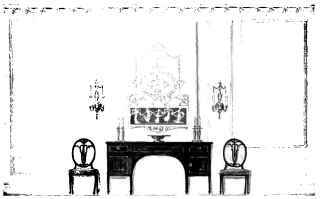
SIDE WALL ELEVATION IN COLOR, WITH EXCELLENT BACKGROUND SPACINGS AND INTENSELY INTERESTING DECORATIVE ARRANGEMENT THROUGH THE USE OF CURVED AND RHYTHMIC LINES.
Take, for example, many of the religious pictures of early Italian art. Some of them contain from three to one hundred figures, including perhaps the mother, the child, and the rest of the Holy Family, saints, angels and other persons. The function of each of these figures as a matter of composition is to emphasize some precept or ideal for which the picture stands as a whole. We will suppose, for the sake of argument, that the Christ idea is to be brought out or the child Christ idea is to be emphasized. The child is small, not brilliantly coloured, and lies quietly in the mother's arms. The bend of the head, the gaze of the eyes, compel the observer of the picture to find interest in the very thing in which the mother is most interested. Other members of the family, saints and attendants, are generally interested and looking directly at or bending their body toward either mother or child. If they are not, one is looking at another and either pointing to the object of most importance or, by looking at another who is absorbed in contemplation of this object, compels you to follow his gaze.
This setting of composition, arranging of forms, comparison of lines and use of gaze attraction is emphasized always in the best stage performances in which more than one or two persons are concerned in the exposition of an idea.
Every principle of composition and arrangement exists to make clear some given quality or idea. These principles also assist in producing a corresponding mental state in any person who is active in sensing such qualities. Conformity to these principles will result in producing qualities related to the idea for which an expression is sought. Disregard of them may have a result quite opposed to those ideas which may be struggling for expression.
Movement, then, is the complement of balance. Balance exists to produce rest and all those qualities which are intimately related to it. Movement exists to destroy balance, to create unrest, to lead the individual in certain directions from one thing to another to keep him on the alert, and it ends by bringing him to some particular point.
Let us not confuse these two vital principles or fail to see their import in the arrangement of colours, forms, lines and textures in any problem where the decorative idea is the one to be considered.
Continue to:


My Books

