


Part I. Introduction. When, Where, And How To Decorate
Description
This section is from the book "Interior Decoration: Its Principles And Practice", by Frank Alvah Parsons. Also available from Amazon: Interior Decoration: Its Principles and Practice.
Part I. Introduction. When, Where, And How To Decorate
THE very term "interior decoration" is misleading, and is the cause of much of the bad interpretation of the decorative idea for which it stands. Love of beauty and the desire to create it is a primal instinct in man. The personal pride and pleasure one takes in his own house is too generally acknowledged to need comment. If, however, one desires to possess a so-called artistic house, the making of such a house involves an understanding of certain principles.
In the first place there are two quite distinct classes with whom one must deal: first that of the art connoisseur, or artist collector of antique objects. While every man of this type is individual, there are principles of choice and arrangement by which he must be governed, be his taste ever so fine. His room is a personal expression of his taste in the combining of things with different meanings, but it is quite impossible for the rank and file of those who live in ordinary homes to appreciate such an expression.
Because of this first class the general public has not grasped the difference between a museum or department-store collection of objects, such as furniture, hangings, carpets, etc., and a room in which to live. Only an artist can be trusted to attempt such house furnishing. By an artist I do not mean a man who paints pictures merely. I mean a man who possesses the art quality in such a degree that he may be able, not only to group art objects in any field, but also that he may have a sensitive appreciation of them in whatever combination they may appear.
The second class includes ninety-five per cent. of all people who use a house, and it is to them in particular that this book is given.
We find among these a lack of the remotest conception of what decoration really is, for there are many ways in which this term may be, and is, misapplied. One person believes that ornament, pattern, or art objects placed anywhere, in any relation one to the other, must be decorative. Nothing is further from the truth. Be a thing ever so good, it may easily lose its charm through association with the wrong things. Another person believes that the more he buys and crowds his room with either new or expensive objects, the more decorative or decorated it becomes. This, too, is a fallacy. Not only is it not decorative to use too much or too many decorative things, but it prevents any one of the objects from having a decorative effect. Neither these things nor their cost, neither show, vogue, period, nor sentimental foolishness, are in the least concerned with an expression of the decorative idea.
Decoration implies, first of all, something to decorate. By this we mean some definite form or arrangement to which decoration is to be applied, and a reason for applying it. It is not because I have a room that I rush to pile something onto or into it. It is because I need some things in certain places in this room. This necessitates additions of a certain kind to make the room fulfill its function, and to make it a beautiful unit when it is finished. The room is, first of all, to fulfill its function. This matter of function is fundamental m any applied art. The room, and most objects in the room, exist for use first. The quality of beauty is desirable and essential in fulfilling the highest ideal; but however beautiful the objects are, if the functional idea is not adequately and fully carried out, the art from the standpoint of house furnishing is but one-half expressed. Take, for example, a dining-room. The first question to be asked is: what is the dining-room for - that is, for whatidea does a dining-room stand ? The only sensible answer is: this room exists to eat in, and to eat in in peace. Any object found therein which detracts for any reason from this idea is not only a non-essential, but a preventive of the realization of its ideal. When I enter a dining-room I expect to see a table of such size, proportion, scale, and arrangement as will not only attract my aesthetic sense, but will also bid me sit and eat in comfort. The same quality should be felt in whatever is on the table; also in the chairs, the sideboard, and other accessories essential to this room. If, however, on entering the room I find as the most prominent thing the embalmed head of an antique deer or a collection of stuffed birds, or other objects properly belonging to the Museum of Natural History, there is nothing present in these to bid me eat or permit me to do so in peace. A still more common and glaring failure to realize this functional idea is seen in the inordinate display of silverware, cut glass, painted dishes, and other indiscriminate acquisitions of family life displayed upon sideboard, serving table, and plate rack, or even hung upon the walls as decorative objects. Not only is it in bad taste to display one's private collections to public gaze, but it suggests in this case that articles designed for use, and requiring cleanliness as their essential quality, will need some personal attention before they can be placed upon the table, or used elsewhere. They are neither decorative nor related to the scheme of furnishing a dining-room.
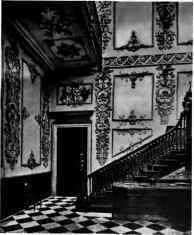
B. THE WRONG USE OF ORNAMENT APPLYING WITHOUT PURPOSE OH REASON. TUB ONLY EXCUSE BEING SHOW.
If the problem is a bedroom, I ask myself what is the bedroom for, and the answer comes: the bedroom is a place in which to rest and sleep. If this is what the room is for, anything in its furnishing and decoration that interferes materially with these two functions should be avoided. The bed, dressing-table, chair, toilet articles, etc., in this sequence, seem to be the es-sentials for such a room. Spotted wall papers, floral carpets, scattered photographs, and the like, create a series of stripes and spots that are not only ugly in their arrangement, but unrestful, undignified, and perplexing in their effect.
Continue to:


My Books

