


When, Where, And How To Decorate. Part 4
Description
This section is from the book "Interior Decoration: Its Principles And Practice", by Frank Alvah Parsons. Also available from Amazon: Interior Decoration: Its Principles and Practice.
When, Where, And How To Decorate. Part 4
The first division of this art quality is that of fitness or function, which we have discussed. This requires an element of intellectual ability on the part of the art producer. The aesthetic, or second part, refers to the knowledge and feeling regarding the relationship of forms, lines and colours that will by their combination excite an aesthetic emotion when presented to the sense of sight.
The response to the aesthetic or art quality is simply a question of becoming keen to what relations of colour, form, and line have in the best art expression succeeded in exciting the strongest aesthetic emotion. This response reveals what basic principles underlie the formation of these combinations, and, finally, determines the application of these principles to simple problems of choice and arrangement of the necessary things for any room under discussion.
Nothing is more helpful in sensing the art quality and securing a natural expression of it than to eliminate from one's mind some of the things that art is not.
First, it is not prettiness. Art is beauty, and beauty is "from within out," not "from without in." Its quality is eternal. Beauty of mind, if it exist, may express itself unconsciously in whatever one does. Some people with very homely and ordinary features are, when thinking and acting rightly, truly beautiful. Prettiness, on the other hand, is from without. It is ephemeral, and pleases the eye only. It takes no intellect and no aesthetic sense to appreciate prettiness. Second, the inordinate and blind worship of the antique is not art. If a man at seventy has retained any charm, it is in spite of his age, not because of it. Time softens and accentuates good things because their qualities are permanent. It sometimes aggravates and makes unbearable ugly things for the same reason. If this difference can be seen in persons, it certainly can be perceived in things. Let the worship of pasted labels, telling how old an article is, cease to exist, and one obstacle to understanding art will be removed. Another and more deadly mistake is the idolizing of a particular man's work. "Is it a real Rembrandt?" "Is this truly of the fifteenth century?" "Was it done by Bramante?" "Are you certain this is an authentic Queen Anne piece? " No one has ever done well all the time. Much of the work of the very greatest artists has been unworthy of them. Some work of much lesser lights has been of an excellent character. Let us see the quality of art in the object, and not the man's name or the conditions under which he made it, and there is a chance that we shall know art when it appears in the work of others or in our own.
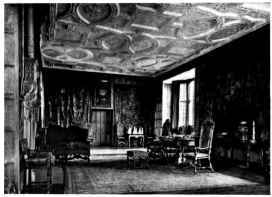
HISTORIC ROOM, ILLUSTRATING THE PRINCIPLES OF SUCCESSFUL WALL DECORATION AND CONSISTENT, STRUCTURAL UNITY IN THE ARRANGEMENT OF FURNITURE GROUPED FOR COMFORT, DIGNITY AND ELEGANCE.
It is more difficult still to disassociate art from the idea of picture painting. In the past drawing and painting have been art education. If a man studied art, expressed art, or loved art it must be through pictures only, and they were expected to belong to the school of realism and naturalism, in which not a thing was left to the imagination of the observer except, perhaps, how long it took to paint them and how much it cost to buy them. To disassociate the art quality from pictures, drawings, statuary, or any one particular medium of expression, is essential to the realization of its quality in any field.
Any discussion, however simple, of these terms seems to establish the following facts: that art is an essential quality in human life and that it is the expression of a knowledge and feeling for functional fitness and for beauty in every made thing. It should further appear that decoration is the natural expression of this art quality in objects of use and beauty, with a realization of their relation to each other, and the possibilities and limitations attendant upon the problem of furnishing a house. It should seem clear also that the structural line or build of the object is the guiding idea in the application of whatever is to be used decoratively upon the room as a background. The decorative material must not only be in harmony with the idea for which each piece stands, but it must be used harmoniously in making up the room and so expressing a complete decorative thought.
Continue to:


My Books

