


Balance. Part 3
Description
This section is from the book "The Principles Of Interior Decoration", by Bernard C. Jakway. Also available from Amazon: The Principles of Interior Decoration.
Balance. Part 3
It is clear that the general problem of the decorator is to invest his room, as a unit, with the degree of repose and steadiness essential to comfortable living, while he at the same time invests it with whatever degree of lightness, animation and subtlety best accords with the purpose of the room and with the needs and tastes of its occupants. In other words his problem, here as everywhere, is to create an effect of unity in diversity, since in the absence of such an effect beauty cannot be made to appear in his room. Knowing that bisymmetric balance, being obvious, makes for repose and unity, while occult balance makes for animation and subtlety; and knowing that the fixed decorations, as structural elements, ought to be more obvious and the non-structural more subtle, he will naturally seek to place the walls of his room in a condition approximating rather closely to formal balance. The emphasis properly to be placed upon formal balance in the wall treatment will in general be more marked (a) in a very large room, where emphasis upon structure is necessary in order to prevent the room from appearing weak and amorphous; (b) in any room intended to be markedly restrained and formal in character; (c) in a hall, or room in which people do not linger, since such a room must be made to reveal whatever it possesses of character and interest to the passing glance; and (d) in a room to be furnished with a large number of small and widely-varying elements, since such a room tends naturally to become over-complex and confusing. While no definite formula can be adduced, we may, however, consider that in the ordinary room two walls symmetrically balanced will be too few and four walls too many. Three constitute the ideal toward which to work.
Where a single opening is placed at the center of a wall, or like openings at equal distances from the center, the wall will be in balance. Where a single opening is placed at any point other than the center the wall will be out of balance, and a balance must be created either bisymmetrically or substitutionally. By the latter method a group of any desired composition - say a wall table, a mirror, a bowl of flowers and a small easel picture - will be placed against the wall on the other side of the center at a point where the total group weight seems to the mind to be equal to that of the opening. By the former method a single object - say a bookcase, cabinet, or large mirror with its supporting console bracket - of a shape and size practically identical with that of the opening, is placed against the wall at an equal distance from the center. Here the mind is far less concerned with identity in height than with identity in width. It will, for example, accept a bookcase four feet wide and five feet high as a balancing weight for a window four feet wide and seven feet high; but it will not accept a hall clock seven feet high and two feet wide, or a tapestry seven feet high and five feet wide.
In the case of two unequal openings equally distant from the center the wall will be out of balance. Where the difference in width is slight the hangings of the narrower opening can be placed far enough beyond the casing to make the apparent width of the openings equal. Where this is impracticable a balance must be created substitutionally.
In the degree that the decorator finds it possible sufficiently to emphasize bisymmetric balance in the fixed decorations of the room, he will incline toward a more occult distribution of the movables. In the degree that he finds it impossible he must minimize the effect of deficiencies in structure through a greater emphasis upon formal balance in the distribution of movables. Thus in a room having symmetrically placed openings on three sides and the fourth wall blank, he will be likely to arrange the features on that wall in an occult balance. If, on the other hand, the openings of two or three walls are unsymmetrically placed, the blank wall will normally be arranged in formal balance, since such an arrangement will tend to restore the unity and repose of the whole treatment. In formal balance the most important object will naturally be placed at the center of the wall. If there are two identical important elements they will be placed at either side of the center, at a distance determined by what use is to be made of the remaining wall space. In occult balance the most important object will be placed far enough from the center so that the mind will be in no doubt of the fact that it was not intended to be in the center, and at a distance determined by the decorative weight of the features on the other side, according to the formula that unequal attractions balance at distances inversely proportional to their weight.
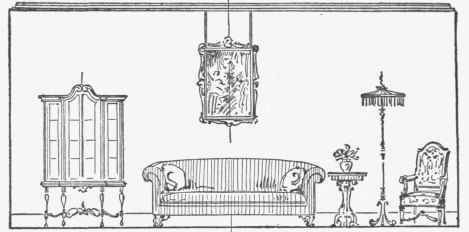
Figure 37. - The sofa and picture, constituting the most important element of the treatment, are in symmetrical balance. The cabinet on one side is balanced substitutionally by the composite group on the other side. Note however that a suggestion of symmetry is afforded by the fact that the cabinet and lamp are of the same height, and that their centers are equidistant from the center of the wall.

Figure 38. - Occult balance, poorly arranged. Note that the cabinet appears to be a little too heavy; also that both cabinet and lamp affect the mind with a sense of constraint, due to their closeness to the end walls.
In the case of a large piece, like an upright piano, to be placed against a short wall, it will sometimes happen that the piece must be placed at the exact center, even though the decorator may desire to avoid by every means the appearance of formality or stiffness in the room, since the wall space available is too short to permit the use of features sufficiently numerous and heavy to produce an occult balance. In this case he will fill the spaces at either side with features markedly dissimilar; for example, an English card-table with some small accessories at one side and a floor lamp and chair at the other. Where the weight of one group is slightly greater than that of the other, he can restore the balance while adding to the diversity of the wall as a composition by placing a single small object, as a vase or plastic figure, on the piano toward the end near the lighter group.

Figure 39. - A better arrangement of the same elements in occult balance. The decorator would in practice be justified in placing the chair so near the end wall only in the case of a window in that wall which would make the chair usable. Every arrangement of furniture must be based first of all upon a study of all the considerations of fitness to function involved.
Continue to:


My Books

