


Chapter III. The Grammar Of Decoration
Description
This section is from the book "The Principles Of Interior Decoration", by Bernard C. Jakway. Also available from Amazon: The Principles of Interior Decoration.
Chapter III. The Grammar Of Decoration
WE have seen that interior decoration is an art of selection and arrangement, working under the guidance of the faculty of taste. In practice this faculty is first employed in a comprehensive process of elimination. The decorator, having familiarized himself with what is made in furniture, fabrics, and all sorts of decorative accessories, with local market conditions and costs, and with the requirements of the house to be furnished and the needs, tastes and means of its occupants, surveys the whole body of available materials and processes and eliminates from further consideration all those which do not promise to meet adequately the requirements both of the household and the house. There remains a second process, which is to choose from the relatively small body of materials and processes remaining after this twofold elimination those which seem to possess special fitness and beauty, and to combine and arrange them in such a manner as to create a harmonious whole.
This process of combining the parts of any work of art into a whole is called composition. It constitutes, of course, the real creative problem. Writing of the art of painting, Ruskin defined composition as the help of everything in the picture by everything else, and the definition applies with equal felicity to the other arts. Poetry combines words into phrases, lines and stanzas in such ways that each word and each phrase helps all the others. Musical composition combines tones into helpful relations known as chords, and helps these chords with rhythm, timbre and expression. Interior decoration takes lines, shapes, colors and textures - or, more concretely, rugs, papers, fabrics, furniture, pictures, statuary, pottery and lamps - and so arranges and combines them in a given space that each is helpful to all the rest.
What is meant by the statement that words or tones help each other? Clearly, it can mean only that each contributes, according to its nature and in the most effective way possible, toward the expression of a common idea. Clearly, too, the parts of a furnished room can help each other only in the same way. When we say that things harmonize, or go well together, we mean, whether we are conscious of it or not, that they possess in some degree a common significance and therefore concur in the expression of a common idea. Thus if we place a long, low over-stuffed sofa upon a large, low-toned rug each will help the other because, while they do not look alike, each suggests to the mind the ideas of repose and tranquillity. On the other hand, a small Aubusson rug, or a little Kermanshah, with its light, gay colors and spirited design, could not help such a sofa, because by its very nature it suggests the ideas of animation and buoyancy. Used together rug and sofa would oppose or contradict each other, and only a meaningless confusion of ideas could result.
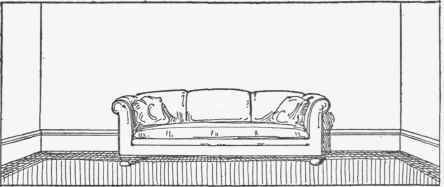
A.
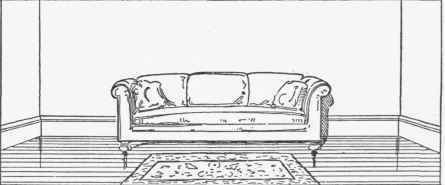
B.
Figure 3. - The long low davenport arouses in the mind a sense of repose and tranquillity. A large low-toned rug or carpet (A) suggests the same ideas; while a small light rug (B), especially when it reveals a pattern made up of spirited curves, suggests the contrary ideas of animation and buoyancy.
It appears, therefore, that in order to make the furnishings of a room harmonize, or help each other, the decorator must see to it that they concur in the expression of a common idea. Accordingly he must first of all decide upon a dominant idea to be expressed by the finished room. Having done so, he must choose and combine in the room such things as suggest or help to affirm that idea, and keep out any considerable number of things that suggest an inharmonious or contrary idea. This is the beginning of every process of decorative composition. To undertake it successfully the decorator must know, first, what ideas, or what kind of ideas, can be expressed by his art, and secondly, how they can be expressed.
It is clear that interior decoration, being a part of architecture, can neither set forth an appearance of nature, as can painting and sculpture, nor tell a story, like poetry or the drama. Nor can it, like music or the dance, express complex and changing emotional states. It can, however, adequately express simple emotional ideas ranging through a fairly long gamut. Thus a room may be made bright or somber, grave or gay. Given a suitable architectural background, the decorator can create at will a restful living room, a gay and brilliant ball-room, a solemn church or lodge-room. Rooms may be made dignified, sumptuous, simple, informal. Their emotional quality may be varied from repose to animation, from stateliness to abandon, from rough homeliness to elegance or daintiness. Obviously the choice of the dominant emotional idea for a given room will be determined in practice chiefly by such considerations of fitness as the purpose of the room and the tastes of its occupants. The point to be pressed here is that, however chosen, some definable emotional idea must underlie and condition the decoration of every artistically furnished room. Good composition, in decoration no less than in the other creative arts, can never be fortuitous - never the product of chance or the play of circumstance. However simple or complex its processes, it must always result in expression. Every great composition in any art is thus built upon a motive, in the expression of which all its chief lines, colors or sounds concur, as the sweeping diagonals and vigorous curves of the Winged Victory of Samothrace concur in investing even the broken remnant of the figure with the idea of imperious and triumphant motion.
A room, however, unlike a picture or a sculptured form, is not complete in itself. It is complete only when there are people in it. and it is decorated not alone to make it harmonious and beautiful, but also - and primarily - to make it a sympathetic and pleasing background for the people who use it. For this reason its emotional quality must not be too strongly emphasized, lest there be lack of harmony with the changing moods of its occupants. Nevertheless every beautiful room, as the first condition of its being, must be built around a dominant motive, and a great part of whatever subtlety and charm its decorative treatment may possess for the person of cultivated taste will depend upon the skill with which this motive is expressed. The child is happy with his blocks; delighted when he is able to find among two dozen strange and meaningless characters the big I or O or S that he has been taught to recognize; content to put the letters together into a meaningless jumble. But when he grows older he will want to see meaning in things. Letters will interest him because they are symbols with which words are formed, and words because they in turn are symbols which, properly grouped, give expression to ideas. It is the same with man and his house. A man may choose and arrange the furnishings of his rooms without reference to their significance because, like the child with his blocks, he does not understand their significance. But in so far as interior decoration is a real creative art it must be concerned with the expression of ideas; and in so far as a man has in his esthetic perceptions put away childish things he will be conscious of these ideas and keenly interested in the manner of their expression.
Continue to:


My Books

