


Color. Part 2
Description
This section is from the book "The Principles Of Interior Decoration", by Bernard C. Jakway. Also available from Amazon: The Principles of Interior Decoration.
Color. Part 2
Instead of uniting any two of the primaries to form binaries, or colors partaking equally of the qualities of their components, we can of course unite them in different proportions to form other hues partaking unequally of these qualities. Thus red can be made dominant in a mixture of red and yellow in a degree that will produce red-orange, a color sharing equally the qualities of red and of orange, and therefore properly lying midway between those colors on the chromatic circle. Similarly, yellow may be made dominant in a degree to form yellow-orange, lying midway between orange and yellow. This process can be continued indefinitely, since it is manifest that any two primaries can be united in any proportions whatever, thus obtaining in theory an infinity of hues differing by infinitesimal gradations. Most of these hues have not been standardized or named. Chevreul, the pioneer in color theory, divided the chromatic circle into seventy-two parts. Ridgeway, whose Color Standards and Nomenclature is an extraordinarily painstaking and most valuable work, makes a division of the spectrum hues - including those hues between violet and red, which do not appear in the solar spectrum - into thirty-six colors, which are here given in their order from red through orange, yellow, green, blue, violet and back to red. The letters R, O-R, OO-R, and so on, indicate the proper positions of the hues in the circle, as well as the relative proportions of the two components in each hue. The names are those employed by the author.
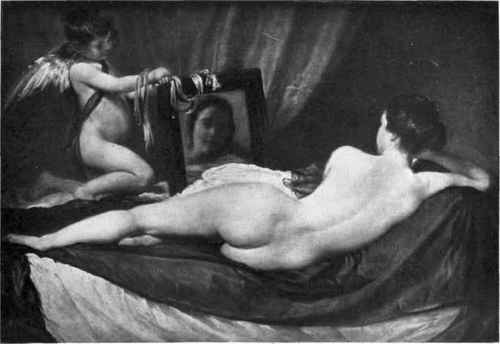
Plate V. - Velasquez: The Rokeby Venus. Note the repose of horizontal lines; the grace, softness and buoyancy of curved lines; the subtle beauty of curves repeated, opposed and balanced; the contrast introduced by the rectangular frame; and the manner in which this contrast is softened by the curved ribbons, the reflected face, and the fact that the mirror, like the body of Cupid, is perpendicular to the body line of the Venus.
Courtesy of the National Gallery.
Red | Spectrum red |
0-R | Scarlet red |
00-R | Scarlet |
R- O | Grenadine red |
OR - 0 | Flame scarlet |
Orange | Orange chrome |
OY - O | Cadmium orange |
Y - O | Orange (the color of the fruit) |
O - Y | Cadmium yellow |
YO - Y | Light cadmium |
O - YY | Lemon chrome |
Yellow | Lemon yellow |
YG - Y | Greenish yellow |
G - Y | Bright green yellow |
GG - Y | Neva green |
Y - G | Yellow green (slightly lighter than Cossack) |
GY - G | Night green |
Green | Emerald green |
GB - G | Vivid green (slightly lighter than Vari-dian; lighter than Chrysoprase) |
B-G | Skobeloff green |
BB-G | Benzol green |
G-B | Italian blue |
BG-B | Cerulean blue |
G-BB | Methyl blue |
Blue | Spectrum blue (lighter in tone than ultramarine) |
BV-B | Bradley's blue |
V-B | Phenyl blue (slightly lighter than Smalt blue) |
B-V | Blue violet |
VB-V | Bluish violet |
Violet | Spectrum violet (slightly lighter than royal purple) |
VR-V | Amethyst violet |
R-V | Violet purple |
RR-V | Purple (true) |
V-R | Rhodamine purple |
RV-R | Tyrian rose |
V-RR | Rose red (slightly lighter than pomegranate; slightly darker than rose color) |
Each hue thus formed by the mixture of two primaries, in whatever proportions, will have the same intensity as the primaries themselves; and since these pure colors are intolerable except in the smallest areas, we must in color work change their character by adding black, white, or gray, or by neutralization through the use of complementaries. Thus, by adding a little black to each color in the chromatic circle we obtain a new circle of colors, slightly darker and duller than the original hues. By adding a little more black we obtain a second circle, still darker and more dull; and this process can be continued until the amount of black in the mixture renders the original hues practically indistinguishable. Another series can be produced by adding white in progressively increasing quantities to the spectrum hues, up to the point where the original colors become the palest of tints and practically indistinguishable, like the colors on the inside of a shell. Chevreul, in the color plates included in Des Couleurs, makes the change by regular ten per cent. increases in the quantity of black or white. Ridgeway gives a typical eight interval scale, starting with spectrum red and ranging downward to black and upward to white:
Tone | Percentages | ||
White | Red | Black | |
White | 100 | ||
Hermosa pink | 45 | 55 | |
Eosine pink | 22.5 | 77.5 | |
Begonia rose | 9.5 | 90.5 | |
Spectrum red | 100 | ||
Carmine | 55 | 45 | |
Oxblood red | 29.5 | 70.5 | |
Victoria lake | 12.5 | 87.5 | |
Black | 100 | ||
In addition to these scales produced by the addition of varying quantities of black or white to the spectrum hues, we can produce new colors by adding to each of the spectrum hues definite and increasing amounts of neutral gray, the effect of these additions being, not to make the colors increasingly darker or lighter, but rather to make them increasingly less pure and more grayish. The table below, which, together with the one that follows, is also taken from Ridgeway's work, illustrates the process as applied to spectrum red:
Color name | Percentages | |
Red | Neutral gray | |
Spectrum red | 100 | |
Eugenia red | 68 | 32 |
Dark vinaceous red | 42 | 58 |
Livid brown | 23 | 77 |
Purple drab | 10 | 90 |
Neutral gray | 100 | |
Using any one of these grayed-out variants of the spectrum hues as a base we can in turn construct a new scale ranging in value from black upward to white:
White Venetian pink.
Alizarine pink.
Old rose Eugenia red Acajou red Vandyke red Hay's maroon.
Black.
White.
Pale vinaceous.
Vinaceous.
Deep vinaceous Dark vinaceous Hydrangea red Mineral red Dark mineral red.
Black.
White.
Pale purplish vinaceous Light purplish vinaceous Purplish vinaceous Livid brown Deep livid brown Dark livid brown Warm blackish brown.
White.
Pallid purple drab.
Pale purple drab Light purple drab Purple drab Dark purple drab Dusky brown Blackish brown.
Black.
If we take a considerable quantity of orange cadmium paint and add to it a very small amount of ultramarine blue, the orange will immediately lose a little of its purity and become slightly more grayish, and it will continue to grow progressively less orange and more gray as the amount of blue in the mixture is progressively increased, until finally all trace of orange disappears and nothing remains but a neutral gray. Any two hues which thus complete each other in the production of neutral gray are called complementary colors. In the chromatic circle each one of a pair of complementaries lies directly opposite the other, since each is made up of a hue or hues which have no part in the composition of the other.
It is obvious that a pair of complementary colors will neutralize each other completely - that is, they will unite to form a colorless gray - only when they are mixed in a certain proportion, and that when they are mixed in any other proportion the result will not be a neutral gray, but a more or less grayish tone of the hue which is in excess in the mixture. An unlimited variation in these stages of neutralization is therefore possible, but for the sake of clearness three stages are ordinarily recognized in decorative practice. Thus we speak of full intensity colors, and of colors of three-fourth, one-half and one-fourth intensity. The resulting colors are in intensity the same as would be produced by the addition to the spectrum hues of one, two, and three parts of neutral gray. Thus the pure scarlet of the spectrum becomes, when reduced to three-fourths intensity, coral red. When reduced to one-half intensity it becomes Etruscan red; while at one-fourth intensity it is a deep brownish mauve.
It is clear from the preceding discussion that the colors differ from each other in several ways, and that to speak of a color as red, or blue, or violet is to communicate to the mind of the auditor a very incomplete and inaccurate idea of the real nature of the color. In fact a color, in order to be accurately characterized, must be described in terms of three different attributes, called the color constants. These constants are hue, purity or intensity, and luminosity or value.
Hue is that property of a color which depends upon its optical composition, and determines its position in the chromatic circle. Thus red, orange, yellow-green, blue-violet and purple are hues. Normal hues are hues which approach as closely as possible in pigments to the colors of the solar spectrum. Emerald is the normal hue of green, and grenadine red the normal hue of red-orange. Colors which are darker than the normal hue are called dark colors; those which are lighter than the normal are called light colors. Those variations of a hue which are produced by the addition of black to the normal are called shades of that hue; while those formed by the addition of white are called tints of the hue. Thus carmine is a shade of red and begonia rose is a tint of red.
Continue to:


My Books

