


Light And Shade. Part 2
Description
This section is from the book "The Principles Of Interior Decoration", by Bernard C. Jakway. Also available from Amazon: The Principles of Interior Decoration.
Light And Shade. Part 2
Light in a room may be either direct or indirect. That is, it may reach the eye directly from its source, or it may be reflected and diffused by the walls, ceiling, or other surfaces of the room, the illuminating agent remaining out of sight. The dynamic, vitalizing power of light is peculiar to radiant light. Reflected light does not possess it. Thus a room lighted by reflected or diffused sunlight, though it may be cheerful and serene, can never possess the joyous, animating quality of a room which receives the direct rays of the sun. Nor can indirect artificial light, no matter how powerful its source, kindle a sense of gayety and excitement. There would be the same difference between a ballroom lighted, however skillfully, by the indirect method, and one lighted by crystal chandeliers, that there would be between dance music played with open and with muted strings. Indeed, the charm of any room depends largely upon the skillful use of radiant light. By night this light may come chiefly from ceiling fixtures, or from wall brackets, or from lamps. It may flood the whole room, as in a ballroom, or it may, as in a living room, be so shaded as to illuminate merely the keyboard of the piano, the corner of a reading table, or the arm of an easy chair. But unless there is somewhere the gleam of light radiated directly from its source, there can be no vivacity or brilliancy of effect.
It is clear that the illumination of a given room will depend, first, upon the amount and character of the light admitted to the room by day or generated therein by night, and, secondly, upon the relative luminosity and power of reflection of the surfaces by which the light is diffused. If little light is admitted or generated the room will be relatively dark; and if little light is reflected the room will still be relatively dark, however great the amount of light admitted. Whatever light finds its way into a room is reflected and diffused chiefly by the walls and ceiling, and this diffusion will vary in direct proportion to the luminosity, height of tone, and smoothness of texture of those surfaces. Smooth white walls will yield a maximum reflection of light, and rough black walls a minimum. Between these two extremes the gamut of grays will vary in luminosity according to the amount of black in the mixture.
Textures vary widely in their power of reflecting light. Nearly all wall papers absorb more light than does paint, because of their relatively open textures; but the variations among different classes of papers, as among different classes of cloth fabrics, are too irregular to admit of classification. It is always wise in practice to test a given texture under the light with which it is to be used, if there is the least doubt as to how it will act. In general, it will be found that any paper or fabric, hung in large areas, will look distinctly darker than the sample looked in the shop, so that the total effect of the room will be lower in tone than was expected.
The differences in luminosity among the various hues, apart from considerations of tone and texture, are very great. These differences are illustrated graphically, though with approximate accuracy only, in Figure 42. Study of the curve of luminosity reveals, for example, that normal red, violet and blue reflect very little light, while normal yellow reflects a great amount; that yellow-orange is almost four times as luminous as red-orange; yellow-green six times as luminous as blue-green; while normal yellow is almost twenty times as luminous as normal red. Inasmuch as the luminosity of the light-reflecting surfaces is a factor which largely determines the amount of light, either natural or artificial, necessary to bring a room up to a desired degree of illumination, it is evident that the importance of this factor in choosing the color of background surfaces can hardly be over-estimated. Where the amount of light available by day is limited by the situation or fenestration of the room, or the amount available by night is limited by considerations of economy, luminous colors and firm, smooth and light-reflecting textures must be chosen.

Plate VII. - Finely-designed wing chair, revealing sound proportions and a rhythmic flow of like curves. Note that this curve is echoed in the covering; that the pattern, which serves to enrich the chair, is set off by contrast with the plain outside back and arms; and that the structural lines are defined by a properly made gimp.
Courtesy of Gill & Reigate Ltd., London.

Figure 42. - Curve representing graphically the relative luminosity of the spectrum hues in their normal intensity.
In determining the nature and distribution of light desirable in a given room, and the height of tone desirable in its various colored surfaces, the general problem of the decorator is five-fold. He must determine (a) the intensity and character of illumination most fitting for the particular room to be lighted; (b) the height of tone desirable for the background surfaces; (c) the distribution of light and dark tones as to position in the room; (d) their distribution as to relative area; and (e) the distance by which the principal and secondary tones must be separated in order to yield the maximum esthetic effect.
The first consideration was discussed in an earlier paragraph of this chapter, wherein it appeared that within the limits imposed by the physical comfort of the eye the amount and brilliancy of the light desirable in a given room will depend upon the function of the room, and hence upon the motive of its decorative treatment.
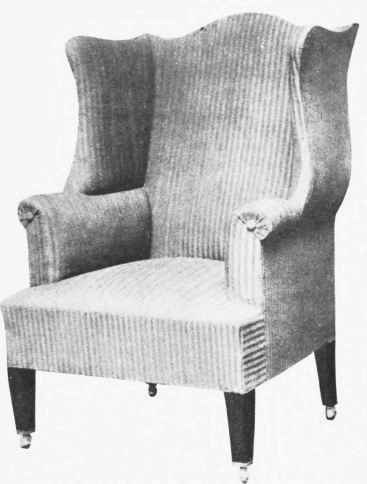
Plate VIII. - Wing chair in which the flow of curved line is abruptly broken by the use of straight legs and base. Note the difference in richness between plain and ornamented surfaces by comparing this chair with the one in Plate VII.
Continue to:


My Books

