


Ninth Exercise
Description
This section is from the book "A Laboratory Course In Wood-Turning", by Michael Joseph Golden. Also available from Amazon: A Laboratory Course In Wood-Turning.
Ninth Exercise
Material
Gum or cherry disk, 7 1/2" diameter, 1" thick.
Exercise
To turn the material to the form and dimensions shown in Fig. 82.
Fasten the disk to a face-plate with 1-inch screws, and then turn the face smooth and the edge true, making it to be 7 inches in diameter. Next, turn a recess in the face 4 1/4 inches in diameter and | inch in depth, and when this is done remove it from the faceplate. Put on instead of the disk just turned a pine one 5 inches in diameter, and turn from it a chuck to fit tightly into the recess turned in the first disk. Put the disk on the chuck, and turn its edge to the form shown in Fig. 83, after which round the fillet to the form shown by the dotted line, using the 1/4-inch skew chisel. Next cut the recess shown at [A].
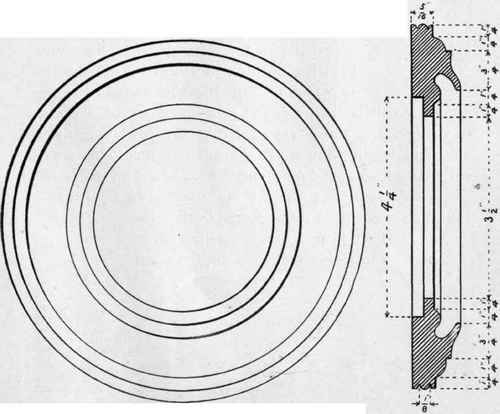
Fig. 82.
The curve shown at [b] in Fig. 84 is cut with the 1-inch gouge, used as a scraping tool. When using a gouge as a scraping tool, have the cutting portion of the edge supported on the rest. If, while the gouge is in the position shown in Fig. 85, the cutting is done with the part marked [a], the tendency will be to press [a] down, and so roll the cutting edge into the work, rendering the edge unmanageable and tearing the work. Undercut the inner curve with the 1/4-inch round-nose chisel, held as shown in Fig. 86, where the manner in which it is supported by the tee rest is also shown. After the undercut portion has been turned, round the fillet left on the inside and then cut the opening at the centre through, using the parting-tool. Next cut the bead around the edge of the disk with the acute corner of the 1/4-inch skew chisel, using it as a scraping tool. All 'of these cuts are shown in Fig. 86.
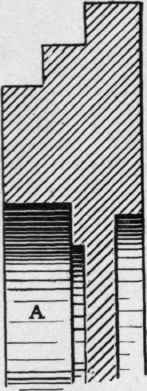
Fig. 83.

Fig. 84.
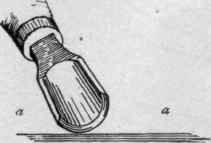
Fig. 85.
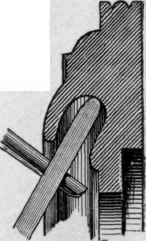
Fig. 86.
Varnish and polish the work, and then remove it from the chuck.
Turned pieces of this character are used principally in making wooden patterns for metal castings, and in cabinet work and the interior finishing of buildings.
Continue to:


My Books

