


Wood. Part 4
Description
This section is from the book "Design and Construction in Wood", by William Noyes. Also available from Amazon: Design And Construction In Wood.
Wood. Part 4
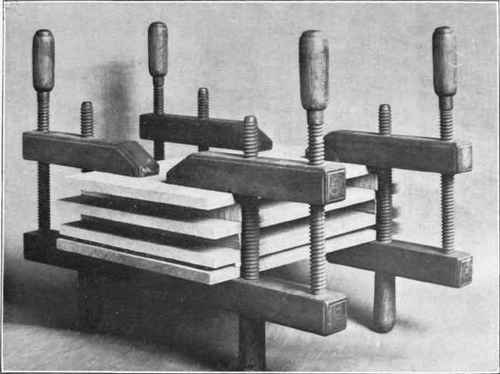
Fig. 5. Clamping up boards to keep them from warping.
Mahogany is a general name covering a number of species, all of which are imported. The chief varieties are Central American mahogany, African mahogany, Mexican mahogany, East Indian mahogany (vermillion wood or padouk), and Spanish cedar. These varieties are somewhat alike in color, a reddish brown, the annual rings are inconspicuous, the pores are scattered, and few woods take glue better. They vary considerably in hardness, in difficulty of nailing, and in shade of color. The common uses are furniture and interior finish. The grain is very likely to be variable, causing a very pleasing, changeable, reflection of light. Price in N.Y.C., 1913, $185 per M. In the following studies, the woods just described will be recommended.
It is impossible to give explicit directions for laying in a supply of wood. Some varieties of wood may be plentiful in certain places, others may be scarce and hence expensive. Some workers may be able to obtain the wood in nearly the sizes wanted; others may be compelled to purchase whole boards. Some may have a dry storage room of ample size, as, for instance, an attic; others may be compelled to store their lumber in a damp cellar. In general it may be said that one should buy only what he can take good care of. Where any quantity of lumber is stored, it should, if possible, be "stacked," that is, piled flat, each board separated from its neighbors by small cross sticks to allow free circulation of air. If possible, there should be a weight on the top board. Where only a few boards are to be put under pressure, it is often convenient to clamp them together with hand screws, as in Fig. 5.
Bibliography
Filibert Roth. Timber. Bulletin No. 10, of the Forestry Service, Washington, D. C. (May be secured from the Supt. of Documents, Washington, D. C, for IOC.) A brief, accurate, and non-technical but comprehensive study of the structure and properties of woods, with a description of common varieties and a key to their study.
Katherine Golden Bitting. Woodcraft, June-Sept. '06.
William Noyes. Wood and Forest. Manual Arts Press, Peoria, II.
Continue to:


My Books

