


Woodworking Machines. Part 4
Description
This section is from the "Educational Woodworking For Home And School" book, by Joseph C.Park . Also see Amazon: Educational Woodworking For Home And School.
Woodworking Machines. Part 4
94. Formulae Used In Selecting Belts
To Determine The Horse Power Of Belts
Horse Power = Working Tension x Width x Speed
33000
To Determine The Working Tension
Working Tension = Horse Power x 33000. Width x Speed
To Determine The Width Required To Transmit Given Horse Power
Width = Horse Power x 33000
Speed x Working Tension
To Determine Speed
Speed = Horse Power x 33000
Width x Working Tension
95. Belt Lacings
Belt lacings are strong leather strings usually made from Calcutta cowhide, which is very tough, or from the best native cowhides, and are used in fastening the ends of a belt together. They should not be too large. A small lacing properly used is more effective than a large one improperly used. Figs. 135, 136,137, and 138 show different methods of lacing belts.

Side next to pulley.

Reverse side.
Fig. 135. Old style lace.
96. Old Style Lace.1
Punch the holes as shown in Fig. 135, the first hole about one half an inch from edge and about seven eighths of an inch apart, the first row about five eighths of an inch from end of belt and the second row about three quarters of an inch back of the first row. Commence in the center and lace both ways to the edge of the belt with a single lace and then back to the center, having the lace straight on the pulley side of the belt and the cross on the reverse side of the belt. Use a small belt punch and small lacing.
1 The writer has permission from Bickford & Francis Belting Company, Buffalo, N.Y., to use the cuts showing different styles of belt lace; also much of the information on belts came from them.
97. New Style Lace
This style of lace is recommended as being one of the strongest and most serviceable for general use. A much smaller hole and lace can be used and still give greater strength, and, according to the arrangement of the holes, the belt is weakened less than with almost any other method of lacing.
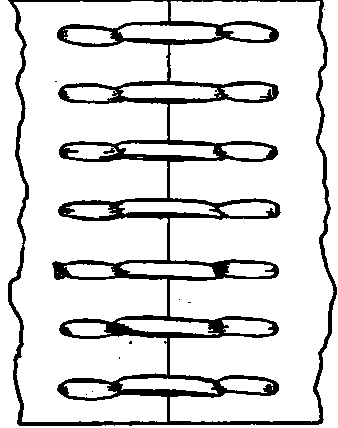
Side next to pulley.

Reverse side.
Fig. 136. New style lace.
For this method of lacing use 1/4 or 5/16 inch lace for single belts and 3/8 inch lace for double belts, except on extra large driving belts. Punch the first hole at least one half of an inch from the edge of the belt and about five eighths of an inch from the end. The centers of the holes should be from three quarters to one inch apart, depending upon the width of the belt. The second row should be directly back of the first row and about three quarters of an inch distant. Commence at the center and lace both ways to the edge, using only the first row of holes. In working back to the center the second row of holes is used, giving a single strand of lace between the first and second rows and a double strand between the two rows nearest the end of the belt. The straight lace should always be on the side next the pulley and the cross lace on the reverse side.

Fig. 137. Single hinge lace.

Fig. 138. Double hinge lace.
98. Single Hinge Lace
In this style of lace a small hole and a small lace should be used. The holes should be about one half of an inch from the end and edge of the belt and the same distance apart. The corners should be taken off both sides of the ends of the belt to prevent cutting the lace. Begin at the center and lace towards the edge, as shown in Fig. 137. Where belts run over small pulleys, this method is very effective, as the joint is very pliable.
99. Double Hinge Lace
The same size punch and lace should be used as in the single hinge joint. The first row of holes should be about one half of an inch from the edge and end of the belt and three quarters to one inch apart. The second row should be about three quarters of an inch back of the first row and arranged as shown in Fig. 138, page 117.
100. Belt Hooks
Belt hooks are metallic hooks used in fastening the ends of a belt together. They are especially desirable on short belts because they will not stretch.

Fig. 139. Belt hook.

Fig. 110. A simple method for lining up quarter twist belts. A, driving pulley; B, driven pulley; C, driving side of belt; D, driven side of belt; E, driving side driven pulley; F, Driven side driving pulley.
Continue to:


My Books

