


Lathes
Description
This section is from the "Elementary Turning" book, by Frank Henry Selden. Also available from Amazon: Elementary Turning.
Lathes
Fig. 287 illustrates a modern all-metal lathe for wood turning. Such lathes may be adapted to the working of brass and soft metals.
In elementary turning, all you have to deal with is the adjustment of the tee rest and the tail-stock; the changing of the belt to a suitable speed, and the exchanging of the live-center for face-plate, or vice versa.
Your lathe may not be exactly like the one shown in the picture, yet all woodworking lathes for hand turning are similar. The one shown in Fig. 288 is quite equal to an all-metal lathe for many kinds of work. By comparing the two you will notice that the cones are not placed alike, and also that the oil holes are not in the same position. Fig. 288 shows the parts of the lathe except the wooden bed or

Fig. 287. Iron Bed Turning Lathe.
A Set Screw. B Tee Rest Stand. C Cone Pulley. D Dead-center. E Clamp Handles. F Face-plate. H Clamp Screw. I Crank Handles. L Live-center. O Oil Holes. S Shoe. T Tee Rest.
shears. The long bolts are for securing the head-stock, tail-stock, and rests to the bed. Two tee-rest stands are shown. There is also a double tee rest for long work. In elementary turning there is so seldom need for a long rest that usually none is provided and instead, two short ones are set side by side as shown in Figs. 239 and 243. The lathe shown in Fig. 287 has an oil cavity under the bearing, so arranged that the oil is fed up to the bearing as required, and hence a quantity of oil is put into the reservoir once in a long time.
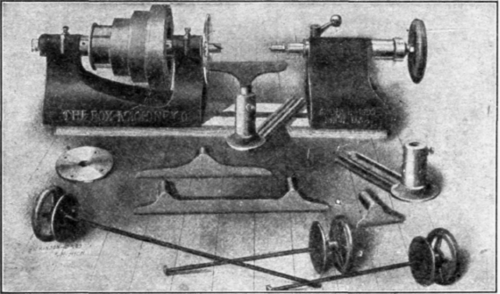
Fig. 288. Wooden Bed Turning Lathe.
Most lathes are oiled as shown in Fig. 288, and require oiling once or twice for every ten hours of running. Watch your lathe bearings by touching them with your fingers, and if they are hot, report it to the instructor. Sometimes all that is required to cool them is a few drops of oil, but at other times it is necessary to adjust the boxes. You should not attempt to make any adjustments of the bearings unless you are sure that you will do no harm.
Continue to:


My Books

