


54. Edge Joint. Continued
Description
This section is from the book "Elements Of Construction", by Charles A. King. Also available from Amazon: Elements of construction.
54. Edge Joint. Continued
6. Unless both pieces are perfectly fair and " out of wind " (i as in kind), that is, unless they will lay perfectly flat upon a true surface, it is impossible to make a joint which will stand this test of the try-square; and by this method, if the boards are a little winding or twisted, as they are very apt to be, they may be averaged to make the finished board more nearly true than would be practicable if its accuracy depended upon a try-square.
7. In testing the two members of a joint for accuracy, place their edges together with nothing to hold them, as shown in Fig. 99, and move piece a back and forth a little, sideways; if there is a lump upon either edge, a will swing upon it as upon a pivot, as at k. The same test should be applied from each end, and the defect carefully remedied.
8. To obtain the best results in gluing up a wide board, the center of the joint should be a very little open, as explained in A of this exercise. If this is well done, a short board may be glued up with but one clamp to hold it together, instead of with three or four clamps, which would be necessary if the joint were made perfectly straight.
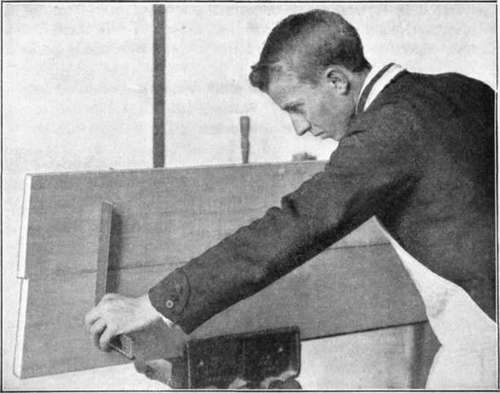
Fig. 98. - Testing the Faces of the Pieces.
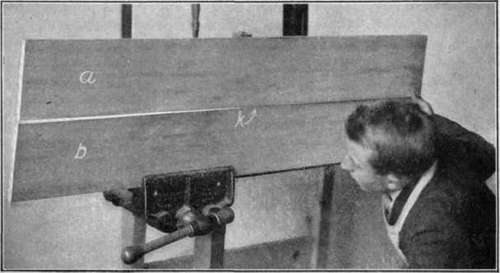
Fig. 99. - Testing the Joint.
G. Rub joint: Method 4. This joint, which is sometimes used in gluing up wide boards, is made by fitting two edges together, so that they will bear equally their entire length. The glue is then put on and the pieces rubbed back and forth endways until the glue is well rubbed out of the side of the joint or into the wood. In doing this, care should be taken that the sides of the boards are kept flush; therefore this form of joint can be used only with perfectly straight stock. After the joint is made, the board should be set away until the glue is thoroughly hardened, until which time the board should be handled very carefully, as a sudden jar or blow may break the joint. If well made, this joint is as strong as any unreenforced square-edged joint.
H. Gluing: In all glue joints, except the rub joint, the pieces should be fitted and held wood to wood with clamps, or hand screws, until the glue sets. The glue should all be squeezed out, as there is very little strength in a joint which shows a fine line of glue.
To repeat and emphasize B, it is the glue which enters the pores of the wood of each member of the joint that gives the joint its strength, and if the joint is not perfectly fitted, a quick rap or exposure to a sudden change in temperature is liable to break it open.
I. Preparation for smoothing : After the glue is set, which will take at least three hours for hot glue, or twelve hours for cold glue, the superfluous glue upon the surface of the board should be cleaned off, and the board trimmed to the required size when it is ready for smoothing. For smoothing a surface, see Topic 17.
J. Sandpapering: In making ready for the sandpaper, do not depend upon the sandpaper to make the work smooth, as it is easy to scour a hole in the surface. Although this may seem of no importance, when the finish is spread, it may be very prominent, and will always stand as an evidence of unskillful work. The smoothing plane and the scraper are the tools which should do this part of the work. For the use of the latter tool, see Topics 29 and 30.
In using sandpaper, a sheet should usually be torn in halves the short way of the paper; if it is to be used upon a flat surface, one half should be folded back to back, and held, not tacked, around a block about 3" X 4" X 7/8" with the hand, as in Fig. 100.
The act of grasping the block with sufficient force to hold it while at work will keep the sandpaper in its place. The use of any device to fasten it there is an unmistakable mark of the novice, as the workman realizes that his time is too valuable to spend upon anything so useless as tacking a piece of sandpaper to a block or using any of the devices that some amateurs consider an advantage. A sandpaper block should always be used upon a flat surface, and the smaller the surface, the more need there is of a block.
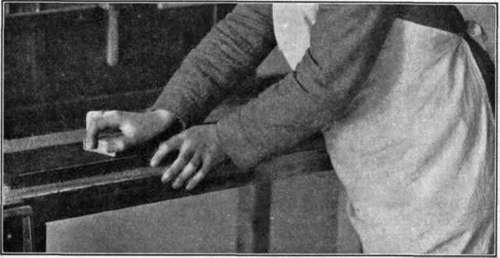
Fig. 100. - Method of Grasping Sandpaper.
If there is much sanding of moldings to be done, it is best to make blocks to fit their curves, as it is hard upon the hands to do this work very long at a time, though nothing has ever been devised which fits irregular forms as well as the fingers. Never use sandpaper upon a piece of wood until all of the cutting upon it with edge tools has been done, as the particles of sand will enter the grain, and any edge tools used upon it afterwards will be dulled quickly.
1. In using sandpaper, the workman should guard against rounding square corners or destroying the form of curved or flat surfaces, a raw corner, however, should always be removed with a few light, careful strokes, as otherwise, if it is square, it will be more or less ragged. When this is well done, it is one of the evidences of skillful workmanship.
2. Do not use a piece of sandpaper so large as to prevent any part of it from being under perfect control, for the loose ends will scratch the wood, and it has an awkward and unworkmanlike appearance.
3. Always work parallel with the grain, and be sure that all plane marks and uneven places are well rubbed down. In order to do this, it is often necessary to use considerable muscle. This part of the work requires good judgment, for unless sandpapered thoroughly, there are apt to be places which will show when the finish is spread on the work, though they may have been invisible before. No one can tell as well as the workman himself when he has sandpapered enough, though it may be evident to any one if it has been done injudiciously, and one or two careless strokes may destroy an otherwise good job.
Upon a coarse job it is usually allowable, and sometimes desirable, to sandpaper across the grain, especially if the work is to be painted.
Too much care cannot be taken in the use of sandpaper, especially upon the part of the amateur, for he is more liable to injure his work than to improve it.
Continue to:


My Books

