


82. Coat Hanger
Description
This section is from the book "Elements Of Construction", by Charles A. King. Also available from Amazon: Elements of construction.
82. Coat Hanger
Coat Hanger. Fig. 156. (See Handbook: Fig. 18.)
Material:
1 piece, 15 1/2"X 2 1/2" X 7/8".

Fig. 156. - Coat Hanger.
A. Drawing curves through given points: Make the piece square and parallel, and mark the intersections of the curves upon it from the dimensions given; these marks should be made upon the face side, as shown in the sketch, and curves should be carefully drawn through the intersections, as indicated. They should be drawn free hand; by resting the elbow upon the bench, and using it as the center of an arc, an almost perfect curve may be made. In working down to these marks with a compass saw, or with a frame or turning saw, care should be used that the marks are not cut off. (A frame saw is simply a small bucksaw ; it is preferred by many workmen for nearly all purposes for which a compass saw would ordinarily be used, as it does not bend nor break so easily, and the arc of a smaller circle may be cut.)
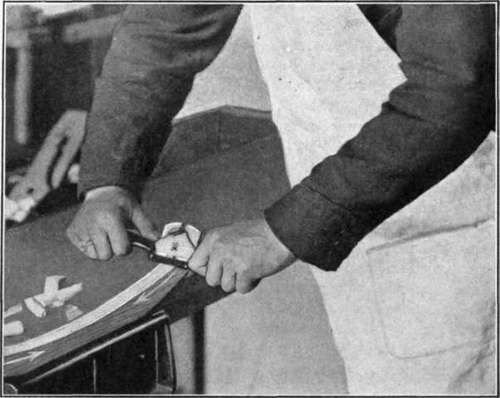
Fig. 157. - Use of the Spokeshave - Taking Advantage of the Grain.
B. Sawing "under": It seems that every novice has an irresistible tendency to "cut under" in a case of this sort; that is, to make the back side of a piece of work smaller than its face: the result of this is, that the piece must be cut below size, or the edge finished out of square, neither of which is permissible. To prevent this, the edge of the blade should be carried as nearly as possible at right angles with the face of the board, and about 1/8" outside of the mark.
C. The grain: Study the direction in which the grain runs, and as the spokeshave is to be used, the student should be careful to work in the direction in which the tool cuts without tearing the grain. The method of grasping the spokeshave is shown in Fig. 157, and the direction indicated by the arrows should be the direction of the cut of the spokeshave upon the inside of the model. If these directions, are reversed, the wood will generally be badly torn, as the cut will be against the grain. Upon the outside of the coat hanger, the stroke should be made from the middle to the end.
D. Use of the wood file: This is the first model upon which the wood file should be used, and here only in smoothing off a curve after the spokeshave has done all that it can. Unless care is exercised with this tool, the sharp corners of the work may be chipped off and destroyed.
E. Machine planing: Boards which have been run through the planing machine are not ready for the sandpaper; they should always be smoothed with a smoothing plane, as it is almost impossible to remove with sandpaper the minute ridges which are left by the planer at right angles with the grain of the wood.
F. Smoothing and sandpapering: The term "smoothing" applies only to planing; if sandpapering is meant, it will be noted separately.
This model should receive a shellac finish, well rubbed down; one coat of shellac will be enough, if it is not too thin, and provided it is finished with wax finish and well rubbed.
Continue to:


My Books

