


91. Medicine Cabinet
Description
This section is from the book "Elements Of Construction", by Charles A. King. Also available from Amazon: Elements of construction.
91. Medicine Cabinet
Medicine Cabinet. Fig. 175. Material: Poplar (Whitewood).
In making this model, the top, bottom, and two sides should be made first; and the rabbet, shown at a, should be cut before the pieces are nailed together, stopping the rabbet in the top and bottom at nearly the place where it will intersect with the rabbet d of the sides, so that when the case is nailed together, the back, b, will fit into both rabbets. The location and use of the various pieces will be seen by a careful study of the sections.
A. Movable shelves: In preparing the ratchets, c, which allow the shelves to be placed where wanted, cut a 7/8" piece the same length as the sides of the case, and wide enough to allow all of them to be cut from it, say 2 1/4". With a sharp knife, lay out the cuts, d, across the piece, as shown at A, Fig. 176, marking their depth with a gauge. Make the cuts with a backsaw, and remove the wood between them with a narrow chisel. With a sharp ripsaw, cut the pieces as indicated by dotted lines, e, and plane them down to 3/8" or 5/16" uniform thickness. Allow wood enough to insure that there will be little danger of planing them too thin. The ratchets, c, Fig. 175, are placed against the back, b; and the door stile, e, as indicated at the section of the side, at K. The cleats, j, are cut between the ratchets, c. Cut these from a piece about 4" wide, as indicated at F, Fig. 176, the seven dotted lines showing where the pieces should be ripped, after the ends, t, t, have been cut. They should then be planed to the same thickness as the ratchets, c.

Fig. 175. Medicine Closet.
B. The door: The pieces for the door should be about 1/8" wider than needed, to allow the door to be planed to a fit after it has been made. The stiles, especially, should be longer than needed, so that they may be sawed off after the door is glued up. The door may be either doweled or mortised together, and the glass or wood panel held in by the same method as in the screen. See Fig. 169.
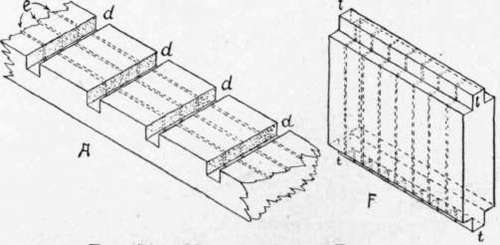
Fig. 176. - Medicine Closet Details. A, Method of cutting ratchets. F, Method of cutting cleats.
C. Accuracy of case and door: Care must be used, in setting up the case and the door, to have them both square and out of wind; the latter may be proved by sighting across them. If the faces of the two stiles of the door coincide, and the front edges of the sides of the case appear the same, they will be all right.
D. Fitting the door: The door should be carefully fitted so that it will fall back of the front edge of the sides, or have a sinkage of about 1/16", as shown at s, Fig. 175, as nothing of this sort should be finished flush.
E. The hinges: In cutting in hinges, the gauge is an indispensable tool, as a high degree of accuracy is necessary if even fairly satisfactory results are desired. They may be cut half into the door and half into the side of the case, though upon ordinary work of this nature, they are usually cut entirely into the door. Whichever method is used, the hinges should be fitted carefully against the wood. In this instance, there is an advantage in cutting them by the latter method, as more wood is obtained for the screw in the side, thus permitting a longer screw to be used.
The top of the top hinge should be placed opposite the bottom of the top rail, and the bottom of the bottom hinge should be placed at the top of the bottom rail, and both set so that about two thirds of the round of the hinge will project beyond the face of the door. A pair of 1 1/2" butts will be suitable; they should be fastened on with 3/4" screws, which should be of a size to allow their heads to be driven flush with the inside of the hinge.
Finish in the natural wood with shellac, or stain and wax to suit taste.
Continue to:


My Books

