


Warping
Description
This section is from the book "Exercises In Wood-Working", by Ivin Sickels. Also available from Amazon: Exercises in Wood Working.
Warping
Because of the unequal shrinking of the wood in drying, the planks and boards have a natural tendency to warp or curl. Those cut farthest from the center of the log warp the most, while those at the center remain nearly flat. Lumber seasoned under pressure, such as that exerted in the pile in the open air, dries straight and true; but, if it should be resawed into boards of half the thickness, it will require further seasoning to avoid warping. This tendency to warp is sometimes seen in very old wood; for instance, in planing down an old mahogany table - top to remove scratches, what was perfectly straight and flat before now warps and twists to a remarkable degree. This shows the necessity of using, in construction, lumber of the same thickness in which it has been seasoned.
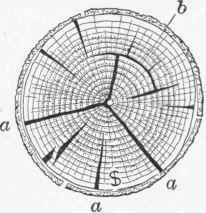
Fig. 14. - End of oak-log exposed to the weather, a, wind-check; 6, shake.
Another cause which changes the shape of wood is its tendency to absorb moisture, either from the air or the ground. This makes it necessary to protect exposed surfaces with paint or varnish. Pieces of work, in process of construction, should stand endwise and not lie on the floor, even if it seems perfectly dry. Lumber in the workshop is kept in racks hanging from the ceiling. These racks are so arranged as to allow the boards to rest on one edge, and to be separated by vertical strips. In this manner the boards are easily accessible, and the seasoning process is continued by the warmth of the room.
Continue to:


My Books

