


Fig. 5. Sandpaper Block
Description
This section is from the "Handbook In Woodwork And Carpentry" book, by Charles A. King. Also available from Amazon: Handbook in woodwork and carpentry.
Fig. 5. Sandpaper Block
New subject: Sandpaper; its manufacture; its use and abuse; its effect upon edge tools. Wood: Same as in Fig. 1. Preparatory: Same as in Fig. 1.
Exercises.
1, 2. Same as in Fig. 1.
3. A. Measure desired length from end 2, and mark with knife, working from face edge or edge 1. Mark this end " 3." The edge parallel to edge 1 should be marked " 4." B. Square across edges 1 and 4 from this mark, and connect the lines across the back side (the poorer broad surface), using the knife for all lines.
C. With the backsaw, cut off the wood beyond mark 3, as near the mark as possible, and leave the mark on the wood.
D. Finish to the knife mark with the block plane. 4. A. With a fine gauge, mark upon the face the required distance of edge 4 from edge 1.
B. With the jack plane, work edge 4 down to mark, and square with face side.
C. Plane sides.
D. Inspect for defects and remedy them.
5. A. Cut or tear a sheet of No. 1 sandpaper into eight equal parts.
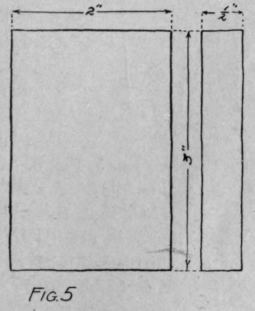
B. Fold it, not tack it, around a block of wood about 2" x 3" and sandpaper all six faces with it. Be sure that the corners of the model are not rounded off, but that they are perfectly square, and that true edges and sides are maintained.
Continue to:


My Books

