


A Good and Cheap Camera
Description
This section is from the "Handicraft For Boys" book, by A. Frederick Collins. Amazon: Handicraft for boys.
A Good and Cheap Camera
To take real pictures you want a real camera. Now there are many kinds of hand cameras but there is only one size that I am going to try to interest you in and that is one which will make pictures 31/2 x 4 1/2 inches.
With a camera of this size you can take nicely proportioned little pictures to give to your friends, to keep in your album, to make enlargements of and to make lantern slides of by direct contact printing and this will save you a lot of trouble.
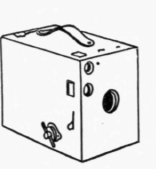
A
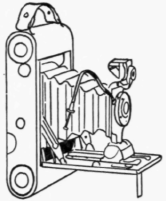
B
Fig. 57. two cheap and good cameras
A. A Brownie box kodak.
B. A folding kodak.
The cheapest 3 1/4 x 4 1/4 camera you can buy is a No. 3 Brownie box kodak,49 see A Fig. 57, which costs about $3.00. A folding No. 3 Brownie camera, shown at B, will serve your needs much better and this one will cost you in the neighborhood of $5.50, or you can buy a Graflex camera50 for $75.00 if father is rich and mother doesn't care.
49 These cameras can be bought most anywhere or you can send to the Eastman Kodak Company, Rochester, N. Y.
Every good camera has what is called a rectilinear lens, that is, a compound lens formed of two achromatic lenses, which means that each acromatic lens is made up again of two lenses one of which is of crown glass and the other is of flint glass, and these two latter lenses are cemented together with Canada balsam.51
Now whereas a common convex lens will produce all the colors of the rainbow around its edges when a ray of light passes through it, an acromatic lens lets through only the white light and while a single convex lens makes the straight lines of a building curved in the picture, an acromatic lens keeps all the lines straight, or rectilinear, and hence its name.
These little cameras are filled with mechanical snap shutters and they use roll films, that is the sensitive silver and gelatine emulsion is spread on a thin celluloid film instead of on glass plates. These roll films come on spools in lengths of 1/2 and 1 dozen each and they can be loaded into the camera in daylight. The same kind of developing and fixing solutions are used for films that are used for dry-plates.
Continue to:


My Books

