


Cartoons While You Wait
Description
This section is from the "Handicraft For Boys" book, by A. Frederick Collins. Amazon: Handicraft for boys.
Cartoons While You Wait
This is a good feature to start off your season's divertisements with. Make a substantial easel on which to set a large drawing board as shown in Fig. 116, or you can fasten the paper to a wall with thumb tacks if you live in a home and not in a residence.
Get a dozen sheets of good white print paper - you can buy a quire (24 sheets) 24 x 36 inches for 25 cents - and tack 1/2 a dozen sheets to your drawing board or the wall. Also buy a stick of black marking crayon,112 which is better than chalk or charcoal for it makes a heavy black line that will not smut, blur or rub off.
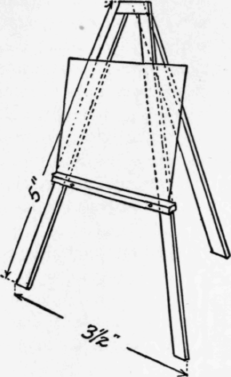
Fig. 116. how an easel is made
Drawing the Cartoons
Start in with your crayon in hand and explain that what you propose to do is to show the principles upon which free-hand drawing is based. Then make a simple line drawing of the boxer
112 You can buy a marking crayon at a hardware or stationery store.
reaching for the maxillary of his invisible opponent as shown in Fig. 42, over in the chapter called Drawing Simply Explained, and then draw the horse galloping home on the three-quarter stretch.
Next draw around these simple line figures, which are really the skeletons of the man and beast, the outlines as shown in Fig. 43. If you are not expert in free hand drawing you can trace these figures on the paper in faint lines with a lead-pencil before you begin your performance, and then all you have to do is to mark over the lines with the crayon.
After you have made these drawings and explained all about them tear off the sheet and on the clean one draw the outline of a man as shown in Fig. 44 and mark on the proportions of the human body. Have your next sheet ruled off into squares with the lines 2 inches apart; draw in the face and at the same time explain that this makes it easy for any one to get the features in proportion.
Now comes the grand finale113 (pronounced fi-na'le) and that is your cartoons.114 You should practice drawing these and also have some patter115 about each one so that when you do them for the family audience your tongue will be as clever as your fingers. You can begin by explaining how the expres113 The last part of an exhibition and it is generally the climax of it.
114 A cartoon is usually a caricature of a person or thing done in sketchy style. The word comes from the French carton, which means pasteboard.
115 Witty or amusing talk to help along the act.
sions of one's face - that is the way the features look when the mind is at rest or is excited - can all be represented by a few very simple lines.
Draw eight circles 5 or 6 inches in diameter in a double row on the paper with your marking crayon as shown at A in Fig. 117. Now you say first that sleep can be represented by four straight horizontal lines and you draw them as shown in the first circle.

Fast Asleep

Wideawake

Some Joy

More Sorrow

Quite Modest A

Much Disdain

Some What Surprised

A Little Angry
Fig. 117A. First Principles Of Cartooning
Next draw four vertical lines in the second circle and before you can say awake your little audience will see it and laugh its approval.
Joy is represented by four little arcs, or curved lines with the ends of each pointing up, which you draw in the third circle, while sorrow is, of course, shown by four curved lines the ends of which point down as in the fourth circle, since the emotion of sorrow is the opposite to that of joy.
Show how modesty is depicted by drawing four little angles in the fifth circle with the vertex, or point of each one at the bottom, while disdain, which is the reciprocal of modesty, can be illustrated in the sixth circle by reversing the positions of the angles and having their vertices at the top.
To portray surprise all you have to do is to draw four little circles inside the seventh large circle and you will have caught the expression. Finally in the eighth circle draw two slanting lines for the eyes, a vertical line for the nose and an angle with the ends of the lines pointed down and you will have a very good representation of anger, (or maybe it's a Chinaman.)
Now without my telling you how to draw the cartoons shown at B C and D in Fig. 117, draw each one of them half a dozen times on a sheet of paper with your marking crayon and when you get before your audience you will be able to do them like a lightning crayon artist.
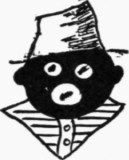
By Delight Of De Sllvery Moon B

Pat And His Poipe
C
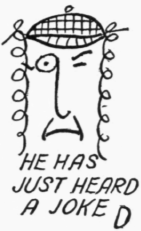
Fig. 117 B, C, D. Three Simple Cartoons That You Can Do
Continue to:


My Books

