


Drawing Tools You Should Have
Description
This section is from the "Handicraft For Boys" book, by A. Frederick Collins. Amazon: Handicraft for boys.
Drawing Tools You Should Have
Drawing instruments, or drawing tools as they are commonly called, consist for the most part of (1) one or more pairs of dividers; (2) one or more pairs of compasses
with pen and pencil points, and (3) one or more ruling pens. One of each of the above tools will be enough for you to begin with. A cheap set is shown in Fig. 46.
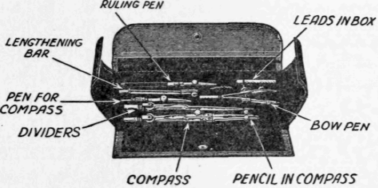
Fig. 46. The Drawing Tools You Need
Then you will need (4) a rule, or scale as it is called; (5) a protractor; (6) a T square 20 inches long; (7) a 30 degree triangle 5 inches long; (8) some drawing paper34 not less than 10 x 12 inches;
(9) a couple of medium hard (HHH) lead pencils,35
(10) a good rubber eraser;36 (11) a bottle of Hig-gins' India ink,37 (12) a few thumb tacks, and (13) a drawing board about 12 x 17 inches. And now let's see what these tools and other things are for and how they are used.
A pair of dividers is a tool having hinged legs, the free ends of which are pointed; they are used to take, mark off and subdivide distances.
The compasses are made like the dividers, but one end has a needle point and the other is hollow so that either a pencil or a drawing pen point can be slipped into it; this tool is used to draw curves and circles, either with a pencil or in ink.
A ruling pen is formed of two bowed steel blades having a screw adjustment so that they can be forced together or drawn apart and so make lines of varying widths. Not only is a ruling pen different from a writing pen but the ink that is used with it is thicker than an ordinary writing ink. This pen is used to make straight lines by running it along the edge of a rule or T square.
A protractor is a semi-circle of brass or of German silver and it is divided into 180 degrees - since it is half of a circle and there are 360 degrees in a circle. You can buy one for a quarter.
34 Get a 2-ply bristol board with a medium or smooth surface.
35 Koh-i-noor or Venus pencils are good ones.
36 Get Faber's red rubber Van Dyke.
37 This is a prepared India ink but you can make your own by rubbing up stick India ink with water.
By placing the edge of your rule in the center of the straight edge of the protractor and laying it on any one of the lines - they are numbered from 0 to 180 - you will find the number of degrees the edge of the rule is from the horizontal
The T square is laid with the head, that is the short thick piece, against the left hand edge of the drawing board which brings the blade, that is the long thin piece flat on and across the board. The triangle is placed against the straight edge. The triangle is laid on the board with one of its edges against the blade of the T square as shown in Fig. 47.
Simple Working Drawings
There are two kinds of working drawings that will be of use to you and these are, (1) plan drawings, and (2) isometric (pronounced i-so-met'-ric) drawings and you will find both of these quite easy to do.
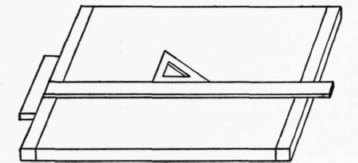
Fig. 47. The T Square And Triangle On The Drawing Board
Continue to:


My Books

