


Stencils
Description
This section is from the "Handicraft For Boys" book, by A. Frederick Collins. Amazon: Handicraft for boys.
Stencils
A stencil is a piece of heavy paper or thin sheet of metal in which letters or a design are cut through with broken lines, and it is used for marking the letters or design on any smooth surface by daubing a color on it through the open spaces with a brush or sponge.
There are two kinds of stencils, namely (I) those used for practical work and (2) those used for decorative purposes.
How to Cut Stencils
You can cut your stencils in either (a) oil board,82 or (b) in thin sheet brass or copper. Paper stencils, as those cut in oil board are called, are much easier to make than those cut in sheet metal and as they are quite durable they will probably serve your every need.
Cutting Paper Stencils
All you need to cut paper stencils with is a sheet of oil board and a pen-knife with a good, sharp-pointed blade. A stencil alphabet is shown at A in Fig. 82 and by taking a look at it you will see exactly where the lines must be broken to hold the letters together.
82 Oil board can be bought of C. B. Hewitt and Bros., 48 Beek-man St., New York.
First mark out with a pencil the size of the sheet you want the stencil to be and then draw a line down through the middle to divide it into equal parts. For every line of letters you want draw a pair of lines across the oil board and have the space between them whatever you want the height of the letters to be.
When you mark in the name or word start with the middle letter and draw it on the middle line of the board and then draw in the rest of the letters to the right and to the left; by lettering the oil board or metal this way you will get the whole name or word exactly in the middle of the sheet.
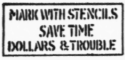
B
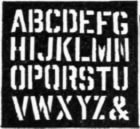
A
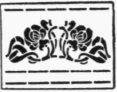
C
Fig. 82. Stencil Letters And Stencils
A. How stencil letters are cut.
B. A stencil for marking boxes.
C. Decorative stencil for wall borders.
To cut the stencil lay it on a smooth board and hold your knife just as you do a pen when you write but with your fingers a little closer to the point. Start at the top of each line if it is a vertical one, or on the left hand side if it is horizontal; hold the knife at a slight angle so that all the lines you cut will slant in toward the center of the letter and so bevel the paper. In cutting the stencil you can turn the sheet around to bring the lines into the best position for cutting.
It does not take much pressure to cut through the board but press down hard enough on the blade to make the first cut go clear through and never cut over the same line twice and also make the cuts run right up sharp into the corners. It takes very small skill to cut stencils but the chief part of the art lies in drawing the letters or the designs on the paper or metal.
Cutting Brass Stencils
To cut sheet metal stencils use annealed 83 sheet metal about No. 25 Brown and Sharpe gauge; 84 mark out the letters or design as for paper stencils and then cut them with stencil chisels. When you have the stencil all cut file the burr off of the edges of the letters or design with a fine file and file them at an angle so that all the edges are sharp. A practical stencil is shown at B.
How to Use Practical Stencils
A short, stubby brush, called a stencil brush and made especially for the purpose is the best kind to use to stencil with. Dampen it a little and rub it on a cake of stencil ink; 85 hold the stencil down tight to the surface you are to mark and then dab - not paint - the spaces in it with the brush.
How to Make Stencil Inks
Dissolve 4 ounces of shellac and 1 part of borax in a little boiling water and put in enough logwood to make it red if this is the color you want it, or blue carmine if you want it to be
83 Patterson Bros., Park Row, New York, carry sheet brass and copper in stock for stencils.
84 The Brown and Sharpe Wire Gage is also used for measuring the thickness of sheet metal.
85 Nearly every stationery store carries stencil ink and brushes in stock, or you can get them of Hammacher, Schlemmer and Co., Cor. Fourth Ave. and 13th Street, N. Y. C.
blue. Then add enough hot water to make it about as thick as cream.
How to Use Decorative Stencils
Art stencils can be used with good effect for certain kinds of decorative work, but it is especially adapted for putting borders on kalsomined walls. You can cut these stencils, see C in Fig. 82, after your own design or you can buy them already cut.86
Mixing Colors for Stenciling Borders
To make the colors for decorative stencils stir a very little moresco stenciling color87 with some hot water; be careful not to use too much color or the effect on the kalsomined or frescoed wall will be too contrasting. Beautiful colors in half-a-dozen tints can be had for this work.
86 Write to the Frost and Adams Co., Cornhill, Boston, Mass., for a catalogue of their Art Cut Stencils. Also to Sears, Roebuck and Co., Chicago, Ills., for a list of their decorative stencils.
87 Made by Benjamin H. Moore and Son's Co., 180 William St., N. Y., and sold by paint dealers generally.
Continue to:


My Books

