


The Uncanny Wheel
Description
This section is from the "Handicraft For Boys" book, by A. Frederick Collins. Amazon: Handicraft for boys.
The Uncanny Wheel
The Effect
A pitcher is shown full of emptiness and then a cardboard wheel, 4 inches in diameter, with buckets, or cones 1 inch high and 3/4 inch across glued to the rim and which is mounted on a wire so that it can be revolved, is passed for examination.
Placing the wheel on the table you hold the empty pitcher above it and pour out nothing on it when the wheel will turn round just as though you were pouring water on it. It is indeed uncanny. The idea is shown at A in Fig. 121.
118 If you want to buy dilute hydrochloric acid ask for normal hydrochloric acid.
The Cause
But it is all canny enough when you know how it is done. While the pitcher is apparently empty you have, forsooth, previously filled it with a gas called carbon dioxide. This gas is 1 1/2 times as heavy as air.
The cardboard wheel does not move in the air because the latter pushes on all parts of it equally. When, however, you pour the carbon dioxide gas on it from the pitcher, since it (the gas) is heavier than the air it fills the little buckets and makes them heavier just as surely as if you poured water on them; and hence the wheel revolves.
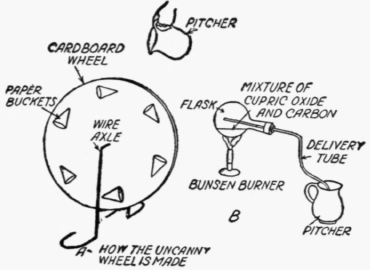
Fig. 121. The Uncanny Wheel
How to Make Carbon Dioxide Gas
Take a perfectly dry bottle or flask of the kind shown in the fountain experiment; fit it with a single hole stopper and push a glass tube through it until it nearly touches the bottom as pictured at B.
Set the bottle at a slant and put a mixture in it of equal amounts of powdered copper oxide (that is cupric oxide) and wood charcoal. Heat this mixture over a Bunsen burner until it glows and for a few minutes longer; the bottle will then be full of the carbon dioxide gas.
Pour it into a glass pitcher and put a sheet of glass over it to keep the air away from it until you are ready to perform the uncanny experiment.
Continue to:


My Books

