


Stair Building. Part 4
Description
This section is from the book "Inside Finishing", by Charles A. King. Also available from Amazon: Inside Finishing (1912).
Stair Building. Part 4
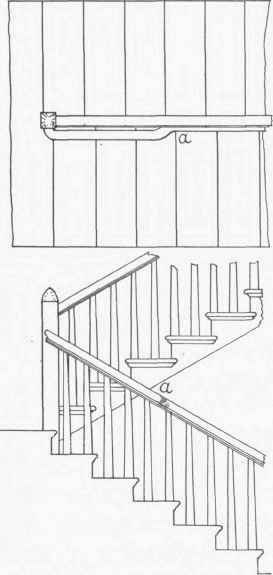
Fig. 66. - Dog-leg Stairs.
Upon ordinary work the winding risers (e, e), shown by dotted lines, usually are sawed to the correct bevel and nailed to the winding post; upon good work, and wherever the greatest strength is necessary, they should be tenoned into the section posts at the angle of their intersection, as indicated. These mortises should be placed so that the faces of the risers or face string will set back from the corner of the post the distance g, or enough to allow the nosing of the tread to stop against the post, and to bring the center line of the handrail and balusters in the center of the post. This distance will be governed partly by the projection of the finish of the tread, and principally by the size of the balusters, rail, and post. If a post 3f " square is to be used, the distance g will generally be about 1 1/4". 50. Stair posts. - (A.) Stair posts are placed at the bottom, top, and angles of the stairs, as indicated in Fig. 68, the plan of a flight of stairs showing the location of Inside Finishing every stair post in common use. Figure 69 shows the method by which the squares receiving the carriages and rails are laid out.
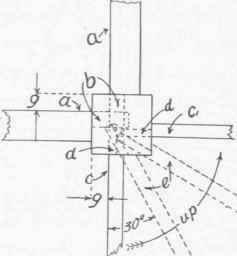
Fig. 67. - Intersection of Carriages and Risers with the Section Post.
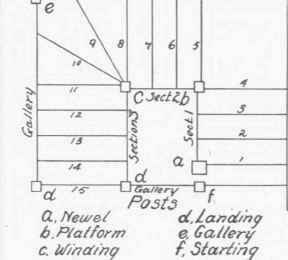
Fig. 68. - Location of Stair Posts.
(B.) The horizontal dotted lines denote the height of the risers, and the vertical dotted lines show the width of the treads; the points of intersection of these lines show the pitch of the stairs, with which the handrail is parallel, the angle of the pitch and the height of the handrail governing the vertical dimensions of the squares and turnings of the posts.
The newel post (a, Fig. 68) is located at the bottom of the flight, and is larger and more ornamental than the section posts, as it generally occupies a prominent place in the hall. The bottom square should extend 3" above the top of the bottom tread and, if it is to receive more than one riser, the bottom end of the square should be enough longer to allow the risers to enter and leave the 3" space above the top of the tread, the rest of the post being unchanged.
The platform post (b) is located at the angle formed by two short runs, a platform being the means of making the turn. It will be seen in Fig. 69 that there are three squares to this post, the two upper ones receiving the rails of the runs, 1 and 2, which form the angle in the stairs, and the lowest square receiving the carriages.,
The winding post is shown at c, the bottom square extending high enough to allow it to receive the rail of the second section. It varies in length to allow the winding risers and the face stringers of the runs, 2 and 3, of the stairs to be mortised into it, the face of the stringer, or the face of the casing being kept back from the outside corner of the post 1 1/4", to allow the nosing or finish of the tread to land back of the corner of the post. This is observed in all the posts, so that there will be a place against which the finish of the steps may be stopped.
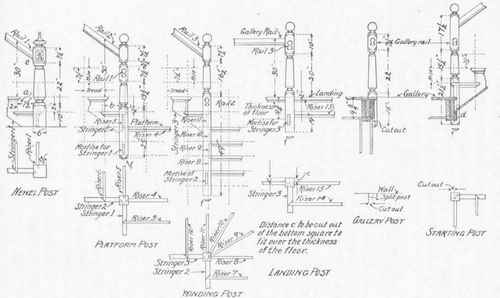
Fig. 69. - Laying out Stair Posts.
The risers of the winding treads are mortised into the bottom square, radiating from a point \\" from the lower and inside face of the post, as shown in Fig. 69. The mortises should enter the post at the same angle at which the risers intersect it, the shoulder of the tenon upon the riser being upon the back side. In setting the posts, stringers, and risers, it is obvious that the posts and risers of the angles should be set simultaneously.
The landing post (d) is located at the head of the stairs; the upper square receives the rail of the third section of the flight of stairs, and the rail of the landing or the gallery which extends to the starting post (/) of the next flight. The bottom square extends below the ceiling, and is finished with a rosette on the bottom. The other landing post is the same as d, but receives no rail from the stairs; it supports one end of the gallery rail extending to the gallery post (e).
The gallery post (e) is to support the end of the rail which extends between it and the left landing post (d). This post usually is cut in halves, one part being fastened to the wall, where it makes a better appearance than if the whole post were used.
The starting post (/), used to start the second flight, just as the newel post starts the bottom flight, should receive the gallery rail from the right landing post, d.
(C.) All of these posts, except the gallery post, should be mortised to receive the stringers or carriages, and the joists of the gallery or landing; if the work is well done and the risers well fastened to the wall, the stairs will need no additional support under the face stringer. However, unless there is another flight of stairs underneath, it usually is studded up for a closet.
Any stair post may be laid out by the above method, but in practice the builder will generally order his stair stock from the mill, or building supply house, or will have the stair-builder do the work. For ordinary work, the stock sizes of posts will be satisfactory, for by the exercise of a little judgment they can be made to fit stairs of almost any dimensions.
The squares of stock posts furnished by mills and supply houses are usually suitable for a rise of 7 1/4" or 7 1/2", these being about the average rises used for stairs.
The following table gives the vertical dimensions of posts which will, in most cases, be satisfactory; their locations are indicated upon Fig. 68. If a larger post is used, the squares should be lengthened, and the turnings shortened proportionately.
Continue to:


My Books

