


Volumetric Shrinkage And Specific Gravity. Specimens
Description
This section is from the book "The Mechanical Properties Of Wood", by Samuel J. Record. Also available from Amazon: The Mechanical Properties Of Wood.
Volumetric Shrinkage And Specific Gravity. Specimens
Selection and preparation: Four 2" × 2" × 6" specimens will be cut from the mechanical test sticks of each "d" bolt; also from each of the composite bolts used in getting a comparison of green and air-dry. One of these specimens will be taken from near the pith and one from near the periphery; the other two will be representative of the average growth of the bolt. The sides of these specimens will be surfaced and the ends smooth sawn.
Marking: Each specimen will retain the shipment, piece, and stick numbers and mark of the stick from which it is cut, and will have the additional mark "S."
Manipulation: Soon after cutting, each specimen will be weighed and its volume will be determined by the method described below. The rings per inch and per cent summer wood, where possible, will be determined, and a carbon impression of the end of the specimen made. It will then be air-dried in the laboratory to a constant weight and afterward oven-dried at 100°C. When dry, the specimen will be taken from the oven, weighed, and a carbon impression of its end made. While still warm the specimen will be dipped in hot paraffine. The volume will then be determined by the following method:
On one pan of a pair of balances is placed a container having in it water enough for the complete submersion of the test specimen. This container and water is balanced by weights placed on the other scale pan. The specimen is then held completely submerged and not touching the container while the scales are again balanced. The weight required to balance is the weight of water displaced by the specimen, and hence if in grams is numerically equal to the volume of the specimen in cubic centimetres. A diagrammatic sketch of the arrangement of this apparatus is shown in Fig. 51.
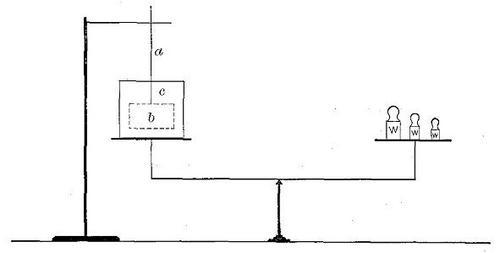
Figure 51
Diagram of specific gravity apparatus, showing a balance with container (c) filled with water in which the test block (b) is held submerged by a light rod (a) which is adjustable vertically and provided with a sharp point to be driven into the specimen.
Air-dry specimens will be dipped in water and then wiped dry after the first weighing and just before being immersed for weighing their displacement. All displacement determinations will be made as quickly as possible in order to minimize the absorption of water by the specimen.
Continue to:


My Books

