


Sail Boats
Description
This section is from the book "Problems In Woodworking", by M. W. Murray. Also available from Amazon: Problems in Woodworking.
Sail Boats
It is much more profitable for boys to design their own boats, and additional interest is created when several are made and raced. Since many boys are working at home with electric motors and small steam-engines, it is a good plan to encourage the building of power boats. It has not been found practicable to make such boats less than 34 inches long, as they will not hold the motors, batteries, etc.
Approximate rules for designing sail boats
The width should not be more than one-third of the length and in case of boats 24 inches or less not much under one-third the length.
The mast may be placed one-third or half way between one-third and one-half way from the bow.
In making the hull, it is desirable to work to centre lines, laying out and cutting the deck plan first, then the sheer plan and lastly shaping the hull, finishing it smooth before boring and gouging out the inside. After the inside is finished, the sheer of the deck may be cut.
When the keel has been screwed on and the inside of the boat painted (this should always be done if the stock has been glued up) the deck may be glued and nailed in place.
The amount of lead for a model yacht may be determined when the hull is finished by putting in sufficient weight to sink it to the load water line and then weighing what has been used.
The lead may be cast in moulds either of wood, plaster-of-paris or sand, by first making a wooden pattern of the right size and shape. The wooden mould has been found very satisfactory. It is made by taking two pieces of wood about 2 inches longer than the pattern, the same width as the pattern, and from 1/2 to 7/8 of an inch thick, and cutting one-half the shape of the pattern out of each piece. The line made by the meeting of the two broad faces should correspond to the center line which runs lengthwise through the pattern. When this is done, the two halves of the mould are fastened together and pieces nailed to the top and bottom. Two 3/16-inch dowels should extend through the mould from top to bottom, to form the holes for the screws which fasten the lead to the upper keel. In addition to this the top should have a pouring hole and one or more vent holes. The size of the pattern from which the mould is made may be figured on the basis of a cubic inch of cast lead weighing .408 pounds. (A piece of lead 2x1 x 1/2-inches also weighs .408 pounds, etc.)
The deck and spars should be finished with spar varnish.
Model Yacht Hull

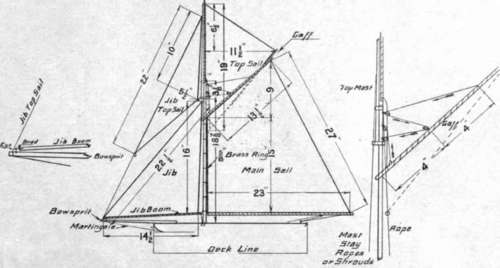
Madel Yacht Sail Plan
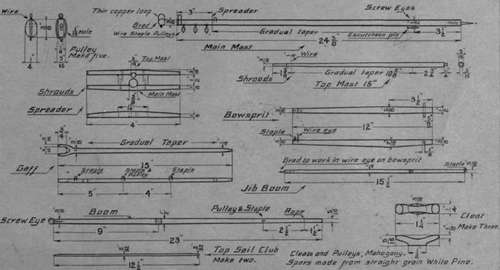
Model Yacht Details
Continue to:


My Books

