


Chapter V. Gates And Fences
Description
This section is from the book "Rustic Carpentry", by Paul N. Hasluck. Also available from Amazon: Rustic Carpentry: Woodworking with Natural Timber.
Chapter V. Gates And Fences
In many gardens there is a space devoted to the tool-house, potting shed, refuse head, etc. Shrubberies of course hide the unsightly appearance of this particular spot to a certain extent, but it may be found desirable to close the entrance to this part of the garden from the remainder, and the gate illustrated in front elevation by Fig. 65 is, from its semi-rustic nature, particularly suitable. Fig. 66 shows a plan and Fig. 67 is a part back view. The gate is quite simple in construction, and should be of sufficient height to obstruct the view from each side.

Figs. 65 and 66. - Front View and Plan of Solid Garden Gate.

Fig. 67. - Part Back View of Frame for Solid Garden Gate.
Local circumstances will of course determine the width of the gate, but the one illustrated by Fig. 65 is constructed on a framework 6 ft. square, the total height being 8 ft. The timber for the frame need not be planed.

Fig. 68. Fig. 70.
Figs. 68 to 70. - Joints in Frame of Solid Garden Gate.
Cut the closing and hingeing stiles 6 ft. long out of stuff 6 in. wide by 2 1/2 in. thick. The three rails are of the same dimensions, and can be halved and dovetailed to the stiles or, better, mortised, tenoned, and wedged and braced, as shown in Figs. 68, 69, and 70. Separate pieces of stuff are fixed up the centre to form a muntin for supporting the rustic work; the necessity is obvious from Fig. 66, where it will be noticed the twigs are outlined on the frame. Each twig has a bearing on the frame, and can thus be nailed individually.

Fig. 71 and 72. - Fixing Ends of Twigs.
Two stout gate hinges and hooks are required, and they can be bolted on with 7/16in. Whitworth bolts and nuts, or secured from the back with square-headed coach screws. Now commence fixing on the unbarked twigs; they should be as straight as possible and used in their natural shape, without being split in halves.

Fig. 74.

Fig. 75.
Figs. 74 and 75. - Designs for Rustic Gates.
The terminations of the joints for circular stuff are slightly different from the ends of the half-round stuff; see Figs. 71 and 72. Start by fixing the outside square, then the two inner squares, and finally the diagonal filling.
The posts are 9 in. or 10 in. in diameter by 9 ft. long, 3 ft. being underground. Cut three mortises in the posts to receive the rails for the side fencing. These rails are nailed flush to the secondary posts, nails also being driven through each mortise in the gate posts. Next dig the holes for the posts, these being kept at correct distances apart by nailing battens to the top and at the ground line while ramming in the posts. Two parts of old brickwork and one part of Portland cement will make a good concrete for the posts.
A week or more should elapse before the gate is hung to the posts. This may then be propped up fair between the two posts, and the positions should be marked for the staple of the latch, and hooks for the hinges. A rebate is formed for the gate on the posts by nailing on split sapling; see Figs. 67 and 73. Finally, a short post can be driven in the ground and fitted with a hook for retaining the gate when open wide.

Fig. 76.

Fig. 77.
Figs. 76 and 77. - Designs for Rustic Gates.
Suitable designs for small rustic gates are given by Figs. 74 to 77. The wood for making gates to the two designs (Figs. 76 and 77) should have the bark removed. The chief rails and posts are about 2 in. thick, filled in with 1 1/2in. or 1-in. pieces, halved and nailed together where they cross. The joints may be hidden by bosses of planed wood (see Fig. 77). If the gate is to be removable, fix a hook on the hanging stile to engage with a staple in the joint, and a pin in the bottom to turn round in a socket. The gate is then easily taken out of its hangings. Varnish the wood on completion.
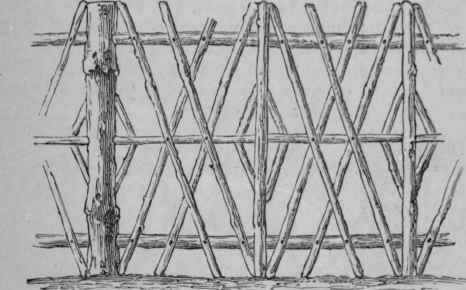
Fig. 78.

Fig. 70.
Figs. 78 and 79. - Designs for Fences.
Rustic fences can be constructed as shown in Figs. 78 to 80.
The garden trellis illustrated at Fig. 81 will form an attractive addition to the grounds of a suburban or country villa residence. In the case of new houses, the existence of such a trellis, with creepers ready planted, will often prove a deciding factor in effecting a quick sale or letting. The structure extends to a length of about 20 ft., but the dimensions may readily be altered to suit requirements. The material may be fir or other straight unbarked saplings and twigs. The posts are 12 ft. long; the four for the arch being 4 in. in diameter, and the others 3 in. or 3 1/2 in. The rails are 2 1/2 in. in diameter, and the twigs for the trellis, etc., 1 3/4 in. or 2 in. The bay seat with canopy is 6 ft. long by 1 ft. 4 in. wide.

Continue to:


My Books

