


Introduction
Description
This section is from the book "Elementary Sloyd And Whittling", by Gustaf Larsson. Also available from Amazon: Elementary Sloyd And Whittling.
Introduction
Sloyd is tool work so arranged and employed as to stimulate and promote vigorous, intelligent self - activity for a purpose which the worker recognizes as good. By 'Elementary Sloyd' is meant bench work in wood, in two dimensions adapted to children from eight to twelve years of age. In 1889 I published a series of working drawings for 'Preliminary Sloyd' with a teachers' 'sloyd Manual of Working Directions.' The changes and improvements made since that time are the results gained from the experience of many teachers, and are embodied in the course here outlined.
It is thought by some that children under twelve years of age have not the requisite strength and maturity to handle ordinary wood-working tools, but, owing to the recognized necessity of providing for the vigorous muscular activity of younger children, this course is suggested.
I have endeavored to select larger objects than those commonly given children at this age, so that they may obtain more physical exercise, and, although a good finish should be insisted upon, less accuracy is required. The objects are chosen with special reference to the interests of a. child at this age, and are different from those which have been suggested for the three upper grammar grades. This course may include toys and games which appeal to young children.
Many of the objects in this course have been evolved after a careful study of a large variety of children's original work in wood.
Whether we should always allow children to select what they may choose to make, or whether some consideration of logical sequence or graded effort should underlie the work, can best be decided by visiting schools and carefully observing classes engaged in actual work under different conditions. The point is, I believe, that we should find out whether or not what the child would like to do harmonizes with the educational idea of what he had best do. For myself, I believe fully in the value of spontaneity in educational work. I also believe that spontaneity may be guided, greatly to the advantage of the child.
The many different kinds of handiwork now experimented with in the lower grades of our public schools are, without doubt, of much value when given by a teacher thoroughly competent and interested in his work, and they also have the advantage of being taught in the regular schoolroom, by the regular grade teacher, and with inexpensive outfit. Such work, however, can never take the place of sloyd, which, with its large variety of tools and exercises, provides for more free and vigorous muscular movements and offers a more stimulating motive to the worker in the objects which he makes.
'Elementary Sloyd' is suggested for use in the fifth and sixth grammar grades, and also for any special classes, public or private, given at home clubs, settlements, summer schools, etc. It requires a special room equipped with suitable benches and tools. The number of children in the class should be limited to twenty.
The teacher should have training and experience, as well as a good knowledge of the correct use and care of tools and of the best methods of performing the various exercises.
The drawings, models, tools, and material are simpler than those used in the upper grades. Generally, only one view is given in the drawing, and only the necessary facts for the construction shown. The directions are brief, being intended merely as hints for methods of procedure.
While these drawings and directions are intended primarily for the use of the teacher, the children may work from them directly, after they have gained some facility in the use of tools and in the ability to read drawings. It should be understood, however, that no directions or drawings can take the place of the teacher.
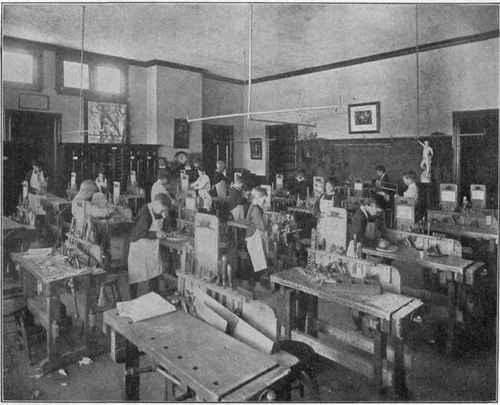
Class Of Boys At Work
In order to give the children a clear idea of what they are to do, the teacher should first present the model, and, by questions and explanations, lead the children to a correct understanding of both the model and its use. Enlarged blackboard drawings should be made for the children to read, and they may also be taught to make sketches and simple working drawings.
Continue to:


My Books

