


Dovetail Grooving
Description
This section is from the book "Woodwork Joints", by William Fairham. Also available from Amazon: Woodwork joints.
Dovetail Grooving
The dovetail housing joint should first be carefullymarked out with a marking knife, so as to cut across the fibres of the wood. For obtaining the bevel on the edge of the wood a joiner's bevel may be used, and the angle should not be too acute. (See previous chapter.) Take a chisel and pare away a small channel as at A, Fig. 315 , to form a small shoulder to guide the saw.
 Fig. 315. - Paring away Channel for Dovetail Grooving.
With a fine tenon or dovetail saw, cut the saw kerf as at Fig. 316 . If any difficulty is experienced in cutting the kerf true and square, you may resort to the method shown at C, Fig. 315 ; a small temporary piece of timber has been screwed on the top of the work to form a guide for the saw.

Fig. 316. - Cutting the Saw Kerf.
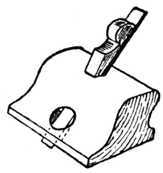
Fig. 317. - Old Woman's Tooth Plane.
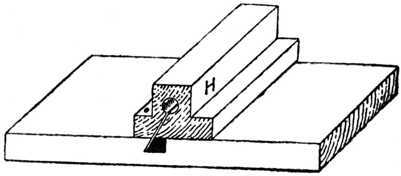 Fig. 318. - Guide Block for Bevelling.
Fig. 315 , B, shows the small channel formed by the chisel prior to the sawing operation. The sawing ofthe bevelled side is worked in a similar manner; but occasionally we find amateurs who adopt the method shown at Fig. 318 . A block of wood (H) is first made by boring a 11⁄4-in. hole through its entire length, and afterwards making a saw cut at the desired bevel. The object of this block, which is kept specially for the purpose, is to form a guide for those who have not full control of the dovetail saw; the back of the saw clears the hole, and the required bevel is obtained. When a saw cut has been made at each side of the groove, thesurplus timber is pared away in the following manner: Cut away portion E, Fig. 319 ; then cut away portion F, and lastly cut away the apex portion marked G. Continue by this method of paring until the approximate depth is reached. To ensure a correct depth throughout the entire groove, the router plane (or, as it is often called, "the old woman's tooth plane," Fig. 317 ) is used.
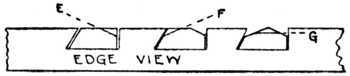 Fig. 319. - Showing Method of Paring.
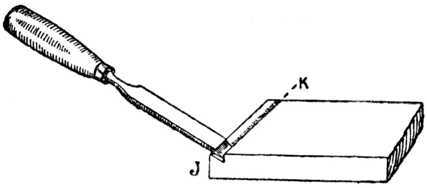 Fig. 320. - Channelling the Alternate Piece.
With regard to cutting the alternate piece, it is necessary to first plane the end of the shelf true and square. With a cutting gauge strike the line K, Fig. 320 ; the required bevel on the edge (J) is then set out, and with the chisel a small channel is again formed. With the tenon or dovetail saw cut down the line K to the required depth, and carefully pare away the wood with a sharp chisel to the correct shape.
Continue to:


My Books

