


Housed And Mitred Dovetail
Description
This section is from the book "Woodwork Joints", by William Fairham. Also available from Amazon: Woodwork joints.
Housed And Mitred Dovetail
Fig. 286 is another form of dovetail - commonly called a housed and mitred or rebated and mitred dovetail. In this instance we see that a small portion is mitred at top and bottom edges, and when used in plinth or cornice work, or for making tea-caddies, etc., the edges are (when completing the work) covered either with the moulding, which is planted on the cornice or plinth, or with the top and bottom of the box or tea-caddy.
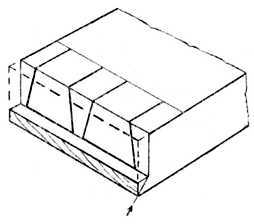
Fig. 286. - Housed and Mitred Dovetail.
The method of making a housed and mitred dovetail joint is seen in Fig. 286 . The ends to be joined areplaned up true and square and then rebated as shown. The dotted lines indicate the portion which has been worked away. The dovetails are now sawn and pared out in the usual way and the part denoted by the arrow is afterwards cut away with a chisel and finally finished to a smooth surface with a rebate plane; the method of working is shown at Fig. 287 , where the dovetail pins are seen with the waste portions cut away.
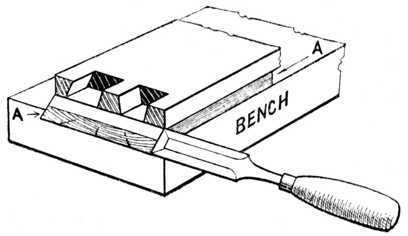 Fig. 287. - Working a Housed and Mitred Dovetail Joint.
Fig. 287 also shows the method of cutting away the mitred part. A temporary piece of wood is planed to a true mitre and placed underneath the dovetailed piece to form a template. Both pieces of the timber are now secured to the bench with a handscrew or cramp; the template A will form a guide for the chisel and rebate plane and allow a sharp edge or arris to be worked on the mitre.
A Secret Mitred Dovetailjoint is illustrated at Fig. 288 ; it is used in all the better class of cabinetand box work. Fig. 288 shows the pieces separated; note the mitre at the top and bottom edge.
 Fig. 288. - Secret Mitre Dovetailing.
Continue to:


My Books

