


Notched Joints
Description
This section is from the book "Woodwork Joints", by William Fairham. Also available from Amazon: Woodwork joints.
Notched Joints
Fig. 350 is a "notched joint," where two joists, or scantlings, cross each other, the object of the joint being to prevent the joists moving from their position without materially weakening them. For an end notch, see Fig. 352 .

Fig. 350. - Notched Joint.

Fig. 351. - The Saddle Joint.
The "saddle joint" ( Fig. 351 ) is used for connectingupright posts to heads or sills of framing, and undoubtedly takes its name from its similarity to the way in which the saddle fits the horse. It does not weaken the framing as does a mortise and tenon joint, and shrinkage has little effect upon the joint. The "cogged joint," used for connecting purlins to rafter and joists to girders, is illustrated in Fig. 353 .

Fig. 352. - End Notch.
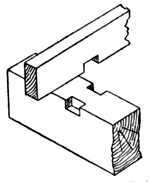
Fig. 353. - Cogged Joint.
Continue to:


My Books

