


193. The Use Of Figurative Language
Description
This section is from the book "Lessons In English", by Chestine Gowdy, Lora M. Dexheimer. Also available from Amazon: Lessons in English.
193. The Use Of Figurative Language
The occasional use of good and fresh figures of speech, if they seem to be introduced easily and naturally, adds to the beauty, force, and effectiveness of speech.
But there are dangers connected with the use of figurative language. If a figure is worked out laboriously, it is seldom effective; and those figures that we use almost unconsciously have generally been heard so often before that they have become stale and uninteresting. Then, too, if we do not think clearly, as well as quickly, we shall be in danger of using what are called "mixed metaphors."The person who said that a public speaker "uttered a torrent of words that fanned the anger of the audience into a flame" mixed his metaphors. A torrent is a stream, and a stream cannot fan anything into a flame. The following words, supposed to have been uttered by an excited orator, are the stock illustration of this error: "I smell a rat! I see it brewing in the air! but, mark me, I will nip it in the bud!' Point out the absurdities.
Perhaps you remember Whittiers description of the speech of Abraham Davenport:
"Wisely and well spake Abraham Davenport Straight to the question, with no figures of speech Save the ten Arab signs, yet not without The shrewd, dry humor natural to the man."
We may admire the beautiful writing of others, but we should certainly learn to stick to the point and to speak wisely, well, and naturally before we make any great effort to use figures of speech ourselves.
Exercise 230. Oral Composition
Tell the story in some poem. The following list may help you to select one:
1. The Gift of Tri te' mi us, - Whittier.
2. Rhoe'cus, - Lowell.
3. The Vision of Sir Launfal, - Lowell.
4. Her ve Riel, - Browning.
5. The Legend Beautiful, - Longfellow.
6. The Norman Baron, - Longfellow.
7. How the Old Horse Won the Bet, - Holmes.
8. Soh rab and Rus turn, - Matthew Arnold.
9. Little Giffen, - Francis Orrery Ticknor. 10. Incident of the French Camp, - Browning.
Tell the story as directly and naturally as you can. Let the class see if you use any figures of speech.
Exercise 231. Written Composition
1. Write a paragraph or two describing a person who, either in physical or moral characteristics, reminds you of a particular kind of tree; for example, an oak, a silver birch, an elm, a white pine, a Scotch pine, or a poplar.
2. Write a paragraph or two describing a person who in some respects resembles a particular kind of animal; for example, a Newfoundland dog, a sheep dog, a bulldog, a poodle, a wolf, an ox, a tiger, a blue jay, a lion, a parrot, a humming bird, a robin.
Perhaps, after you have written your description, you can write a simile expressing the comparison in a sentence.
Topics And Topic Sentences For Short Talks
1. If you expect a horse to keep in good condition, you must give him painstaking and intelligent care.
2. To-day the farmers' best horse is the gasoline tractor.
3. The horse (pony) I should like to own.
4. A dog and pony show I once saw.
5. The types of horses represented in the neighborhood.
6. Purposes for which I should like to see automobiles used instead of horses.
7. Many a good horse has been spoiled by a yanking driver.
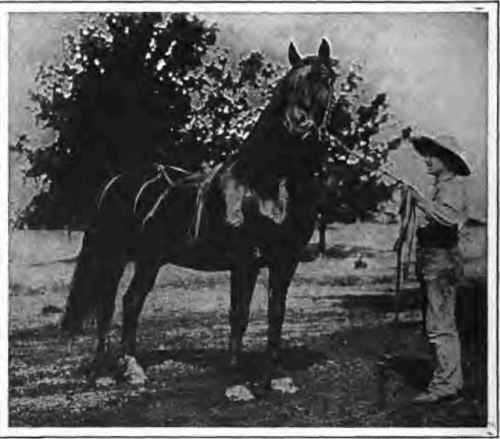
Monarch. A.J.Swanson.
Continue to:


My Books

