


238. The Choice Of Tense
Description
This section is from the book "Lessons In English", by Chestine Gowdy, Lora M. Dexheimer. Also available from Amazon: Lessons in English.
238. The Choice Of Tense
A story is generally told chiefly in the past tense. But occasionally a narrator, wishing to make his story very vivid, tells it in the present tense, as if the event were actually passing before the eyes of those to whom he is speaking. He tries in this way to put the story into the form of a series of moving pictures.
If you can find Phoebe Cary's poem, The Leak in the Dike, read it and notice the change in tense. The first part of the story is quiet and peaceful; but suddenly there is a change, and what follows is a thrilling tale of danger, anxiety, and rescue. With the change in the nature of the story, the author alters the tense from past to present.
You may have read the poem without noticing this; but if the same change should be made in telling a fairy story, or a myth, or even in an account of real events that happened long ago, the story would become ridiculous. Such tales are likely to begin in some such fashion as "Once upon a time," "All this happened long, long ago," "In the days when the earth was young." What they tell is so different from real, present-day experiences that it takes skill to make them seem real even to an imaginative child. So the narrator tries at once to make his audience feel that the event he is describing happened when things were very different from what they are now. And he must keep up the impression if he doesn't wish to spoil the effect of his story.
But in telling of exciting events that might have really happened recently and that can easily be imagined, or in telling of something that has occurred often and is likely to occur again, the present tense may often be used with advantage.
Description of things that have been recently seen, or that are not likely to have changed since they were seen, are generally written in the present tense.
Explanations are generally written in the present tense.
Exercise 290
Description, narration, and explanation are combined in the following passage. Bead it and see if the author makes you enter into the experiences he describes.
Notice what he uses for his chief tense. See if you can explain why he made the choice of tense.
Camping
When our trappers come, late in the afternoon, to the bank of a lovely lake where they purpose to enter the primitive life, everything is waiting for them in virgin expectation. There is a little promontory jutting into the lake, and sloping down to a sandy beach, on which the waters are lapsing, and shoals of redfins and shiners come to greet the stranger; the forest is untouched by the ax; the tender green sweeps the water's edge; ranks of slender firs are marshaled by the shore; clumps of white birch stems shine in satin purity among the evergreens; the boles of giant spruces, maples, and oaks, lifting high their crowns of foliage, stretch away in endless galleries and arcades; through the shifting leaves the sunshine falls upon the brown earth; overhead are fragments of blue sky; under the boughs and in chance openings appear the bluer lake and the outline of the gracious mountains. The discoverers of this paradise, which they have entered to destroy, note the babbling of the brook that flows close at hand; they hear the splash of the leaping fish; they listen to the sweet, metallic song of the evening thrush, and the chatter of the red squirrel, who angrily challenges their right to be there. But the moment of sentiment passes.
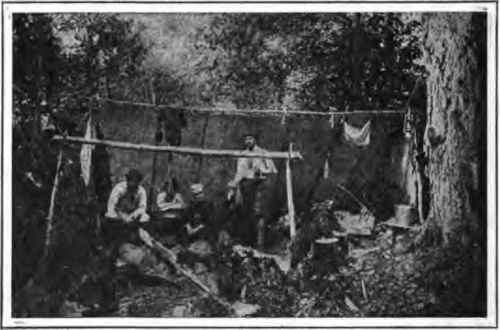
A Camping Scene.
This party has come here to eat and to sleep, and not to encourage Nature in her poetic attitudinizing.
The spot for a shanty is selected. This side shall be its opening, towards the lake; and in front of it, the lire, so that the smoke shall drift into the hut, and discourage the mosquitos; yonder shall be the cook's fire and the path to the spring.
The whole colony bestir themselves in the foundation of a new home - an enterprise that has all the fascination and none of the danger, of a veritable new settlement in the wilderness. The axes of the guides resound in the echoing spaces; great trunks fall with a crash; vistas are opened towards the lake and the mountains. The spot for the shanty is cleared of underbrush; forked stakes are driven into the ground, cross-pieces are laid on them, and poles sloping back to the ground. In an incredible space of time there is the skeleton of a house, which is entirely open in front. The roof and sides must be covered. For this purpose the trunks of great spruces are skinned. The woodman rips the bark near the foot of the tree, and again six feet above, and slashes it perpendicularly; then with a blunt stick, he crowds off this thick hide exactly as an ox is skinned. It needs but a few of these skins to cover the roof; and they make a perfectly water-tight roof, except when it rains.
Meantime, busy hands have gathered boughs of the spruce and the feathery balsam, and shingled the ground underneath the shanty for a bed. It is an aromatic bed; in theory it is elastic and consoling. Upon it are spread the blankets. The sleepers are to lie there in a row, their feet to the fire, and their heads under the edge of the sloping roof. The fire is in front; it is not a fire, but a conflagration, - a vast heap of green logs set on fire - of pitch, and split dead-wood, and crackling balsams, raging and roaring.
By the time twilight falls, the cook has prepared supper. Everything has been cooked in a tin pail and skillet, - potatoes, tea, pork, mutton, slapjacks. It is a noble meal; and nobly it is disposed of by these amateur savages, sitting about upon logs and roots of trees. Never were there such potatoes, never beans that seemed to have more of the bean in them, never such curly pork, never trout with more Indian meal on them, never mutton more distinctly sheepy, and the tea, drunk out of a tin cup, with a lump of maple sugar dissolved in it, - it is the sort of tea that takes hold, lifts the hair, and disposes the drinker to anecdotes and hilariousness. There is no deception about it; it tastes of tannin and spruce and creosote. Everything, in short, has the flavor of the wilderness and a free life. It is idyllic. And yet, with all our sentimentality, there is nothing feeble about the cooking. The slapjacks are a solid job of work, made to last, and not to go to pieces in a person's stomach like a trivial bun; we might record on them; and future generations would doubtless turn them up as Accadian brick Good, robust victuals are what the primitive man wants.1
Charles Dudley Warner.
Exercise 291
Select from Camping a list of words and group of words that make good pictures.
Make a list of words and groups of words that appeal to the ear. Classify each chief word in the lists.
Compare a fire and a conflagration. A spruce and a balsam.
Explain these words as used by Mr. Warner: tender, arcades, challenges, attitudinizing, vistas, amateur, savage.
Find a good explanation in the passage. A description.
Notice the topic sentence of the first paragraph and the way it is developed.
1 Used through the courtesy of the Houghton Mifflin Company.
Exercise 292
You have noticed that Mr. Warner uses verbs in the present tense almost continuously in his account of Camping. But he uses some verb phrases, not all of which are in the present tense. Make lists of the following kinds: perfect, passive, progressive. Tell whether each perfect phrase is present, past, or future, and why the author used that particular tense.
Exercise 293
Rewrite or read the passage from Camping and change the verbs and verb phrases that are in the present tense to past. What changes do you have to make in the perfect phrases?
Which form do you like better, Mr. Warner's or yours?
Composition Exercises
1. A day that I remember. This day was some time ago and was very different from other days. Give an account of it. What tense will you use for the most part?
2. How we spend our days. You are one of a camping party, or you are going to school, or making a long visit, or working in a store or factory, or selling papers, or helping with the house or farm work. Your days are much alike. Give an account of a sample day to some one who is interested in everything that affects you. Write it in the first person, singular or plural number, and present tense.
3. A fairy story. Choose any one you wish, and tell it as if you were telling it to a child. What tense will you use?
4. A place that I remember. Take some more definite subject, such as, The house where I was born or Grandfather's house.
5. A spot that the poem The Rhodora or Warner's Camping reminds me of.
6. How to get two crops from the same piece of land.
7. Camp cooking.
8. A good game for a winter evening party.
9. Compare the camping scene shown in the picture on page 288 with the scene described by Mr. Warner.
Continue to:


My Books

