


248. Rule
Description
This section is from the book "Lessons In English", by Chestine Gowdy, Lora M. Dexheimer. Also available from Amazon: Lessons in English.
248. Rule
Use may and might as attributive verbs when you wish to express permission. Use can and could as attributive verbs when you wish to express ability.
Exercise 302
Fill each blank with may, might, can, or could.
1. You ----- stay an hour.
2. ----- I take your knife ?
3. ----- you read the sign at this distance?
4. - Mary and I go down town?
5. You ----- go to the concert if you ----- persuade your brother to go with you.
6. ----- you play chess?
7. ----- we play ball ?
8. He said that he ----- float an hour or two.
9. You said that we ----- stay till ten.
10. ----- I come?
11. ----- you open the door?
12. You ----- if you -----.
13. Were you sure that you ----- find your way home?
Exercise 303
1. Write four sentences in which you use shall as a copulative verb.
2. Write four in which you use should as a copulative verb.
3. Write four in which you use may as an attributive verb.
4. Write four in which you use can as an attributive verb.
Exercise 304. Composition
Write your plans for some day in the future. Write in the future tense. Let some one besides yourself be connected with the plans. Be sure to use shall and will correctly.
Exercise 305. A Description
Semaphore is the title of the article from which the passage given below is taken. What does the word mean? The author describes a ride he took at night in the engine cab of one of the limited trains running between Chicago and the Atlantic coast. As you read it, think how many-persons are guarding the safety of the unconscious sleepers in the Pullmans behind the engine. The train was running almost ninety miles an hour.
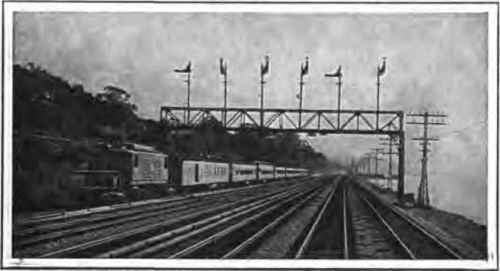
The Green Beacon.
Long ago the headlight had become useless except as a warning of our approach; we were past the farthest range of its illumination before the eye could discern what lay before us. Blind and helpless we tore on. Broken rail, a train on the crossing, or open switch, - we should never see it. But green shone the light; and wholly trusting in the silent men who flashed to us their word of safety, we never faltered. I thought of a stalled train that might lie sleeping on our rails. But "green " was the light.
The engineer, silent, his hand fingering throttle and air brake, sat huddled high on his seat. Through his goggles he watched the blackness ahead. A brief second's time to set his brakes was all he asked. Far off in the great city the chief dispatcher was following our flight mile by mile, block to block. Over the wires his voice and the voice of his helpers told the rapid story of our progress. In the lonely tower at the next curve some one would flash the green beacon to our straining eyes, and report us on our way. To him others were now reporting, giving him the certain knowledge that our way was safe. Keepers of the safety of our path; how perfectly we trusted them; how great and unrewarded is their perfect service.1
Joseph Husband,
Atlantic Monthly, April, 1914.
Exercise 306. Class Conversation
What is an open switch? A block?
Find out all you can about the provisions for security in railroad travel, and about the lives of the "keepers of the safety of our path." Be ready to tell in class what you have learned.
Exercise 307. Word Studies
Find the following verbs in the passage given in Exercise 305 and decide whether each is copulative or attributive: could, should, might, would. How would the meanings be changed if should and would were interchanged?
Can you find other words that would have served as well as these: discern, flashed, faltered, huddled, straining, unrewarded, service?
Exercise 308. Oral Composition
Tell of the life and services of some one who serves the public; for example:
An engineer.
A street car conductor.
1 Used through the courtesy of the Atlantic Monthly Publishing Company.
A fireman.
A policeman or policewoman.
A nurse in a hospital.
A red cross nurse in the war of 1914.
A cash girl in a department store.
A newsboy.
A man or woman homesteader.
A coal miner or a worker in a foundry or steel mill.
A reporter on a city paper.
A doctor.
Continue to:


My Books

