


Review Exercises
Description
This section is from the book "Haven's Complete Manual Of Practical Phonography", by Curtis Haven.
Review Exercises
Twenty pages, (commencing with page 118 and ending with page 137) are herein devoted to reviews of the principles contained in the preceding lessons, by means of words and phrases for the most part different from any found in the lessons themselves. No new principles are introduced, as the whole art is clearly and thoroughly set forth in the lessons, but as students sometimes learn an outline by sight alone, with no regard to the principles contained in same, the new words and phrases given in these Review Exercises will show the student his or her weak points, particularly if they are used as follows:
Before looking at the shorthand outlines on any review page, look only at the printed key on page opposite the review shorthand plate, and write the printed words and phrases in your own way. Then, when you have written a full page, compare your shorthand with the plate and your weak points will appear.
If you have a companion or teacher to read them to you, so much the better, but do not omit writing any word given you, no matter if you think you do not know how to write it. Write some outline, if it is only done by spelling the word or phrase phonetically by the aid of the shorthand alphabet. If you know the shorthand alphabet, you can make some kind of an outline with which to make a comparison.
The Review Exercises will not enable the student to neglect the reviewing of the lessons on preceding pages. Not at all. The lesson exercises must be gone over and over again, until every word in those lessons can be correctly written and without hesitation, from dictation, the correctness being provable only by comparison with the lesson key in each case. In fact, absolute perfection in the lessons is the surest way to get these Review Exercises correctly, for the Review Exercises are merely tests of the student's knowledge of the preceding lessons. Lesson and Review Exercises help each other, but neither can be used instead of both, and perfection in both is very necessary.
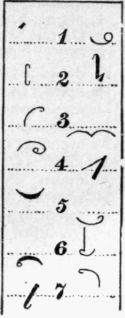
The Review Exercises, plates and keys, are lettered consecutively from A to K, (excluding I), and the words and phrases number from 1 to 200 on each plate. In addition, down the centre of each plate will be seen heavy black figures 1 to 25. Those black figures show the number of lines on each plate, but that is not their object. Primarily, they are for the assistance of teachers in reviewing students. For instance, sometimes students are apt to memorize review words and phrases in the order given in the Exercises, and a teacher might wish to ascertain this. In such a case, instead of reading line for line across the printed page, the teacher could take only the first word of each line of the printed key from top to bottom of page; then the second word of each line of printed key, same way; next the third word of each printed line; lastly, the fourth word .of each line-which would finish a printed key page, there being just four words in each line of printed page, fifty lines to the page, or twice as many lines on printed page as on shorthand page plate. When the first word on each line of printed key page is used, the teacher will find, as shown in the little illustration opposite, that he or she has read one word on each side of the black figures in centre of the shorthand review plates, and is thus provided with a perfect check upon a student's knowledge, the two sorts of numbering of the lines making possible the creation of a variety of ways of dictation. A very important principle, which is illustrated in signs 103 and 104 on page 127 of our Review Exercises, is made by employing the princi. ple of substituting short-i where long I will not join, even when the I is the pronoun and not a letter of a word.
In Lesson IV (Additional Use Of The Visible Vowels) of Part II of this book, there are shown illustrations of how this is done in such proper names as Pine, wherein the short-i is shaded to indicate the substitution of that letter for the sign for long I where that will not join and where it is absolutely necessary to have the long sound indicated. It is even more necessary in phrasing, to join the pronoun I to other words, because it is so natural for the speaker to run those words together in pronouncing such phrases. Therefore, in such sentences as I saw, I asked, etc., the student can join the short sign for i, shaded to indicate the pronoun I.
It is the desire of the author to have students possess a self-reliance which will enable them to put down outlines without stopping to criticise whether or not they are the best. There are words which are illustrated in the lessons, such as read, write, etc., which must always have a certain form or position, but aside from such instances, students should feel unhampered in the writing of words, so long as they write strictly by sound. Students may find, in some of the plates of this book, that the same word is written in two or more different ways. This is due to a difference in treatment made necessary by the occasion - that is, words are treated differently in some phrases than in others, or than they would be when not phrased. If a writer, when taking notes, fears that a certain word will not be legible abbreviated, and has time to vocalize it, this is best done; but when the utmost rapidity is necessary, words should be written as briefly as possible, consistent with legibility. Of course, the greatest speed is obtained by using the briefest outlines.
Continue to:


My Books

