


Long Vowels
Description
This section is from the book "The Manual of Phonography", by Benn Pitman And Jerome B. Howard. Also available from Amazon: The Manual of Phonography.
Long Vowels
29. The Vowel Scale
The alphabet of a language professedly contains a letter for every sound heard in the distinct utterance of that language. The Roman alphabet does not, as has been shown, provide a sufficient number of letters to represent the obstructed sounds, or consonants, of the English language; it is still more deficient in providing representative signs for the unobstructed voiced sounds, or vowels, of the language. In phonography the a-e-i-o-u scale is therefore abandoned, and one more philosophic and complete adopted in its stead.
30. The Long Vowels
Provision is first made for the six primary or long vowels of the language, as heard in the following words: eel aim alms all old ooze
31. Long Vowel Signs
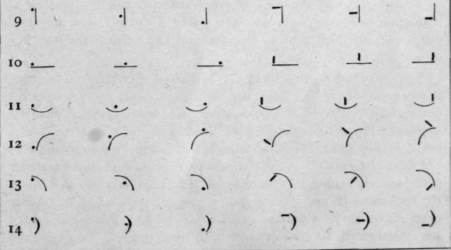
The first three sounds are represented by a dot placed respectively at the beginning, middle, and end of a consonant ; the last three by a short stroke or dash similarly placed. These dots and dashes are written close to, but should not touch, the stroke consonant to which they are placed ; thus,

The upright line (the sign for t) to which the vowel-signs are here written, is used merely to indicate the places of the vowels, at the beginning, middle, and end of the consonant. These signs may be conveniently designated as first-place, second-place, and third-place vowels.
32. Direction Of Dashes
The dashes have the same relative direction to all strokes; that is, they are placed at right angles to the stroke no matter what its direction may be. When written to curves, dashes are always at right angles to the imaginary line which joins the beginning and end of the curve; thus.

33. Order Of Reading
A vowel-sign, when written on the left side of an upright or sloping stroke, is read before the stroke to which it is placed; when written on the right side, it is read after the stroke to which it is placed. When a vowel-sign is written to a horizontal character, it is read before when placed above, and after when placed below the stroke.
Exercise on Vowels Following Consonants.

Exercise on Vowels Preceding Consonants.
Long Vowels
Concluded.
34. Vowel Places
The unvarying rule for placing and reading the vowel-signs, is to reckon from the beginning of the stroke to which they are attached. Thus, the strokes
 and
and
 being written upward, the vowel places are reckoned from the bottom, that is, from the beginning of the stroke.
35. Names Of The Vowels
The vowels should always be pronounced as single sounds; thus, e, as heard at the beginning of eel; a, as in ape; ah, as at the beginning of arm (not as a-aitch); au as awe (not a-you); 0 as owe; 00 as at the beginning of ooze (not as double-o).
36. Consonants Written First
All the consonants of a word must be written without lifting the pen, and the vowel or vowels written afterward. The consonants of a word form what is termed its phonographic outline, or skeleton.
37. Phonetic Spelling
Such are the deficiencies of the common alphabet, and the consequent unphonetic character of English orthography, that the spelling of a word can seldom be taken as a guide to its pronunciation. In writing phonographically, therefore, the student must note what are the actual sounds of which a word is composed, and then write the signs provided for the representation of those sounds. It may not at first be easy for the student to determine what are the exact sounds in any given word, but the difficulty of determining will diminish at every attempt, and the practise of noting the deliberate utterance of a word, as distinct from its usual colloquial sound, will tend to give accuracy and finish to the student's own pronunciation.
38. Method Of Practise
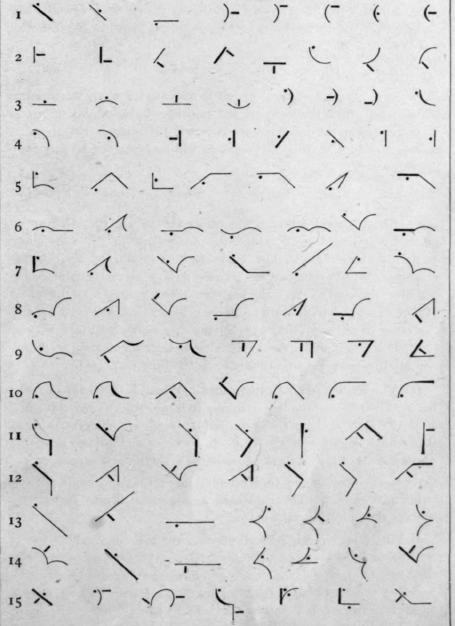
It is advised that before attempting to write the exercise on page 114, the student spell every word in it phonetically; that is to say, analyze each word into its phonetic elements; that is to say, determine what consonants and vowels are heard in the word, and in what order. Thus the word take contains but three elements - first, the consonant t, second, the vowel a (second-place dot), and third, the consonant k; though has only two elements - the consonant dh, and the vowel o (second-place dash.) This practise need not be confined to the writing exercises, and should be pursued persistently until all difficulty is entirely overcome.
Exercise on Words Containing Long Vowels.
Continue to:


My Books

