


Consonants
Description
This section is from the book "Phonetic Shorthand", by William W. Osgoodby. Also available from Amazon: Phonetic Shorthand.
Consonants
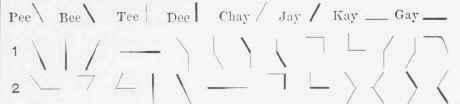
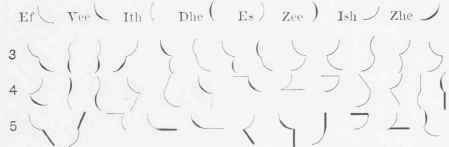
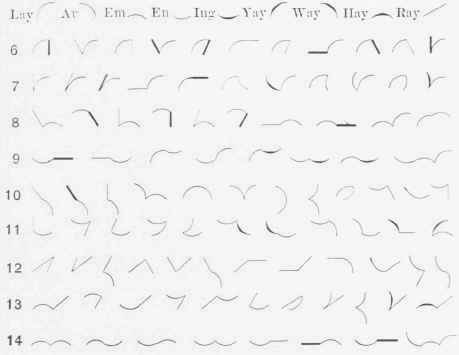
Sec. 3. The consonants are divided into three groups, viz.: 1. Regular Straight Stems; 2. Regular Curved Stems: 3. Irregular Stems. The regular stems are arranged in pairs,the second one of each pair being shaded, thus indicating the natural distinction between the vocal and whispered sounds represented by them. The irregular stems are not thus paired.
Note. - The sound of Th in them, is indicated by the letters Dh, in the rules and writing exercises, the name of the stem being pronounced like the word the. 3 a. Regular Straight Stems. - These are all written downward, except Kay and Gay, which are written from left to right. Great care should be taken to strike these stems in the exact directions shown in the engraving. (See lines 1 and 2.)
Writing Exercise
P, b, t, d, ch, j, k, g; p-b t-d, ch-j, k-g, p-t, t-p, b-t, t-b, t-k, k-t, t-ch, ch-t, k-p, p-k, k-b, b-k, k-ch, ch-k, ch-g, g-ch, k-j, j-k, d-t, b-p, g-k, p-p, t-t, k-k, b-b, d-d, g-g, j-j, k-d, d-k, p-ch, ch-p, b-ch, ch-b, b-j, j-b, t-b-k, k-b-t.
b. Regular Curved Stems. - These may all be written downward, at present. Rules will hereafter be given for writing Sh upward in certain cases. Shade the heavy curves carefully, to give them a graceful appearance. Light and heavy curves are shaded into each other, when joined without an angle. [Lines 3-5.)
Writing Exercise
F, v, th, dh (the), s, z, sh, zh; frg, g-f, ,f-p, p-f, s-p, t-th, ch-s, f-th, sh-f, v-g, g-th, g-dh, f-b, b-f, s-b, t-dh, ch-z, f-dh, sh-v, k-f, s-k, f-t, p-v, s-t, d-dh, j-s, f-v, sh-z, v-f, k-sh, f-ch, p-th, sh-p, t-s, p-sh, f-sh, s-s, g-v, g-sh, f-j, b-th, sh-b, t-z, b-sh.
f-th, s-z, k-th, sh-k, th-t, p-dh, sh-d, d-s. ch-sh, d-z, j-sh, v-sh, s-v, f-f, th-th, s-s, sh-sh, v-v, dh-dh.
c. Irregular Stems. - L is written upward, when standing alone, and in most other cases. Rules will hereafter be given for striking it downward under some circumstances. Ar, Way, and Yay are struck downward. M, N, Ing, and Hay are struck from left to right. Ray, which is a duplicate for R, is always struck upward, and is more inclined than Chay. (Lines 6-14.)
Writing Exercise
L-p, p-1, 1-t, t-1, 1-ch, ch-1, 1-k, k-1, 1-b, b-1, 1-d, d-1, 1-j, j-1, 1-g, g-1, 1-f, f-1, 1-v, v-1, 1-th, th-1, 1-s, s-1, 1-z, z-1. P-m, m-b, t-m, m-d, ch-m, m-j, k-m, m-k, g-m, m-g, m-n, n-m, m-1, 1-m, n-1, 1-n, 1-ng. (Use Ar.) P-r, r-p, t-r, d-r, ch-r, r-m, 1-r, r-1, r-sh, sh-r. W-k, w-1, w-r. Y-l, y-k. (Use Bay, for Italic letters.) R-ch, ch-r, r-r, r-p, ch=p, r-k, k-r, p-r, p-ch, p-r, r-d, ch-d, b-r, b-ch, f-r, f-ch, f-r, m-r, m-ch, n-r, n-ch, r-n ch-n, r-sh, sh-r, r-z, z-r, z-r.
Regular Straight Stems
Regular Curved Stems
Irregular Stems
Continue to:


My Books

