


Planetary Hours
Description
This section is from the book "Astrology In A Nutshell", by Charles Henry Webber. Also available from Amazon: Astrology In a Nutshell.
Planetary Hours
Clock hours are of even length, regardless of Sunlight and darkness. Planetary hours are uneven except about March 21 and Sept 23. They divide daylight and darkness into 12 hours each. They are very useful In Judging the condition of unseen forces at any immediate time. In each of the signs on the wheel you will find a table similar to this. Each is drawn for the time given at the left band above the table.
Bach table answers for 15 days either side of the date given above the table.

The figures in the left hand, middle and right hand columns, give the clock times of the day. when the planetary hour begins. Look on the same line in one of the other columns under the day of the week wanted, (don't forget that) and you will find the symbol of the planet that rules from that time to the time given on the following line. For instance, in the table above, find 7.34 A.M. On same line yon will find 3.24 P. M., and 10.16 P. M. For those times to the next following times (8.41, 4.31 and 11.09). Mercury would rule on Sunday, Jupiter on Monday, Venus on Tuesday, Saturn on Wednesday, Sun on Thursday, Moon on Friday, and Mars on Saturday. In this same way, as quickly as a flash, you can find the planetary ruler for any hour at any time of the year and without any head splitting mathematics.
Do not expect this to be infalliable in matters of curiosity or common associates, but surely in serious or unusual cases, especially as to whether the outcome will be good or bad. Heed them strictly and yon will soon overcome many of your little worries and disappointments, and will encourage beneficial vibrations.
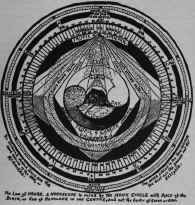
Designed to illustrate the blendings of various laws in one and the same circle. Much study may be given to this cut, if one is so inclined.
Troubles are most likely in Saturn or Mars' hours. Money or pleasures are most likely in Jupiter and Venus' hours. Promotion or credit in Sun hour. Sharp work in Mercury hour,
If you wish to calculate the hours for yourself, by reason of any difference of latitude, you can do so most easily by the following rule.
Double the time of Sunrise and it gives you the length of the night.
Substract the length of the night from 24 and it gives the length of the day.
Divide the length of the day by 2, and point the answer off into hours and minutes.
Convert these hours and minutes into minutes and divide the answer by 6, and it will give the length of the Planetary Hour for the daytime, for such time in the year as you are calculating. For instance:
Hours. | |
Sunrise ........................ | 7.30 |
Double it ........ | 2 |
Gives length of night | 15.00 |
Substract length of night from. | 24.00 |
15.00 | |
Gives length of day | 9.00 |
Divide length of day by 2, = 4 h. 30 m. Reduce 4 h. 30. m to minutes: 4 X 60 + 30 = 270 minutes. Divide these minutes by 6:
270 ÷ 6 = 45 minutes. 45 minutes then is the length of a Planetary Hour, when the length of the day is 9 hours.
For length of the night hours, do the sum same way only using 15 hours, as length of night, instead of 9 hours.
To get the Planet Ruling at any hour, first get the number of hours between Sunrise and the time desired, and multiply the answer by 60, and divide by the length of the Planetary Hour, and the answer will give you the number of the Planetary Hour since Sunrise. For instance, what hour will 10 o'clock a. m. be, with Sunrise at 7.30. First substract 7.30 from 10, .......................10.00
7.30
2.30 Multiply the hours by 60,...... 60
120
Add the 30 minutes............ 30
Total........................ 160
Divide by length of hour:
150 ÷ 45 = 3 15/45. It shows that 3 hours have passed and the time is 15 minutes into the 4th hour. What planet rules? We must know the day of the week, for each planet has its own day to rule the 1st hour from sunrise. The others follow in regular order from that time as follows:
Sunday - Sun, Venus, Mercury, Moon, Saturn, Jupiter, Mars, and so on repeating which will bring the ruling as follows for
Monday - Moon, Saturn, Jupiter, Mars, Sun, Venus, Mercury, and so on, to
Tuesday - Mars, .Sun, Venus, Mercury. Moon, Saturn, Jupiter, and to
Wednesday - Mercury, Moon, Saturn, Jupiter, Mars, Sun, Venus, to
Thursday - Jupiter, Mars, Sun, Venus, Mercury, Moon, Saturn, to
Friday - Venus, Mercury, Moon, Saturn, Jupiter, Mars, Sun, to
Saturday - Saturn, Jupiter, Mars, Sun, Venus, Mercury, Moon. Therefore the ruler of the 4th hour, by the above would be
Moon, if it were Sunday, Mars, if it were Monday, Mercury, if it were Tuesday, Jupiter, if it were Wednesday, Venus, if it were Thursday, Saturn, if it were Friday, Sun, if it were Saturday. By the time that you had learned this fact by calculation, the Hour
Would be gone, and your mind would be perplexed over your sum, but by the Tabula Magus, you would only have to look at the January 1 Table, when the length of day is about 9.27 and you see that on the line 9.41, all the way across are the rulers of the 4th hour from Sunrise, under the several days of the week, just as this long Mathematical, but simplest method of calculation has 'given it
So, no matter what Latitude you may be in, you have only to Change the Table from the Month, as given for Washington time, to fit the Month, having length of days, nearest to the lengths as given on page 29, and you cannot get far away from the Mark.
One-half of a degree of the moon is quite near enough for all practical purposes, and that must be contained in a Planetary • Hour.
Note the decanates on the Wonder Wheel and learn that they run exactly as the planetary hours run, and note again that the middle decanate of each succeeding Zodiacal sign, marks the days of the week in regular order, beginning with Sunday, as the first day in the first sign Aries.
Continue to:


My Books

