


How To Resolve Particular Questions By A Theme Of Heaven. Part 2
Description
This section is from the book "A Manual Of Astrology, Or The Book Of The Stars", by Raphael. Also available from Amazon: A Manual Of Astrology; Or The Book Of The Stars.
How To Resolve Particular Questions By A Theme Of Heaven. Part 2
Direct And Retrograde Motion
Direct as applied to planets, denotes their moving in the true order of the celestial signs, as from  to
to  , and the like. Retrograde, is when they move backwards, or reverse to this order, as from
  to
to  , which is easily known by the Ephe-meris.
Prohibition
Prohibition, is so called, when two planets are applying by aspect to each other; but before the aspect can possibly be formed, a third planet interposes his aspect, and thus hinders or prohibits the matter in hand: thus, were  in 4° of
  ,
,  in 6° of
  , and
, and  in 5° of
  . Here
  applies to a
  of
of  ; but before she can complete the aspect,
  being swifter in motion, outstrips
  , and by forming the
  himself, prohibits the affair, which to the matter in hand, would cause a complete cessation; and that person signified by
  , would describe the party through whose interference the matter would be nullified.
Refranation
Refranation, is when two planets are applying to an aspect; but before the aspect can be completed, one of them turns retrograde, which in practice, is fatal to the success of the question.
Reception
Reception is when two planets are mutually posited in each other's essential dignities, as  in
in  , and the
  in
in  , where
  being in the exaltation of the
  , and the
  in the exaltation of
  , both are in mutual reception; or the
  in
in  , and
, and  in
in  , are in reception, one by house, the other by triplicity. This is accounted an aspect of singular amity and agreement.
Peregrine
Peregrine, is when a planet is void of any essential dignity; and thus is rendered weak and unfortunate.
Void Of Course
Void of Course, is when a planet forms no aspect whatever with any other planet, during his stay in the sign Wherein he is posited. This is particularly evil in certain cases, as it renders the conclusion of the affair extremely uncertain.
Combustion
Combustion, is when a planet is posited within 8° 30' of the  , either before or after the
  's body. In horary questions, unless the
  be a chief significator, this is deemed unfortunate.
The  is singularly weak when so elongated.
Measure Of Time
In Horary Questions, This Measure of Time the following Diagram will at ones clearly exhibit.
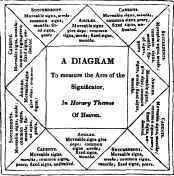
To understand the foregoing diagram, the student most observe that a significator posited in moveable signs and angular, gives for every degree in longitude one day; in a common sign angular, one week,- and in a fixed sign, one month; thus, for instance, were  in the ascendant in 14° of
  in application to a
  of
of  in the fifth house in 16° of
  , his distance (the intercepted arc) between the aspect being 2°, would denote two days 'ere the event, denoted by his application to
  , would be likely to take place; and were he in the ninth house, in the same aspect, the time would be two months. The remainder of the diagram is on the same principles; and by a reference thereto, on any particular occasion, considerable facility will be afforded to the practitioner, or amateur, in the horary part of the science,.and the memory will be thus far less liable to those mistakes which are found usually to happen when it is overcharged.
Besieged
Besieged is when a planet, fortunate by nature, is situated between two malevolent stars, as  in 12° of
  ,
,  in 15°, and
  in 10° of the same sign; where she is in a state of "siege" as the old Astrologers term it, and highly unfortunate. He whose significator it was, would be denoted thereby to be in "a great straight", and particularly "hemmed in" or surrounded with ill fortune.
Continue to:


My Books

