


The Horoscope Of The New London Bridge
Description
This section is from the book "A Manual Of Astrology, Or The Book Of The Stars", by Raphael. Also available from Amazon: A Manual Of Astrology; Or The Book Of The Stars.
The Horoscope Of The New London Bridge
"This ancient city,
How wanton sits she 'midst nature's smiles; Nor from her highest turret has to view, But golden landscapes and luxuriant scenes, A waste of wealth, the storehouse of the world". .
Young.
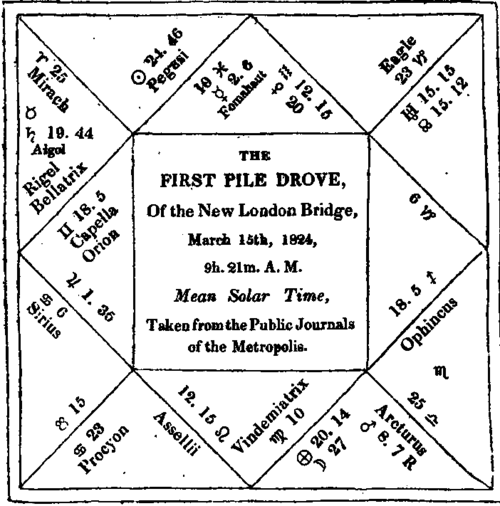
 ab
ab  ad-vac.
 Lord of the Ascendant ab
  ad bi-quintile of
  .
.
 . - Sesquiquadrate of
As the horoscope of the new London bridge exhibits a most remarkable proof of the certain principles on which the science of Judicial Astrology is founded, (a science which is built on a foundation as certain as " the firm pillars of the earth",) we must first beg the reader's attention to the following extract from that clever old Astrologer, the celebrated William Lilly. In his almanack for 1666, be says, " The nineteenth degree of  is London's horoscope, and at the foundation of the city the
  was in twenty-five degrees of the same sign. This is certainly true, that when any notable event happens to concern that city, the planets are in those degrees, or those signs and degrees are affected", etc. etc.
Now, although, the engineers and architects of the present day do not order their buildings " by the courses of the stars", as they did of old, yet it is worthy of observation, that had they employed the most skilful Astrologer to erect an horoscope for the occasion, they could not have chosen a point of time for their great national undertaking, more strictly agreeing with the rales of the sidereal art, than the foregoing horoscope evinces ! Incredulists and sophists may ridicule this assertion, but such is nevertheless the case: for observe, as if to verify the rules given by every author who has written on the science; that Gemini is the ascendant of London, we find, that not only that very sign arose at the commencement of the work, but when the first pile was driven, the identical degree, assigned as the horoscope of the metropolis, also ascended in the eastern horizon. - Next, to the above singular fact, the student will be led to notice the excellent position of  in
in  his exaltation, and in the sign of the second house. - The lord of the ascendant is posited in a watery sign, separating from.the
  of
of  and applying to a bi-quintile aspect of
  ;
; in the mid-heaven - and more singular still; the work was commenced upon a full Moon, which (as the
  at that period is increasing in light and thus rendered fortunate) in Astrology is generally chosen as an excellent testimony where circumstances will permit it.
Independent of the singular fact, which the foregoing proves, that every important undertaking, connected with the welfare of the British metropolis, has the sign  ascendant, at the time it begins; the student will perceive the astonishing number of eminent fixed stars, of the first magnitude rising within the limits of London's Ascendant; which also proves that the old Astrologers had justifiable grounds for attributing that sign, and those degrees thereof, to such a purpose: and as England is justly stiled the greatest and bravest nation in the world, and also the most renowned for her maritime power, so London being the capital, the head of Albion, is the fountain and grand repository of her almost boundless wealth - andjustly did the expert and renowned sages of former times behold these particulars, when they presaged her future grandeur by the discovery of that celestial influence, and that peculiar constellation to which she (next under Divine Providence) owes all her greatness!
It is both amusing and instructive, to reflect on the changes and revolutions which are effected by short-lived man, or rather by that grand march of improvement, which is the proudest characteristic of social prosperity. All is made subservient to his spirit; he hews down forests, which become spread over seas in countless fleets - plains, once barren and deserted, become peopled - the hut leads to a cottage - the cottage to a village - and villages to splendid cities. Such is civilisation in embryo, " Thames the most lov'd of all the oceans sons By his old sire, to his embraces runs, Hasting to pay his tribute to the sea Like mortal life to meet eternity. Though with those streams he no resemblance hold Whose foam is amber, and their gravel gold. His genuine and less guilty wealth t'explore, Search not the bottom but survey his shore; O'er which he kindly spreads his spacious wing, And hatches plenty for th' ensuing spring. Nor are his blessings to his banks confin'd, But free and common as the sea or wind.
When he to. boast or to disperse his stores Full of the tributes of his grateful shores, Visits the world and makes both Indies ours; so that to us no thing, no place is strange, While his fair bosom is the "world's exchange!"
DENHAM.
Continue to:


My Books

